What Speakers Are Used at Concerts? A Complete Pro Audio Breakdown
Ever stood in a crowd, felt the bass drum kick in your chest, and heard a guitar solo slice through the air with perfect clarity from 500 feet away? That incredible power and precision don’t come from just a few big speakers. Concerts use highly complex, engineered professional sound reinforcement systems designed to deliver a consistent and powerful audio experience to every single person in the audience.
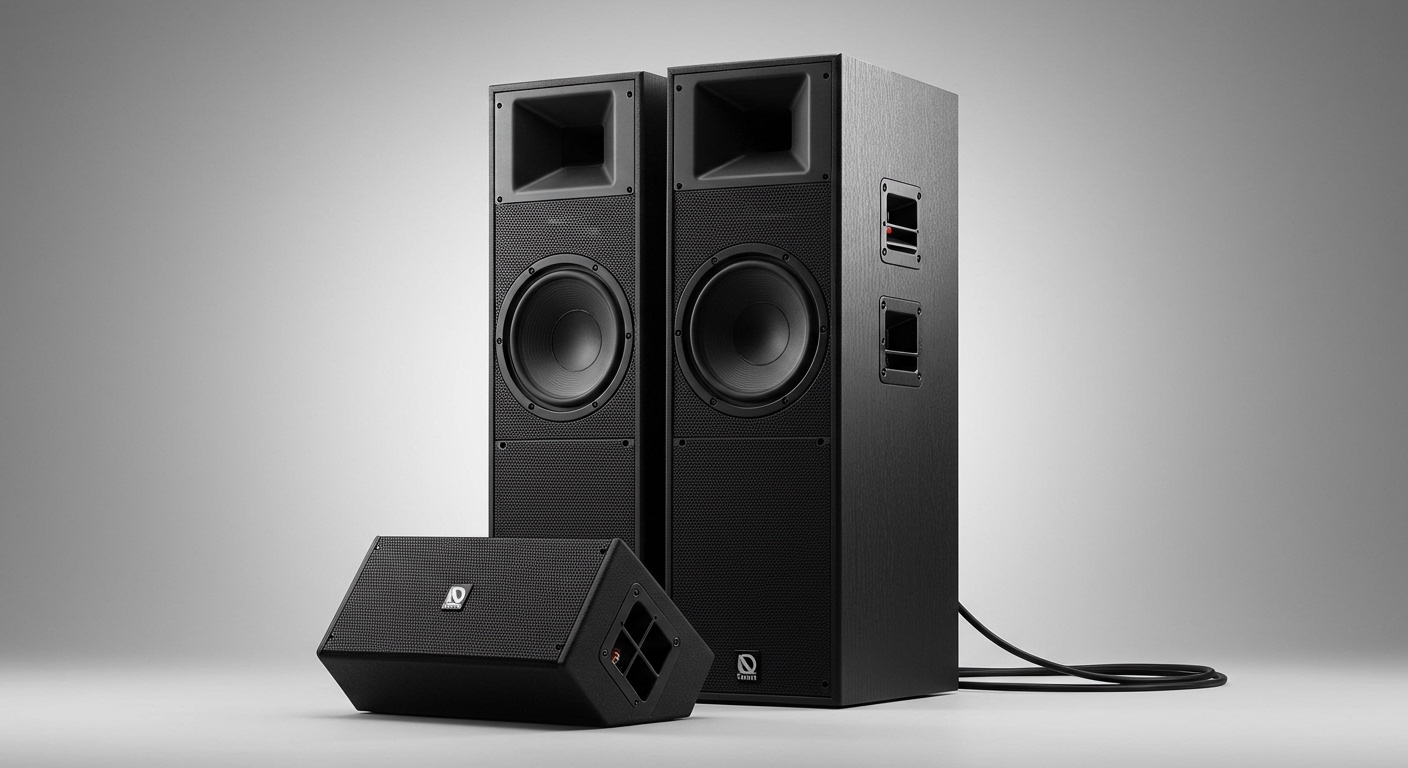
The primary speakers you see hanging in massive vertical columns on either side of the stage are called line array systems. These are supported by a ground-shaking foundation of subwoofers for low-end bass, stage monitors for the performers to hear themselves, and a variety of fill speakers to cover any potential dead spots in the sound coverage. It’s a carefully tuned ecosystem of specialized audio technology.
Key Takeaways: The Concert Speaker System
- Main Speakers: The most visible speakers are line arrays, which are long columns of identical speaker cabinets designed to project sound clearly over long distances.
- Bass Frequencies: Large, powerful subwoofers are used to reproduce the deep bass you can feel. They are often stacked on the ground or flown with the main arrays.
- On-Stage Sound: Performers use stage monitors (floor wedges) or In-Ear Monitors (IEMs) to hear their own instruments and vocals clearly.
- Coverage Gaps: Smaller fill speakers are used to cover areas the main line arrays might miss, like the first few rows (front fills) or the extreme sides of the venue (out fills).
- Top Professional Brands: The industry is dominated by a few key players, including L-Acoustics, d&b audiotechnik, Meyer Sound, and JBL Professional.
The Heart of the Sound: Understanding Line Array Speakers
The most critical component of a modern concert sound system is the line array. These are the long, curved columns of speakers you see hanging from the rigging on the left and right of the stage. They are the workhorses responsible for delivering the main mix to the majority of the audience.
What is a Line Array?
A line array isn’t just one speaker; it’s a series of individual speaker cabinets, called “elements” or “boxes,” connected together and flown (hung) in a vertical line. Each box is engineered to work with the ones above and below it.
The science behind it is fascinating. By arranging the speakers in a tight, vertical line, the sound waves from each box combine constructively. This creates a highly controlled, cylindrical wave front that travels much farther and with less volume loss over distance compared to a single, traditional speaker (known as a point source).
From my experience setting these up, the precise angle between each box is critical. We use specialized software to calculate these angles to “steer” the sound, ensuring the person in the front row and the person at the very back get a similar audio experience.
Why Concerts Use Line Arrays Over Other Speakers
So, what speakers do concerts use and why are line arrays the undisputed king? The answer lies in three key advantages:
- Even and Predictable Coverage: A properly deployed line array can provide a remarkably consistent Sound Pressure Level (SPL), or volume, from the front of the audience to the back. The goal is that every ticket holder gets to hear the show as the sound engineer intends.
- Superior Directional Control: Line arrays are excellent at keeping the sound focused on the audience and away from ceilings and walls. This minimizes unwanted echoes and reverberation, leading to a much clearer, more intelligible sound, especially in difficult acoustic environments like arenas.
- Scalability for Any Venue: The system is modular. For a small theater, we might hang six boxes per side. For a massive stadium tour, we might hang 20 or more boxes per side, plus additional arrays for delays. This flexibility makes it the go-to solution for touring productions.
Key Line Array Brands and Models in the Industry
While there are many manufacturers, the professional touring world is dominated by a handful of elite brands known for their performance, reliability, and global support.
- L-Acoustics: A French company often considered the pioneer of the modern line array with their V-DOSC system. Their current flagship systems, the K1 and K2, are seen on a massive number of top-tier tours.
- d&b audiotechnik: This German manufacturer is renowned for its system integration and sonic purity. Their GSL and KSL series are industry standards, known for their exceptional cardioid pattern control (more on that later).
- Meyer Sound: A US-based company with a reputation for precision and innovation. Their LEO, LYON, and PANTHER systems are mainstays in stadiums, arenas, and prestigious performance halls worldwide.
- JBL Professional: Part of the Harman group, JBL’s VTX Series (like the A12 and A8) are powerful and widely used systems, popular across music festivals and major tours.
The Foundation of Feel: Subwoofers for Low-End Power
That chest-thumping bass you feel at a show isn’t coming from the line arrays. It’s the job of the subwoofers, the speakers dedicated to reproducing very low frequencies—typically from around 25 Hz to 100 Hz.
The Role of a Concert Subwoofer
Subwoofers move massive amounts of air to create the low-frequency energy that gives music its weight, power, and impact. They handle the kick drum, the bass guitar, and the lowest notes of a synthesizer. A concert without subwoofers would feel thin and lack the visceral energy that makes live music so exciting.
Common Subwoofer Setups We Use
You’ll almost always see subwoofers stacked on the ground in a line across the front of the stage. However, the specific configuration is a science in itself.
- Ground-Stacked Arrays: The most common setup. Placing them on the ground uses the floor as a reflective surface to increase efficiency.
- Flown Subwoofers: Sometimes, subwoofers are flown (hung) behind or alongside the main line arrays. This can help distribute bass more evenly, especially in large venues with balconies.
- Cardioid Subwoofer Arrays: This is a clever technique we frequently use to control bass direction. By arranging the subwoofers in a specific pattern and using digital signal processing (DSP) to delay some of them, we can create a “cardioid” pattern. This pushes the bass energy forward towards the audience while canceling it out behind the subs. The result is a much quieter stage for the performers and less low-end rumble bleeding into their microphones.
On-Stage Sound: What Speakers Do the Performers Use?
The audience isn’t the only group that needs to hear the music. The performers on stage need a clear, customized mix to play in time and in tune with each other. This is handled by a completely separate speaker system called the monitor system.
The Classic: Stage Monitors or “Wedges”
For decades, the standard for on-stage sound has been the stage monitor, often called a “wedge” due to its distinctive shape. These are powerful speakers placed on the floor and angled up at the musician or singer.
Each performer can have their own wedge with a unique mix tailored to their needs. For example, a singer might want to hear a lot of their own voice and a little bit of the guitar, while the drummer might want mostly bass and kick drum.
The Modern Standard: In-Ear Monitors (IEMs)
Today, most major touring artists have transitioned to In-Ear Monitors (IEMs). These are essentially professional-grade, custom-molded wireless earbuds that provide a perfect studio-quality mix directly into the performer’s ears.