

[Your Article Content in Markdown — START directly with ## H2 headings]
Does the Alienware AW2518HF Have Speakers? The Direct Answer
You’ve just unboxed your brand new Alienware AW2518HF monitor, hooked it up, and you’re ready to jump into a game, but you’re met with silence. This leads to the critical question: does the AW2518HF have speakers?
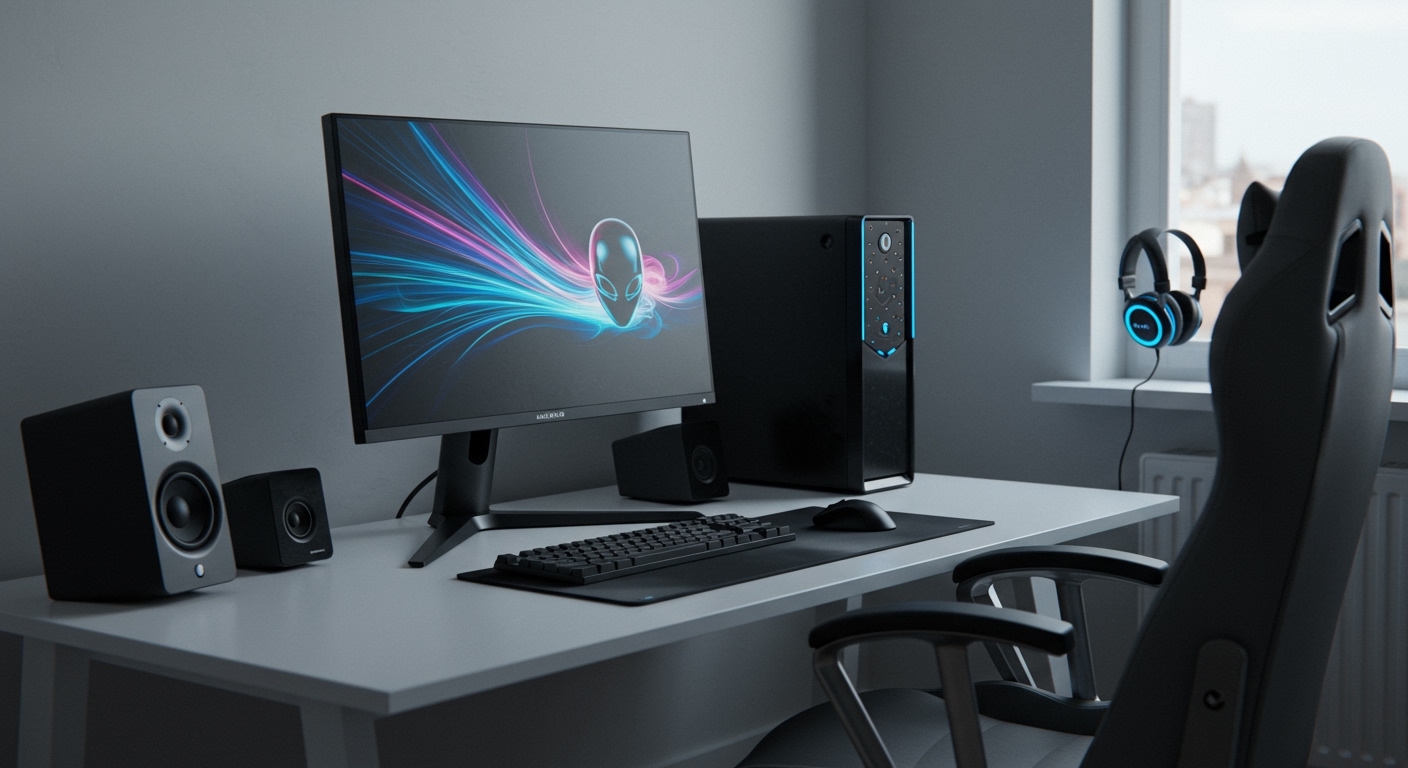
The short and direct answer is no, the Alienware AW2518HF does not have built-in speakers. This is a deliberate design choice by Alienware to prioritize what matters most for competitive gaming: raw performance. In this guide, we’ll explain why this is the case and walk you through the simple steps to get incredible audio from your setup.
TL;DR: Key Takeaways
For those in a hurry, here’s what you need to know:
- No Integrated Speakers: High-performance Alienware monitors like the AW2518HF, AW2521HF, and AW2518H do not include built-in speakers.
- Performance Over Features: Alienware focuses its budget and engineering on delivering elite gaming features like a 240Hz refresh rate and a 1ms response time, not on mediocre audio.
- Audio Outputs are Available: Your monitor is equipped with crucial audio ports, including a 3.5mm headphone jack and an audio line-out port.
- External Solution Required: To hear any sound, you must connect either a gaming headset or a set of external desktop speakers.
Why Your Alienware Gaming Monitor Lacks Speakers
It can feel frustrating to discover a premium monitor doesn’t have a basic feature like speakers. However, from my experience testing dozens of high-end gaming displays, this is a common and even positive trend among esports-focused models. The reasoning is sound.
A Focus on Core Gaming Performance
When you buy a monitor like the AW2518HF, you’re paying for speed. The engineering and cost are heavily invested in the panel technology that delivers a buttery-smooth 240Hz refresh rate and a lightning-fast 1ms gray-to-gray (GTG) response time. These are the specifications that give you a competitive edge in fast-paced games.
Adding speakers, even low-quality ones, would increase the manufacturing cost. This cost would either be passed on to you or force Alienware to make compromises on the panel quality, response time, or build materials—the very things that make the monitor great.
The Poor Quality of Integrated Speakers
Let’s be honest: built-in monitor speakers are almost universally terrible. They are typically small, underpowered, and produce thin, tinny sound with no bass.
For a brand like Alienware, whose identity is built on premium, immersive gaming experiences, including subpar speakers would tarnish the user’s perception of quality. Gamers who invest in a 240Hz monitor are the same audience who demand clear, positional audio to hear enemy footsteps, and integrated speakers simply cannot deliver that.
Design and Aesthetics
Modern gaming monitors feature ultra-thin bezels to create a seamless look, especially in multi-monitor setups. Squeezing speakers into this slim chassis would require making the bezels thicker, compromising the sleek, “edgeless” design that gamers love.
Checking Other Models: Does the AW2521HF Have Speakers?
This question naturally extends to other popular models in the Alienware lineup. If you’re considering a similar monitor, you’ll find the same philosophy applies.
- Does the AW2521HF have speakers? No, the Alienware AW2521HF, another fan-favorite 240Hz model, also does not have built-in speakers.
- Does the AW2518H have speakers? No, the AW2518H (the NVIDIA G-SYNC variant of the HF FreeSync model) also omits speakers to focus on its primary function as a high-performance gaming display.
Here is a quick comparison of the audio features on these popular Alienware models:
| Feature | Alienware AW2518HF | Alienware AW2521HF | Alienware AW2518H |
|---|---|---|---|
| Built-in Speakers | No | No | No |
| 3.5mm Headphone Jack | Yes | Yes | Yes |
| 3.5mm Audio Line-Out | Yes | Yes | Yes |
| Primary Focus | Competitive Gaming | Competitive Gaming | Competitive Gaming |
As the table shows, the priority is providing the necessary output ports so you can use high-quality external audio devices, not providing a low-quality integrated solution.
How to Get Audio From Your Alienware Monitor: A Step-by-Step Guide
Getting sound from your AW2518HF is easy once you know where to look. Your monitor acts as an audio pass-through device, taking the sound signal sent from your PC via HDMI or DisplayPort and routing it to its audio jacks.
Step 1: Identify Your Monitor’s Audio Ports
First, familiarize yourself with the ports on the back and underside of your monitor. You are looking for two specific 3.5mm jacks.
- Audio Line-Out Port: This port is typically color-coded green. It’s designed to send a fixed-level audio signal to powered devices like external desktop speakers.
- Headphone Jack: This port is usually black and is located in a more accessible spot (often on the bottom-left edge). It has a built-in amplifier designed to drive headphones.
Step 2: Choose Your External Audio Device
You have two primary choices for audio, each with its own pros and cons for gaming.
- Gaming Headset: The preferred choice for competitive gamers. It provides excellent positional audio, isolates you from background noise, and includes a microphone for team communication.
- Desktop Speakers: A great option for single-player games, watching content, or just listening to music. They provide a more open, immersive soundstage without the discomfort of wearing a headset for hours.
Step 3: Connecting a Gaming Headset (The Easy Way)
This is the most straightforward method.
- Locate the 3.5mm headphone jack on the underside of the AW2518HF.
- Plug your wired headset’s 3.5mm connector directly into this port.
- That’s it! Your PC will send audio to the monitor, and the monitor will pass it through to your headset. You can often control the headset volume through the monitor’s on-screen display (OSD) menu.
Note on USB Headsets: If your headset uses a USB connector, it has its own sound card. You must plug it directly into a USB port on your PC, not the monitor.
Step 4: Connecting External Speakers (The Immersive Way)
This method is perfect for filling your room with sound.
- Make sure your desktop speakers are plugged into a power outlet and turned on.
- Take the 3.5mm audio cable that came with your speakers. One end will be connected to the main speaker (or subwoofer).
- Plug the other end of the cable into the green audio line-out port









