

Understanding the Core Principles of Speaker Wiring
Before we touch a single wire, it’s crucial to understand the “why” behind the process. From my years of experience installing car audio systems, I can tell you that 90% of speaker performance issues stem from incorrect wiring, not faulty equipment. Getting these three concepts right is non-negotiable for achieving clean, powerful sound and protecting your gear.
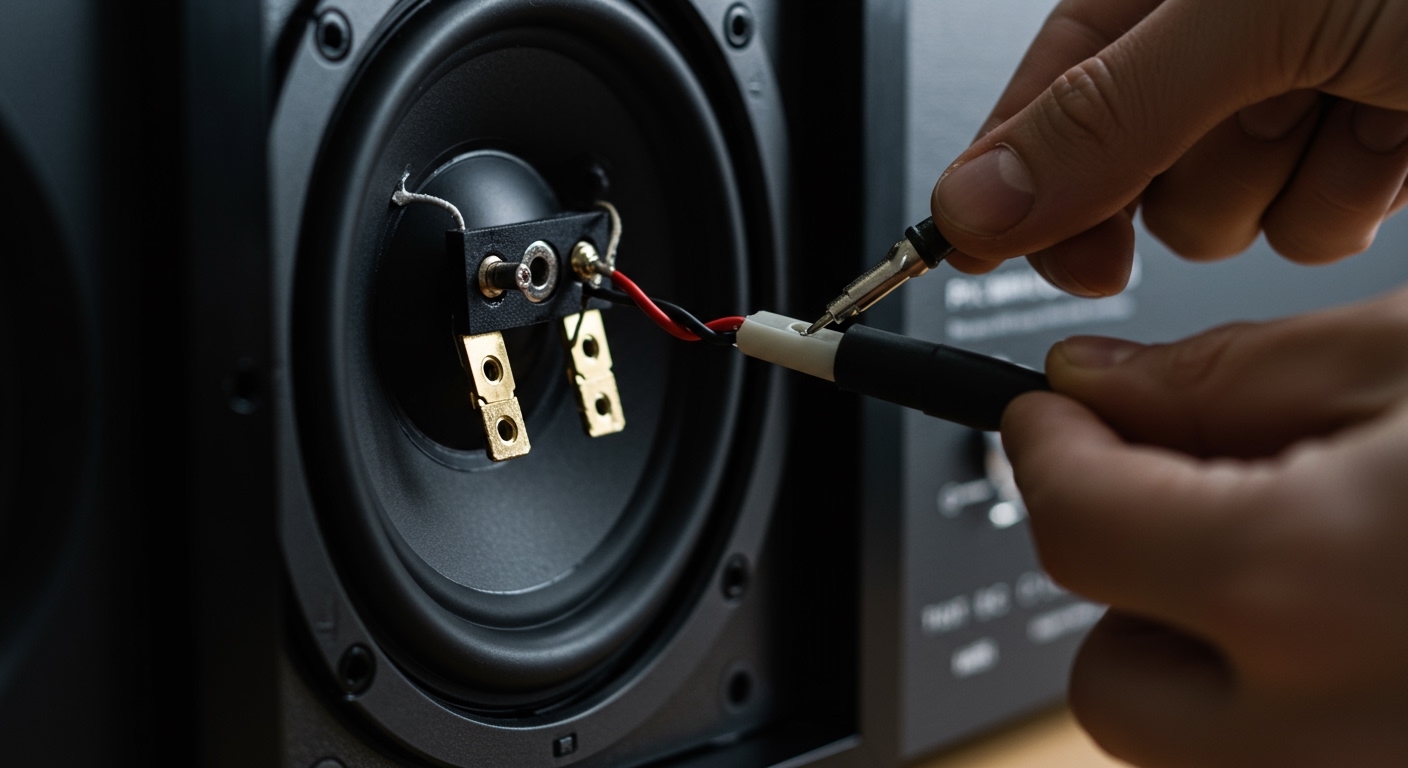
Polarity: The Golden Rule (+ to + and – to -)
The most fundamental rule in speaker wiring is maintaining correct polarity. Every speaker has a positive (+) and a negative (-) terminal. Your amplifier or head unit also has corresponding positive and negative outputs for each channel.
- Correct Polarity: The positive terminal of the speaker connects to the positive output of the amplifier. The negative terminal connects to the negative output.
- Why It Matters: When wired correctly, all your speakers move in and out in unison (in phase). This creates a full, rich soundstage with punchy bass. If one speaker is wired backward (out of phase), it will move in while the others move out, causing sound waves to cancel each other out. This results in thin, hollow sound with a noticeable lack of mid-bass.
Pro Tip: Most speaker wire is marked to help you keep track. One side might have a colored stripe, ridges, or text printed on it. I always use the marked side for positive (+) throughout the entire installation to avoid any confusion.
Impedance (Ohms): The Key to Amplifier Safety
Impedance, measured in Ohms (Ω), is essentially the electrical resistance a speaker presents to an amplifier. Think of it like a water pipe: a lower impedance (like 2 ohms) is a wider pipe, allowing more electrical current (power) to flow. A higher impedance (like 8 ohms) is a narrower pipe, restricting current flow.
Your amplifier is designed to be stable only down to a certain impedance level, typically 4 ohms or 2 ohms.
Matching Impedance: The final impedance of your speaker wiring must* match your amplifier’s stable rating.
- The Danger of Mismatching: Running an amplifier below its stable impedance (e.g., wiring a 1-ohm load to a 4-ohm stable amp) will cause it to overheat, enter protection mode, or even suffer permanent damage. I’ve seen countless amps fried this way. It’s an expensive and easily avoidable mistake.
We will cover how to calculate the final impedance for different wiring configurations in the next section.
The Crucial Role of Crossovers
Midrange speakers are specialists. They are designed to reproduce frequencies in the middle of the audio spectrum, typically from around 250 Hz to 4,000 Hz, which is where vocals and most instruments live. They are not designed to handle the low-frequency energy of sub-bass.
A crossover is an electronic filter that directs specific frequencies to the correct speaker. For midrange speakers, you will use a High-Pass Filter (HPF).
High-Pass Filter (HPF): This filter blocks low frequencies from reaching your midrange speakers, only allowing frequencies above* a certain point to pass through.
- Why It’s Essential: Sending deep bass signals to a midrange speaker will cause distortion and can physically damage the speaker’s cone and voice coil. A properly set HPF protects your speakers and dramatically improves the overall clarity of your sound system by letting them focus on the frequencies they were built to play.
How to Wire Midrange Speakers: Series vs. Parallel Explained
This is where theory meets practice. The two primary methods for wiring multiple speakers are Series and Parallel. Your choice will depend on the impedance of your speakers and the stability of your amplifier.
Series Wiring: Increasing the Impedance Load
In a series circuit, the speakers are wired one after another in a daisy chain. The signal flows from the amplifier, through the first speaker, then through the second speaker, and finally back to the amplifier.
How to do it:
- Connect the amplifier’s positive (+) output to the positive (+) terminal of Speaker 1.
- Connect the negative (-) terminal of Speaker 1 to the positive (+) terminal of Speaker 2.
- Connect the negative (-) terminal of Speaker 2 back to the amplifier’s negative (-) output.
The Formula: The total impedance is the sum of the individual speaker impedances.
R_Total = R1 + R2 + ...
- Example: If you wire two 4 ohm midrange speakers in series, the total impedance presented to the amplifier will be 8 ohms (4 + 4 = 8).
When to Use Series: This method is used when you need to increase the total impedance to meet your amplifier’s minimum requirement. It’s less common for midrange speakers but can be a useful tool.
Parallel Wiring: Decreasing the Impedance Load
In a parallel circuit, each speaker is connected directly to the amplifier’s output terminals. This method splits the power from the amplifier between the speakers.
How to do it:
- Connect the positive (+) terminals of both Speaker 1 and Speaker 2 to the amplifier’s positive (+) output.
- Connect the negative (-) terminals of both Speaker 1 and Speaker 2 to the amplifier’s negative (-) output.
The Formula: For two speakers of the same impedance, the formula is simple.
R_Total = R / Number of Speakers
- Example: If you wire two 4 ohm midrange speakers in parallel, the total impedance presented to the amplifier will be 2 ohms (4 / 2 = 2).
When to Use Parallel: This is a very common method used to maximize power output from an amplifier that is stable at lower impedances (e.g., a 2-ohm stable monoblock or 2-channel amp).
Comparison Table: Series vs. Parallel Wiring
| Feature | Series Wiring | Parallel Wiring |
|---|---|---|
| Final Impedance | Increases (Additive) | Decreases (Divisive) |
| Power Draw | Lower (Less power from amp) | Higher (More power from amp) |
| Amplifier Stress | Low | High (Must be stable at the load) |
| Typical Use Case | Raising impedance to a safe level. | Maximizing power output. |
| Example (2x 4Ω Speakers) | 8Ω Final Load | 2Ω Final Load |
Step-by-Step Guide: How to Wire 4 Midrange Speakers
Wiring four speakers is a common scenario, especially in custom door panels or multi-speaker arrays. While you could wire all four in parallel (resulting in a 1-ohm load for four 4-ohm midrange speakers), this is often too low for most multi-channel amplifiers.
The best and safest method is a Series-Parallel Combination. This technique gives you the best of both worlds, resulting in a safe, stable final impedance that most amplifiers can handle easily.
The Series-Parallel Combination (The Professional’s Choice)
This method involves creating two pairs of series-wired speakers and then wiring those two pairs together in parallel. Let’s walk through the process using four 4-ohm midrange speakers as our example.
Goal: To achieve a final impedance of 4 ohms.
Step 1: Create the First Series Pair (Speakers 1 & 2)
- Take your first two speakers.
- Connect the negative (-) terminal of Speaker 1 to the positive (+) terminal of Speaker 2 using a short piece of speaker wire.
- This pair is now a single 8-ohm unit (4 ohms + 4 ohms). The remaining open terminals are the positive on Speaker 1 and the negative on Speaker 2.
Step 2: Create the Second Series Pair (Speakers 3 & 4)
- Take your other two speakers.
- Connect the negative (-) terminal of Speaker 3 to the positive (+) terminal of Speaker 4 with another short piece of wire.
- This second pair is also now a single 8-ohm unit. The remaining open terminals are the positive on Speaker 3 and the negative on Speaker 4.
Step 3: Wire the Two Series Pairs in Parallel
- You now have two 8-ohm “speaker units.” We will connect these in parallel to the amplifier.
Connect the positive (+) terminal of Speaker 1 and* the positive (+) terminal of Speaker 3 to the amplifier’s positive (+) output.
Connect the negative (-) terminal of Speaker 2 and* the negative (-) terminal of Speaker 4 to the amplifier’s negative (-) output.
The Final Calculation: You have wired two 8-ohm units in parallel.
`(R1 * R2) / (R1 + R









