

Is Irish Easy to Learn for English Speakers? The Honest Answer
So, is Irish easy to learn for English speakers? The straightforward answer is no, it’s not “easy,” but it is absolutely achievable and incredibly rewarding. While it presents unique challenges not found in languages like French or Spanish, it also has surprising simplicities. From my own journey learning the language, I can tell you that success hinges less on natural talent and more on consistent effort and the right learning methods.
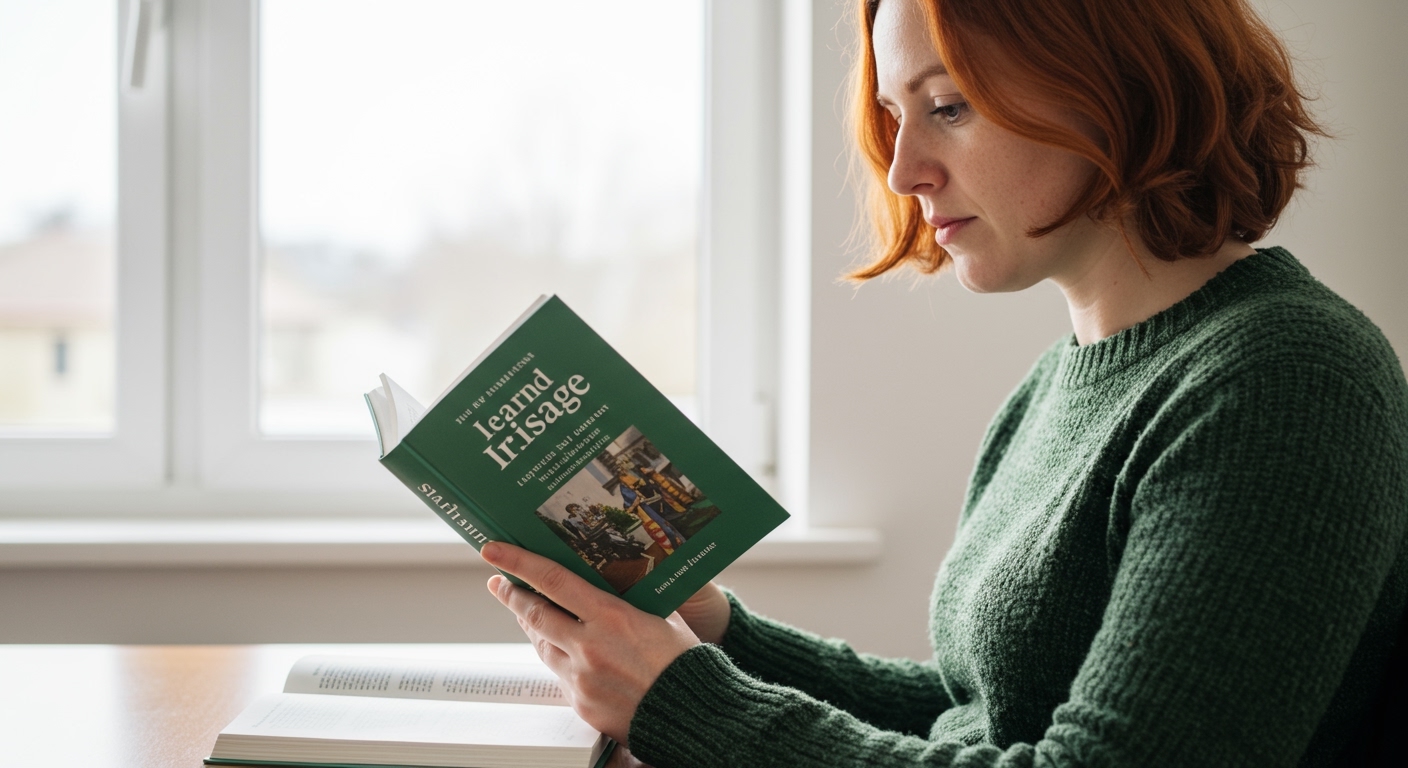
The Foreign Service Institute (FSI) doesn’t officially rank Irish, but based on its unique grammar and vocabulary, it would likely fall into Category IV, requiring approximately 1100 hours of study to reach proficiency. This puts it on par with languages like Finnish or Polish. Don’t let that number scare you; it’s a marathon, not a sprint, and every step is a victory.
Key Takeaways (TL;DR)
- Difficulty Level: Irish is moderately difficult for native English speakers, comparable to FSI Category IV languages.
- Main Challenges: The biggest hurdles are the unique pronunciation rules, initial mutations (changes to the start of a word), and the Verb-Subject-Object (VSO) sentence structure.
- Key Advantages: Irish uses the familiar Latin alphabet, has a simpler verb tense system than many European languages, and there’s a wealth of high-quality, free online resources available.
- The Verdict: While Irish is hard to learn for English speakers at first, its logical consistency and the supportive community make it a deeply satisfying language to acquire.
The Main Hurdles: Why Irish Can Be Hard for English Speakers
When I first opened an Irish textbook, I felt a bit overwhelmed. The words looked nothing like English, and the grammar rules seemed alien. These are the specific challenges you’ll encounter, but understanding them is the first step to overcoming them.
Unfamiliar Pronunciation & Spelling
The Irish spelling system, or litriú, is very consistent, but its rules are completely different from English. A combination of letters can represent a single sound, and the presence of a síneadh fada (a long accent mark, like on the ‘á’ in slán) completely changes a vowel’s sound.
- Broad vs. Slender Vowels: Consonants change their sound depending on the vowels next to them. This is a core concept you must grasp early on.
- Example: The word “bó” (cow) is pronounced simply “boh.” But in the word “beo” (alive), the ‘b’ has a “by” sound because it’s next to the slender vowel ‘e’.
My advice is to spend your first few weeks just listening. Use resources like Forvo or the audio in online dictionaries like Teanglann.ie to hear native speakers. Don’t guess the pronunciation—look it up every single time.
The Concept of Initial Mutations
This is often the biggest grammatical shock for learners. In Irish, the first letter of a word can change depending on the grammatical context. There are two main types:
- Lenition (Séimhiú): This usually involves adding an ‘h’ after the initial consonant. For example, the word for “woman” is bean. But “my woman” is mo bhean (pronounced ‘vo vyan’).
- Eclipsis (Urú): This involves adding a new consonant before the original one, which then becomes silent. For example, the word for “pen” is peann. But “our pen” is ár bpeann (pronounced ‘awr b-yown’).
It seems complicated, but these changes follow clear rules. My breakthrough came when I stopped trying to memorize every single rule at once and instead focused on one trigger at a time, like learning that the possessive adjective mo (my) always causes lenition.
Verb-Subject-Object (VSO) Sentence Structure
English uses a Subject-Verb-Object (SVO) structure: “The dog (S) ate (V) the food (O).” Irish flips this to Verb-Subject-Object (VSO).
- English (SVO): The woman sees the man.
- Irish (VSO): Feiceann (sees) an bhean (the woman) an fear (the man).
This takes a lot of getting used to. For months, my brain wanted to put the subject first. I found that drilling simple VSO sentences over and over again helped retrain my brain until it started to feel natural.
The Surprising Advantages: Why Irish is Easier Than You Think
Now for the good news. While the challenges are real, there are several aspects of the language that make the learning journey smoother than you might expect.
The Familiar Latin Alphabet
Unlike learning Russian, Greek, or Japanese, you don’t need to learn a new writing system. Irish uses the same alphabet as English, albeit with fewer letters (j, k, q, v, w, x, y, z are not native to the language). This is a huge psychological and practical advantage.
A Logical, Consistent System
Once you learn a rule in Irish, it generally stays consistent. Compared to the chaotic spelling and endless exceptions in English, Irish grammar can be a breath of fresh air. For example, there are no indefinite articles (like ‘a’ or ‘an’ in English). Cat can mean “cat” or “a cat” depending on the context, which simplifies things.
A Wealth of High-Quality Learning Resources
There has never been a better time to learn Irish. The amount of top-tier, often free, resources is staggering.
- TG4: Ireland’s Irish-language television broadcaster has a fantastic online player with subtitles in both Irish and English.
- Raidió na Gaeltachta (RnaG): The national Irish-language radio station is a perfect tool for immersive listening.
- Online Dictionaries: Sites like Foclóir.ie and Teanglann.ie are world-class, providing audio pronunciations, grammatical information, and example sentences.
Shared Vocabulary (Loanwords)
While most of the core vocabulary is unique, you’ll find plenty of familiar words borrowed from English, Latin, and Norman French over the centuries.
- ospidéal (hospital)
- fón (phone)
Recognizing these words can provide little confidence boosts along the way.
Your Step-by-Step Guide to Learning Irish from Scratch
Ready to start? Here is the practical, step-by-step plan that I used and recommend to all new learners. Don’t just read about the grammar; dive in and start using the language today.
Step 1: Master the Sounds (Phonetics First)
Before you learn a single word, spend a week focusing only on the sounds of Irish. Learn the difference between broad and slender consonants. Master the sounds of the vowels with and without the síneadh fada. This initial investment will pay off immensely, preventing you from fossilizing bad pronunciation habits.
Step 2: Build Your Core Vocabulary
Don’t try to learn random words from a dictionary. Start with the most common ones. A great place to begin is with the 11 irregular verbs, as they are used constantly. Then, move on to the 100 most frequent nouns and adjectives. Use a flashcard app like Anki or Memrise for this.
Step 3: Grasp Basic Sentence Structure (Embrace VSO)
Start building simple sentences immediately. Use the VSO pattern you learned about.
- Learn a verb: Ritheann (runs)
- Learn a noun: an gadhar (the dog)
- Combine them: Ritheann an gadhar. (The dog runs.)
Practice this with every new verb you learn. It will feel strange at first, but repetition is key.
Step 4: Tackle the Initial Mutations Gradually
Do not try to learn all the mutation rules at once. You will burn out. Instead, learn them in context.
- Start with mo (my). Learn that it causes lenition (séimhiú).
- Practice this until it’s automatic.
- Then, move on to the next trigger, like the word dhá (two), which also causes lenition.
By learning one rule at a time, you build a solid foundation without getting overwhelmed.
Step 5: Immerse Yourself Daily
You need to make Irish a part of your daily life, even if it’s just for 15-20 minutes.
- Change your phone’s language to Irish.
- Listen to the Irish-language radio station RnaG while you’re cooking or driving.
- Watch a short cartoon or news segment on TG4 Player.
- Listen to Irish-language music. Bands like Kneecap or traditional singers provide great listening practice.
Step 6: Find a Community and Practice Speaking
You cannot learn a language in a vacuum. You must speak it, even if you make mistakes.
- Look for a local Conradh na Gaeilge branch or an Irish language meetup group.
- Use online platforms like italki to find tutors or language exchange partners.
- Participate in online communities on Reddit (r/Gaeilge) or Discord.
Speaking from day one, even just saying “Dia duit” (Hello), is the fastest way to build real-world confidence.
The Best Tools & Resources for Learning Irish
Navigating the sea of resources can be tough. We’ve tested dozens of apps, websites, and books. Here are our top recommendations, broken down by their strengths.
| Resource | Type | Best For | Price | My Experience |
|---|---|---|---|---|
| Duolingo | App/Website | Absolute beginners, vocabulary building | Freemium | A great starting point for the first few months, but you must supplement it with grammar resources. |









