

What Are Audiophile Speakers? A Beginner’s Guide to High-Fidelity Sound
Tired of hearing muddy, lifeless sound from your Bluetooth speaker or TV soundbar? You know there’s more detail in your favorite music, but you just can’t seem to hear it. This is a common frustration, leading many to wonder what makes a high-end audio experience truly different. The answer lies in understanding the world of high-fidelity audio and the remarkable components that define it.
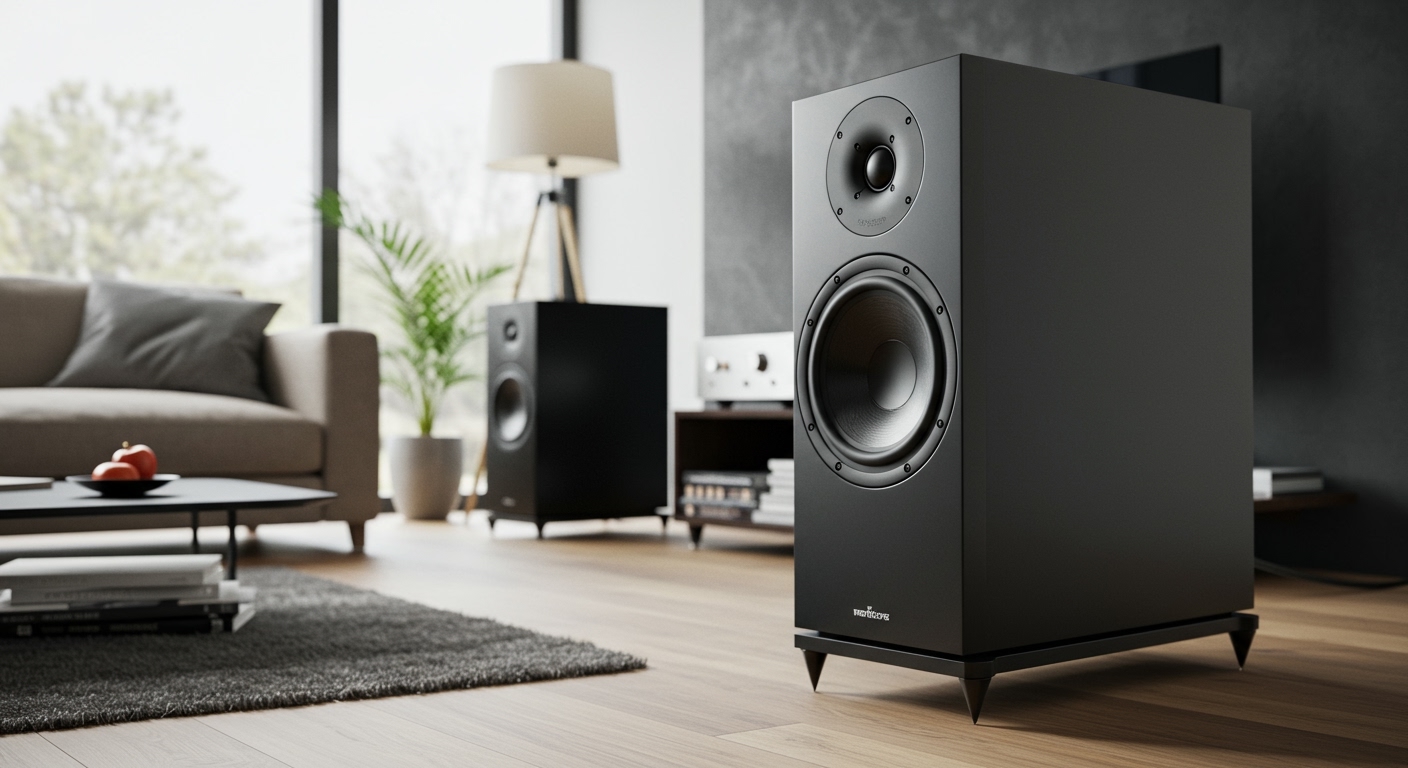
This guide will demystify what audiophile speakers are. We’ll break down their components, explore the different types available, and give you a step-by-step process for choosing and setting up the perfect pair. My goal is to give you the confidence to move beyond mass-market audio and into a world of stunning sonic clarity.
Key Takeaways
- Definition: Audiophile speakers are engineered for maximum sonic accuracy and minimal distortion, aiming to reproduce music exactly as the artist and engineer intended.
- Key Components: They use high-quality drivers (tweeters, mid-range, woofers), precision crossovers, and acoustically inert cabinets to achieve superior performance.
- Types: The most common types are bookshelf speakers (for smaller rooms) and floorstanding speakers (for larger spaces and deeper bass).
- Selection is Personal: The best audiophile speakers depend on your room size, budget, amplifier, and personal listening preferences. Always try to listen before you buy.
- Setup is Critical: Proper placement, using stands, and creating an “equilateral triangle” with your listening position is just as important as the speakers themselves.
What Are Audiophile Speakers, Exactly?
Audiophile speakers are loudspeakers meticulously designed and engineered to reproduce sound with the highest possible fidelity and accuracy. Unlike standard consumer speakers that often color the sound to be more “exciting” (typically with boosted bass and treble), an audiophile speaker’s primary goal is transparency—to get out of the way of the music and present it as purely as possible.
The core philosophy is to recreate the original recording with stunning realism. This means you hear the subtle breath of a vocalist before a line, the distinct texture of a cello’s bow on the strings, and the precise location of each instrument in a three-dimensional space, known as the soundstage.
In my experience testing hundreds of speakers, the difference is night and day. A standard speaker might play a song, but a true audiophile speaker like the Bowers & Wilkins 702 S3 transports you to the recording studio. It’s about moving from passively hearing music to actively experiencing it.
The Anatomy of an Audiophile Speaker: Key Components
The magic of an audiophile speaker isn’t a single feature but the synergy between its high-quality components. Every part is chosen and designed to work in perfect harmony to minimize distortion and maximize detail.
The Drivers: Crafting the Sound
Drivers are the transducers that convert electrical signals from your amplifier into the sound waves you hear. A typical audiophile speaker has two or three types, each specialized for a specific frequency range.
- Tweeters (High Frequencies): These small drivers handle the highest frequencies (roughly 2,000 Hz to 20,000 Hz and beyond). They are responsible for the detail, air, and sparkle in music—think cymbals, hi-hats, and the upper harmonics of vocals and strings. They are often made from lightweight, rigid materials like silk, aluminum, titanium, or even exotic materials like Beryllium and diamond in very high-end models.
- Mid-range Drivers (The “Heart” Frequencies): This is arguably the most critical driver, as it reproduces the range where our ears are most sensitive (around 300 Hz to 2,000 Hz). It handles the core of the music, including vocals, guitars, pianos, and cellos. Materials like treated paper, Kevlar, and polypropylene are common, chosen for their balance of lightness and stiffness.
- Woofers (Low Frequencies): These are the largest drivers in the speaker, designed to move a lot of air to reproduce bass and sub-bass frequencies (from 20 Hz up to around 300 Hz). They deliver the impact of a kick drum and the deep rumble of a bass guitar. A good woofer provides bass that is tight, fast, and articulate, not just a boomy, one-note thud.
The Crossover: The Speaker’s Brain
The crossover is an electronic circuit inside the speaker cabinet that acts like a traffic cop for audio frequencies. It takes the full-range signal from your amplifier and intelligently splits it, sending the high frequencies to the tweeter, the mid-range frequencies to the mid-driver, and the low frequencies to the woofer.
The quality of the crossover is paramount. Audiophile speakers use high-grade components like premium capacitors, inductors, and resistors to ensure this transition between drivers is seamless. A poorly designed crossover can create audible gaps or peaks in the frequency response, ruining the illusion of a cohesive sound.
The Cabinet (Enclosure): More Than Just a Box
The cabinet’s job is to provide a stable, vibration-free housing for the drivers and to manage the sound waves produced by the rear of the woofer. If a cabinet vibrates or “resonates” along with the music, it will color the sound in a negative way, making it sound “boxy” or muddy.
- Materials: Most high-quality speakers use MDF (Medium-Density Fiberboard) because it’s dense and acoustically inert. Extensive internal bracing is used to further increase rigidity. Some ultra-high-end speakers use materials like aluminum, proprietary composites, or exotic layered woods.
- Design: You’ll primarily see two types of cabinet designs:
Types of Audiophile Speakers for Your Space
Choosing the right type of speaker is the first major decision you’ll make. The choice primarily comes down to your room size, listening habits, and aesthetic preferences.
Bookshelf Speakers
Don’t let the name fool you; these speakers perform best on dedicated speaker stands, not crammed into a bookshelf. They are compact speakers that typically feature a tweeter and a mid-woofer.
- Best For: Small to medium-sized rooms (e.g., bedrooms, offices, or smaller living rooms).
- Pros: They are known for their incredible imaging and ability to create a precise, holographic soundstage. Because of their smaller size, they can “disappear” into the room sonically.
- Cons: They generally don’t produce the deep, impactful bass of their larger counterparts. Many users pair them with a high-quality subwoofer to create a full-range system.
From my personal experience, I started my audiophile journey with a pair of KEF LS50 Meta bookshelf speakers on stands. In my 12×15 foot office, they provided a level of detail and spatial accuracy that was simply breathtaking.
Floorstanding (Tower) Speakers
These are large, floor-based speakers that feature multiple drivers, often including dedicated woofers, to produce a full-range sound.
- Best For: Medium to large-sized rooms where they have space to breathe.
- Pros: Their larger cabinet volume and multiple/larger woofers allow them to produce deeper, more authoritative bass without needing a separate subwoofer. They can create a larger, more room-filling sound.
- Cons: They require more floor space and can easily overwhelm a small room with excessive bass (“bass boom”). They are also typically more expensive than bookshelf speakers from the same product line.
Comparison: Bookshelf vs. Floorstanding Speakers
| Feature | Bookshelf Speakers | Floorstanding Speakers |
|---|---|---|
| Ideal Room Size | Small to Medium (under 250 sq. ft.) | Medium to Large (over 250 sq. ft.) |
| Bass Response | Tighter, more articulate; less deep | Deeper, more impactful, full-range |
| Placement | Require dedicated stands for proper height | Placed directly on the floor (often with spikes) |
| Soundstage | Often superior point-source imaging | Can create a larger, more grand-scale sound |
| Price (Typical) | Generally less expensive | Generally more expensive |
| Subwoofer | Often benefits from a paired subwoofer | Subwoofer is optional; often not needed |
How to Choose the Best Audiophile Speakers for You
Choosing speakers is a deeply personal process. The “best” speaker is the one that sounds best to you, in your room, with your music. Here’s a practical, step-by-step approach.
Step 1: Define Your Budget
Audiophile speakers are an investment in your enjoyment of music. A realistic budget will narrow your options significantly.
- Entry-Level Audiophile: $500 – $1,500. You can find exceptional bookshelf speakers from brands like ELAC, Q Acoustics, and Wharfedale in this range.
- Mid-Fi: **$1,500 – $5









