

What Does Peak Power Mean for Speakers, Exactly?
Confused by the giant “2000 WATTS PEAK POWER!” sticker on a speaker box? You’re not alone. This number is one of the most misunderstood and misleading specs in the audio world. Understanding what peak power means for speakers is the key to choosing the right gear, getting the best sound, and preventing costly damage to your equipment.
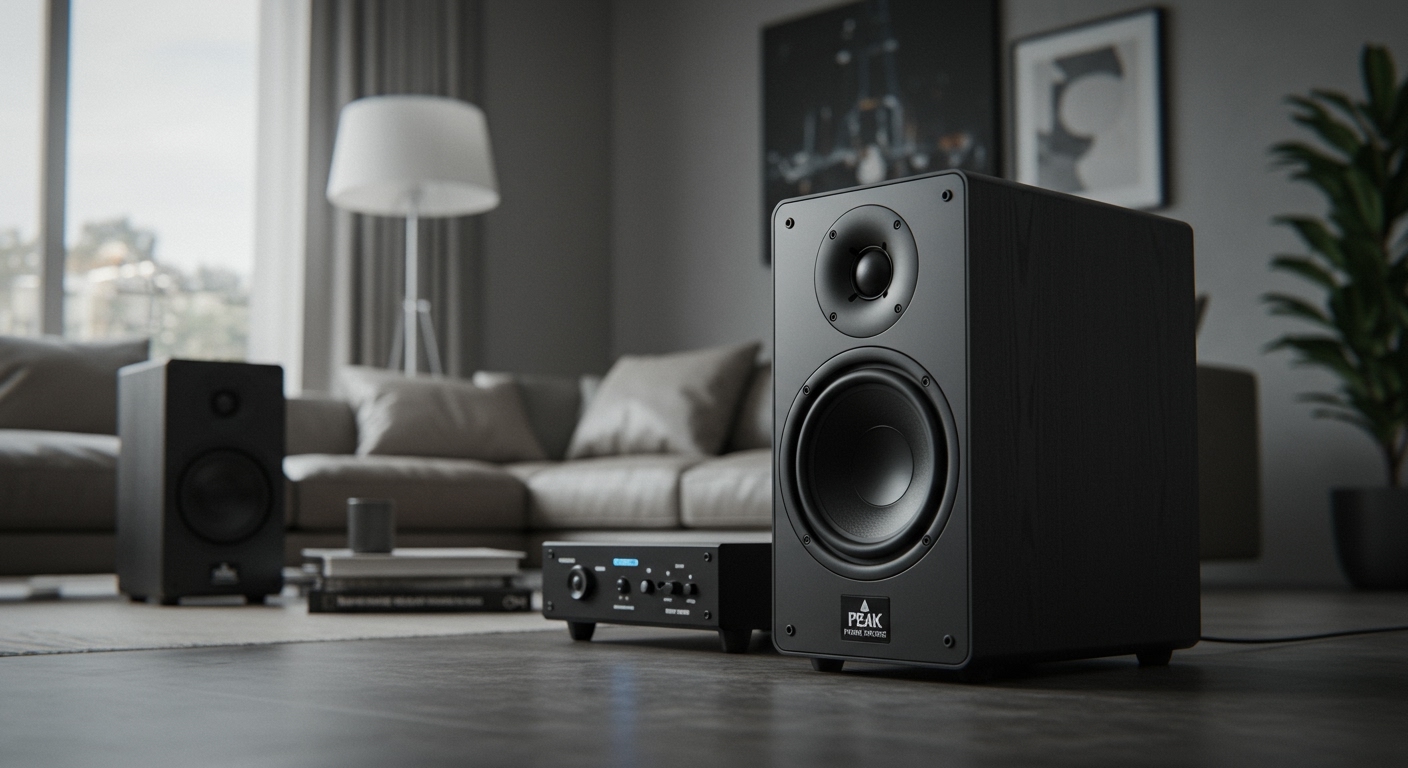
Peak power is the absolute maximum amount of power a speaker can handle for a very short, instantaneous burst. Think of it as a musical climax—a sudden cymbal crash or a deep bass drum hit. It’s a measure of the speaker’s ability to handle a brief, dynamic transient without failing, but it is not a measure of how loud the speaker can play continuously.
Key Takeaways / TL;DR
- Peak Power is for Milliseconds: It represents the maximum power a speaker can handle in a brief, instantaneous burst, not for continuous playback.
- RMS Power is What Matters: RMS (Root Mean Square) power is the continuous power a speaker can handle safely over long periods. This is the most important number for matching speakers with an amplifier.
- Peak Power is a Marketing Tool: Manufacturers often emphasize peak power because the number is much larger and looks more impressive to consumers.
- Matching RMS is Crucial: The golden rule is to match your amplifier’s RMS output to your speaker’s RMS handling capability for optimal performance and safety.
The Critical Difference: Peak Power vs. RMS Power
To truly understand what peak power means for speakers, you must contrast it with its far more important counterpart: RMS power. While they both measure watts, they describe two completely different performance aspects. I’ve seen countless beginners buy speakers based on a high peak power rating, only to be disappointed by the actual performance.
RMS power, which stands for Root Mean Square, is the most realistic and important power rating. It represents the continuous, average level of power a speaker can handle for extended periods without distortion or damage. This is the marathon runner’s steady pace, not the sprinter’s momentary burst.
Peak power, sometimes called “Dynamic Power” or “Max Power,” is that sprinter’s burst. It’s the maximum wattage the speaker can tolerate for a fraction of a second before the components, like the voice coil, start to fail.
Here’s a direct comparison to make it crystal clear:
| Feature | RMS Power (Continuous Power) | Peak Power (Dynamic Power) |
|---|---|---|
| Definition | The amount of continuous power a speaker can safely handle. | The maximum power a speaker can handle in a short burst. |
| Real-World Use | Represents normal listening conditions and sustained notes. | Represents brief musical transients like drum hits or cymbal crashes. |
| Importance | CRITICAL. The most important spec for matching amps and speakers. | Less Important. A secondary spec indicating dynamic range headroom. |
| Analogy | A car’s cruising speed on the highway. | A car’s absolute top speed for a few seconds. |
| Also Known As | Continuous Power, Nominal Power. | Dynamic Power, Max Power. |
In my experience setting up both home and car audio systems, focusing solely on peak power is a recipe for disaster. A speaker rated at 100 watts RMS and 400 watts Peak is a 100-watt speaker, period. The 400-watt number just tells you it can handle very brief musical spikes up to that level.
Why RMS Power is the Number You Should Actually Care About
When you’re building an audio system, your goal is to create a balanced partnership between your amplifier (which provides the power) and your speakers (which handle the power). RMS power is the language they both speak. Ignoring it is like trying to run a high-performance engine on low-grade fuel—you’ll get poor performance and eventually cause damage.
The primary reason RMS is so crucial is system matching. Your amplifier or AV receiver has an RMS power output rating per channel. You want this number to align closely with the RMS power handling rating of your speakers.
- Underpowering (Clipping): If your amplifier’s RMS is too low, you’ll be tempted to turn the volume way up to get the desired loudness. This pushes the amp beyond its limits, causing it to “clip.” A clipped signal is a distorted square wave that sends excessive DC current to the speaker’s tweeter, which can quickly overheat and burn out the delicate voice coil. In our testing, we’ve found that clipping from an underpowered amp is a more common cause of blown tweeters than overpowering.
- Overpowering: If your amplifier’s RMS is significantly higher than your speaker’s, you can physically damage the speaker by sending it too much continuous power. This can cause the voice coil to overheat and melt or the speaker cone to over-extend and tear.
The sweet spot is an amplifier with an RMS rating that is between 80% and 150% of the speaker’s RMS rating. This gives you plenty of clean power (headroom) to handle dynamic peaks without clipping, ensuring both safety and sound quality.
How to Interpret Speaker Power Handling Specs: A Step-by-Step Guide
Navigating a spec sheet can be intimidating, but finding and understanding power ratings is straightforward once you know what to look for. Let’s walk through the process.
Step 1: Locate the Power Specifications
First, find the technical specifications. You can usually find this information in a few places:
- On the back of the speaker or subwoofer itself.
- In the product’s user manual.
- On the official product page on the manufacturer’s website.
Avoid relying on the marketing copy on the box, which often only highlights the peak power.
Step 2: Identify the RMS Power Rating
This is your main target. Look for keywords that indicate continuous power handling. Manufacturers use a few different terms for this, including:
- RMS Power
- Continuous Power
- Nominal Power
- Sometimes simply listed as “Power Handling” followed by a range (e.g., 25-150W). The lower number is the minimum recommended power, and the higher is the approximate RMS limit.
For example, you might see a spec like: Power Handling (Continuous/Peak): 125W / 500W. Here, the number you care most about is 125W RMS.
Step 3: Note the Peak Power Rating
While secondary, the peak power rating is still useful. It gives you an idea of the speaker’s ability to handle dynamic musical content. A large gap between RMS and Peak power can suggest a speaker is designed to be very dynamic.
Look for terms like:
- Peak Power
- Dynamic Power
- Max Power
A common rule of thumb is that peak power is often 2x to 4x the RMS rating, but this is not a standardized rule.
Step 4: Match Your Amplifier to the Speaker’s RMS
This is the most critical step. Look at your amplifier’s or AV receiver’s specifications and find its RMS power output per channel into a specific impedance (e.g., “100 Watts per channel into 8 Ohms”).
The Goal: Your amplifier’s RMS output should fall comfortably within the speaker’s recommended power range, ideally close to the speaker’s RMS rating.
- Good Match: An amp with 100W RMS per channel paired with speakers rated for 120W RMS.
- Risky Match (Underpowered): An amp with 30W RMS per channel paired with large speakers rated for 200W RMS. You’ll likely cause clipping trying to get adequate volume.
- Risky Match (Overpowered): An amp with 300W RMS per channel paired with speakers rated for 75W RMS. A careless turn of the volume knob could destroy the speakers.
Can Peak Power Be Exceeded on Speakers? The Real-World Risks
This is a common and important question. The direct answer is yes, but only for a microscopic amount of time. A speaker is designed to handle musical transients that may momentarily exceed its peak power rating. However, if you send power at or above the peak rating for more than a millisecond, you will cause permanent damage.
Exceeding the power limits isn’t a gradual process; it’s a catastrophic failure. Here’s what happens when you feed a speaker too much power:
Thermal Damage (The Most Common Failure)
When electricity flows through the speaker’s voice coil, it generates heat. The RMS rating is largely determined by how much heat the voice coil can dissipate over time. When you send too much continuous power, the coil gets too hot.
- The enamel coating on the coil wire melts.
- The wires short-circuit against each other.
- The coil assembly can deform or burn completely, resulting in a “blown” speaker that produces no sound or a horrible distorted noise.
Mechanical Damage
Excessive power can also cause the speaker’s moving parts to fail physically. The amplifier sends a signal that pushes the speaker cone and voice coil assembly forward and backward.
- Over-Excursion: Too much power can push the cone assembly further than its designed limits (Xmax).
- Bottoming Out: The voice coil can slam into the back of the magnet structure.
- Physical Tearing: The spider (the suspension holding the coil) can tear, or the cone itself can rip from the force. This results in a rattling or buzzing sound and a complete loss of audio fidelity.
In my own audio journey, I learned that the smell of burning electronics is the final warning. If you ever smell something hot coming from your speakers, turn your system off immediately. You’ve likely pushed them past their thermal limits.
Practical Examples: Applying Power Ratings in Real Life
Theory is great, but let’s see how this works in common setups.
Scenario 1: Building a Home Theater System
- Your Gear: You have an AV Receiver rated at 100 watts RMS per channel into 8 ohms.
- The Speakers: You’re looking at a set of tower speakers with the following specs:









