

What Does Powered Speakers Mean? A Simple, Step-by-Step Guide
Tangled wires, confusing receivers, and bulky amplifiers—setting up a traditional sound system can feel like a complex puzzle. You just want great audio for your turntable or TV without needing an engineering degree. This is where the elegant simplicity of powered speakers comes in, offering a high-fidelity, all-in-one solution that has completely changed how I recommend audio setups to friends and family.
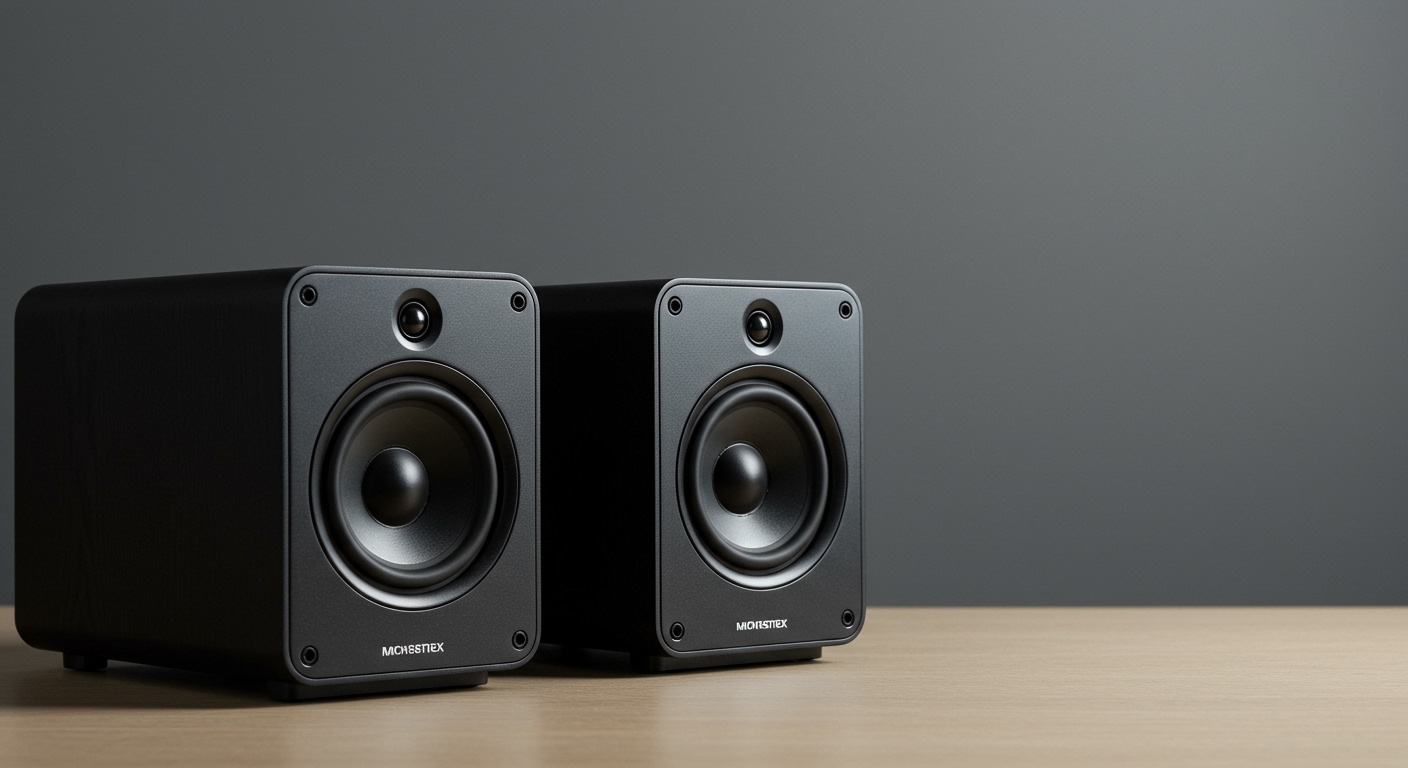
So, what does powered speakers mean? In short, powered speakers are an all-in-one audio system with the amplifier built directly into one of the speaker cabinets. This design eliminates the need for a separate, external amplifier or AV receiver, allowing you to connect your music source—like a phone, computer, or turntable—directly to the speakers themselves for a clean, minimalist, and high-quality sound system.
Key Takeaways (TL;DR)
- All-in-One System: Powered speakers have a built-in amplifier, so you don’t need a separate receiver.
- Plug-and-Play: They connect directly to your audio sources like a TV, computer, turntable, or smartphone.
- Minimal Wires: The setup is incredibly simple, usually involving just a power cord, a wire connecting the two speakers, and a cable to your source.
- System Matched: The internal amplifier is professionally tuned by the manufacturer to perfectly match the speaker drivers, ensuring optimal performance out of the box.
- Ideal For: Beginners, vinyl enthusiasts, desktop audio, TV sound upgrades, and anyone seeking great sound in a small, convenient package.
Understanding What Powered Speakers Mean: A Deeper Dive
At its core, the term “powered speaker” refers to the inclusion of an internal amplifier. Think of it like a combo meal at a restaurant; you get everything you need in one package. In contrast, passive speakers are like ordering à la carte—they are just the speaker drivers in a box and require you to buy a separate amplifier to “power” them.
The magic of powered speakers lies in this integration. The signal from your iPhone, turntable, or computer is too weak to move the physical parts of a speaker to create sound. An amplifier’s job is to boost that signal to a usable level. By building the amplifier into the speaker, manufacturers create a perfectly synergistic system where every component is designed to work together.
From my experience testing dozens of audio setups, this pre-matched harmony is the number one reason powered speakers like the Kanto YU6 or Klipsch The Fives sound so impressive right out of the box. There’s no guesswork involved in pairing the right amp with the right speakers.
The Anatomy of a Powered Speaker: What’s Inside the Box?
To truly grasp what is powered speakers, it helps to look under the hood. A typical pair of powered speakers consists of a “primary” or “master” speaker and a “secondary” or “slave” speaker. The primary speaker houses all the electronics.
The Built-in Amplifier: The System’s Engine
This is the key component. The amplifier takes the low-level audio signal from your source and boosts it with enough power to drive the speakers. Most modern powered speakers use highly efficient Class D amplifiers, which generate less heat and can be made very small, making them perfect for fitting inside a speaker cabinet.
The Drivers: The Sound-Makers
Drivers are the circular parts of the speaker that vibrate to create sound waves.
- Woofer: The largest driver, responsible for producing low-frequency sounds (bass).
- Tweeter: A smaller driver that handles high-frequency sounds (treble).
- Mid-range Driver: Found in some 3-way speaker designs, it handles the frequencies in the middle, like vocals.
The Crossover: The Audio Traffic Cop
An electronic circuit called a crossover directs the right frequencies to the right driver. It sends the deep bass notes to the woofer and the crisp high notes to the tweeter. This ensures each driver is only doing the work it was designed for, resulting in clearer, more detailed sound.
The Inputs & Outputs (I/O): Your Connection Hub
The back of the primary speaker is where you’ll find all the connection options. Common inputs include:
- RCA (Red and White): A classic analog connection for turntables, CD players, and some TVs.
- 3.5mm AUX: The standard headphone-style jack for connecting phones, laptops, and tablets.
- Optical (TOSLINK): A digital connection ideal for getting high-quality sound from a TV or gaming console.
- USB Audio: Allows a direct digital connection from a computer, often providing the best possible sound quality.
- Bluetooth: For wireless streaming from your devices. Look for codecs like aptX HD for higher-quality wireless audio.
- Sub Out: A dedicated output that lets you easily connect an external subwoofer for more powerful bass.
Powered Speakers vs. Passive Speakers: A Head-to-Head Comparison
Choosing between powered and passive speakers is one of the first major decisions when building an audio system. I’ve used both extensively, and each has clear advantages depending on your goals.
Here’s a simple table to break down the key differences:
| Feature | Powered Speakers | Passive Speakers |
|---|---|---|
| Amplifier | Built-in, internally matched | Requires a separate, external amplifier or AV receiver |
| Setup Complexity | Simple (Plug-and-Play). Connect to power and source. | More Complex. Requires component matching and more wiring. |
| Cabling | Minimal. Power cord, speaker wire, source cable. | Speaker wire for each speaker, interconnects for each source. |
| Footprint | Small. Just two speakers. | Large. Speakers + amplifier/receiver. |
| Customization | Limited. You cannot upgrade the internal amplifier. | Highly Customizable. Upgrade any component (amp, speakers) anytime. |
| Ideal Use Case | Turntables, desktops, TV sound, streamlined Hi-Fi. | Dedicated listening rooms, home theater, hobbyists who love to tweak. |
Simplicity and Convenience
This is the powered speaker’s biggest win. For my office setup, I use a pair of Audioengine A5+ speakers. I have my computer connected via USB and my turntable via RCA. The whole system takes up minimal space and was set up in under 10 minutes. A comparable passive system would require a separate integrated amp, adding another box and more cables to my desk.
System Matching
Powered speakers remove the guesswork. The engineers have already done the hard work of ensuring the amplifier provides the perfect amount of clean power for the drivers. With a passive system, you have to research and match speaker impedance (ohms) and sensitivity with an amplifier’s power output (watts). A mismatch can lead to poor sound or even damage your equipment.
Upgradability and Flexibility
This is where passive systems shine. If you want a more powerful amplifier or want to try different-sounding speakers, you can swap out individual components. With a powered system, the amp and speakers are a packaged deal. If you want to upgrade, you have to replace the entire system.
How to Set Up Powered Speakers: A 5-Step Guide
Ready to get your new speakers running? The process is refreshingly straightforward. I’ll walk you through the exact steps I follow when setting up a new pair.
Step 1: Unboxing and Placement
First, take the speakers out of the box. You’ll have a primary speaker (with the power cord input and connections) and a secondary one.
Speaker placement is crucial for good sound. For the best stereo image, create an equilateral triangle between the two speakers









