

What Size Amp for 100 Watt Speakers? The Direct Answer
For 100 watt speakers, you should ideally use an amplifier that can deliver between 150 to 200 watts per channel. This 1.5x to 2x power ratio provides crucial “headroom,” ensuring the amplifier can handle dynamic musical peaks without distorting, which is the primary cause of speaker damage.
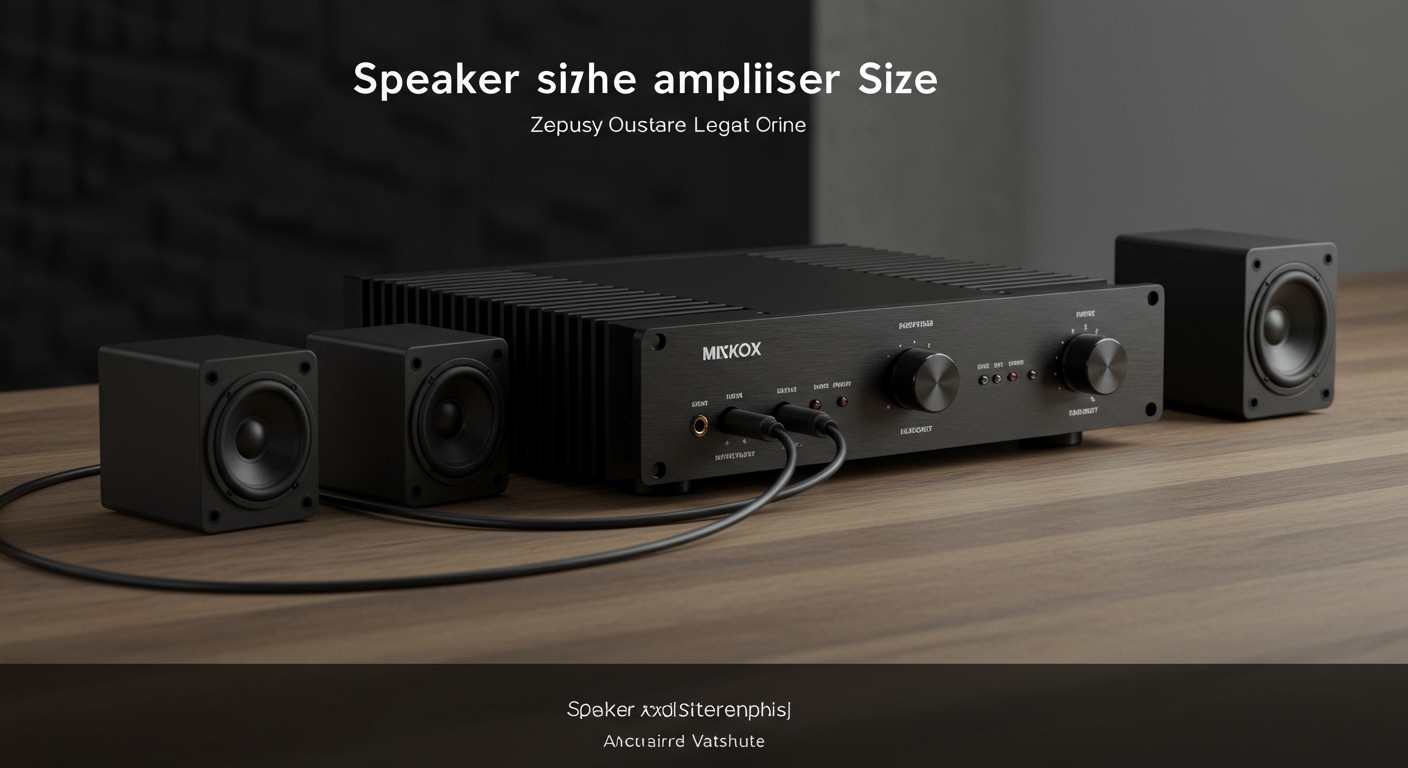
Choosing an amplifier based on wattage alone can be misleading. You’re actually safer with a more powerful, clean-running amplifier used responsibly than with an underpowered one pushed to its limits. In my experience setting up hundreds of audio systems, the most common cause of blown speakers isn’t too much power, but too little power that leads to a destructive signal called clipping. This guide will walk you through exactly how to match your components for the best possible sound and safety.
Key Takeaways: Sizing Your Amplifier
- The Headroom Rule: Aim for an amplifier with 1.5x to 2x the continuous (RMS) power rating of your speakers. For 100W speakers, this means 150W to 200W per channel.
- Underpowering is Dangerous: An underpowered amp, when turned up too loud, creates a distorted signal (clipping) that can quickly destroy your speakers’ tweeters.
- Impedance is Critical: Ensure your amplifier is compatible with your speakers’ impedance, measured in ohms (Ω). Most home audio speakers are 8Ω or 6Ω.
- Sensitivity Matters: Speaker sensitivity rating tells you how efficiently it converts power into sound. Highly sensitive speakers (90dB+) require less amplifier power to reach high volumes.
Why More Power is Better: Understanding Headroom and Clipping
It seems counterintuitive, but having more amplifier power than your speakers are rated for is generally safer. The reason comes down to two critical concepts: headroom and clipping.
What is Amplifier Headroom?
Headroom is the difference between the average power your amplifier is using and the maximum power it can deliver cleanly. Music is incredibly dynamic; a soft passage might only require a single watt of power, while a sudden drum hit or cymbal crash could demand 100 watts or more for a fraction of a second.
- Sufficient Headroom (e.g., 200W Amp): When that sudden drum hit occurs, the powerful amp delivers the 100 watts cleanly and effortlessly. The sound is crisp, clear, and impactful.
- Insufficient Headroom (e.g., 50W Amp): When that same drum hit demands 100 watts, the 50-watt amp can’t provide it. It tries, fails, and instead sends a distorted, damaging signal.
Think of it like a car engine. A powerful V8 engine can accelerate to 60 mph smoothly without straining. A small 4-cylinder engine has to redline and work extremely hard to do the same, creating a lot of noise and stress. Your amplifier works the same way.
The Real Speaker Killer: Amplifier Clipping
When you push an underpowered amplifier beyond its maximum clean power limit, it begins to “clip” the audio signal. Instead of a smooth, rounded sound wave, the amp chops off the top and bottom, creating a distorted “square wave.”
This square wave is poison for your speakers. It forces the speaker’s delicate voice coils to work in ways they weren’t designed to, causing them to overheat rapidly. I’ve seen countless tweeters fried this way. The user thinks they need more volume, cranks their small amp, and the resulting clipping silently melts the speaker’s internal components.
A powerful 150-watt amplifier running at 50% capacity is infinitely safer for your 100-watt speakers than a 75-watt amplifier running at 100% capacity.
Matching Amplifier and Speaker Impedance (Ohms)
Beyond wattage, the most important specification to match is impedance, which is the measure of electrical resistance, expressed in ohms (Ω).
Your speakers will have a nominal impedance rating, typically 8 ohms or 4 ohms. Your amplifier is designed to be stable driving a load of a certain impedance.
- Check Your Specs: Look at the back of your speakers and your amplifier. The impedance rating will be clearly listed.
- Rule of Thumb: Your amplifier’s minimum impedance rating must be equal to or lower than your speakers’ impedance.
It’s important to note that an amplifier’s power output changes with impedance. The same amplifier will typically deliver more power into a 4-ohm speaker than an 8-ohm speaker. For instance, an amp rated for 100 watts at 8 ohms might be rated for 160 watts at 4 ohms. Always check the manufacturer’s specifications.
A Step-by-Step Guide to Sizing Your Amp for 100 Watt Speakers
Let’s put this all together into a practical, step-by-step process. We’ll use a common example: a pair of speakers with a 100W RMS power handling and an 8-ohm impedance.
Step 1: Determine Your Speaker’s Continuous Power Rating (RMS)
First, ignore the “peak” or “max” power rating on your speakers. This number is mostly for marketing and represents a power level the speaker can only handle for a millisecond. The number you need is the continuous or RMS (Root Mean Square) power rating.
- Your Target: For your 100W speakers, the target is 100W RMS.
Step 2: Apply the Headroom Formula (1.5x to 2x)
Now, calculate your ideal amplifier power range. This will give you the necessary headroom to prevent clipping and ensure dynamic, clean sound.
- Low End: 100W (Speaker RMS) x 1.5 = 150 watts per channel
- High End: 100W (Speaker RMS) x 2.0 = 200 watts per channel
Your ideal amplifier will have an RMS power output of 150-200 watts per channel into your speaker’s impedance (in this case, 8 ohms).
Step 3: Verify Impedance Compatibility
Check the spec sheet for both the amplifier you’re considering and your speakers.
- Speakers: 8 ohms
- Amplifier: Look for a specification that says “Power Output: 150W into 8 ohms” and confirms it is stable with 8-ohm loads.
Step 4: Consider Speaker Sensitivity
Speaker sensitivity is a crucial factor that tells you how loud a speaker will play with a given amount of power. It’s measured in decibels (dB) with 1 watt of power from 1 meter away.
- Low Sensitivity (e.g., 84 dB): These speakers are power-hungry. You’ll want an amplifier on the higher end of your calculated range (closer to 200W) to get them to play loudly without strain.
- High Sensitivity (e.g., 92 dB): These speakers are very efficient. They can get very loud with just a few watts. An amplifier on the lower end of your range (150W) will be more than sufficient.
For every 3 dB increase in sensitivity, you need half the amplifier power to achieve the same volume. This is why a high-sensitivity speaker can be a great pairing for a lower-powered (but still high-quality) amplifier.
Amplifier Power Matching Scenarios
To make this crystal clear, here is a table summarizing the outcomes for a 100W RMS speaker.
| Scenario | Amp Power (RMS) | Risk of Speaker Damage | Sound Quality at High Volume | Our Recommendation |
|---|---|---|---|---|
| Dangerously Underpowered | 50-75 Watts | High (from clipping) | Poor, distorted, and compressed. | Avoid |
| Adequate / Minimum | 100-120 Watts | Moderate (low headroom) | Okay, but can sound strained on dynamic peaks. | Acceptable for casual listening |
| Ideal Match (The Sweet Spot) | 150-200 Watts | Very Low | Excellent, clean, dynamic, and effortless. | Highly Recommended |
| Safely Overpowered | 200-300 Watts | Low (with responsible use) | Superb, with limitless headroom. | Excellent choice for audiophiles |
As you can see, the “sweet spot” provides the best balance of performance, safety, and value.
Applying the Rules: What Size Amp for 80 Watt Speakers?
The exact same principles apply to speakers of any wattage rating. If you have a pair of speakers rated for 80 watts RMS, you simply adjust the formula.
- Identify RMS Power: 80 watts
- Apply Headroom Formula:
Therefore, for 80 watt speakers, the ideal amplifier size is between 120 and 160 watts per channel. Again, you must verify that the amplifier is compatible with your speaker’s impedance.
Common Mistakes to Avoid When Sizing Your Amp
In my years in the audio world, I’ve seen people make the same few mistakes over and over. Avoiding these will save you money and protect your equipment.
- Ignoring Impedance: This is the most critical technical mistake. Pairing a demanding 4-ohm speaker with an amplifier only rated for 8 ohms is asking for trouble.
- Buying an Underpowered Amp to “Be Safe”: This is the most common and dangerous myth. As we’ve covered, an underpowered, clipping amplifier is far more dangerous to your speakers than a high-powered one.
- Focusing on “Peak Power”: Always use the RMS or Continuous power rating for both the amplifier and speakers. Peak power is a meaningless marketing number for real-world performance.









