

The Straight Answer: Do TED Talk Speakers Use Teleprompters?
Ever watched a flawless TED Talk and wondered, “How do they remember all of that?” The seamless delivery, the perfect timing, the intense eye contact—it feels almost superhuman. This often leads to the big question: do TED Talk speakers use teleprompters?
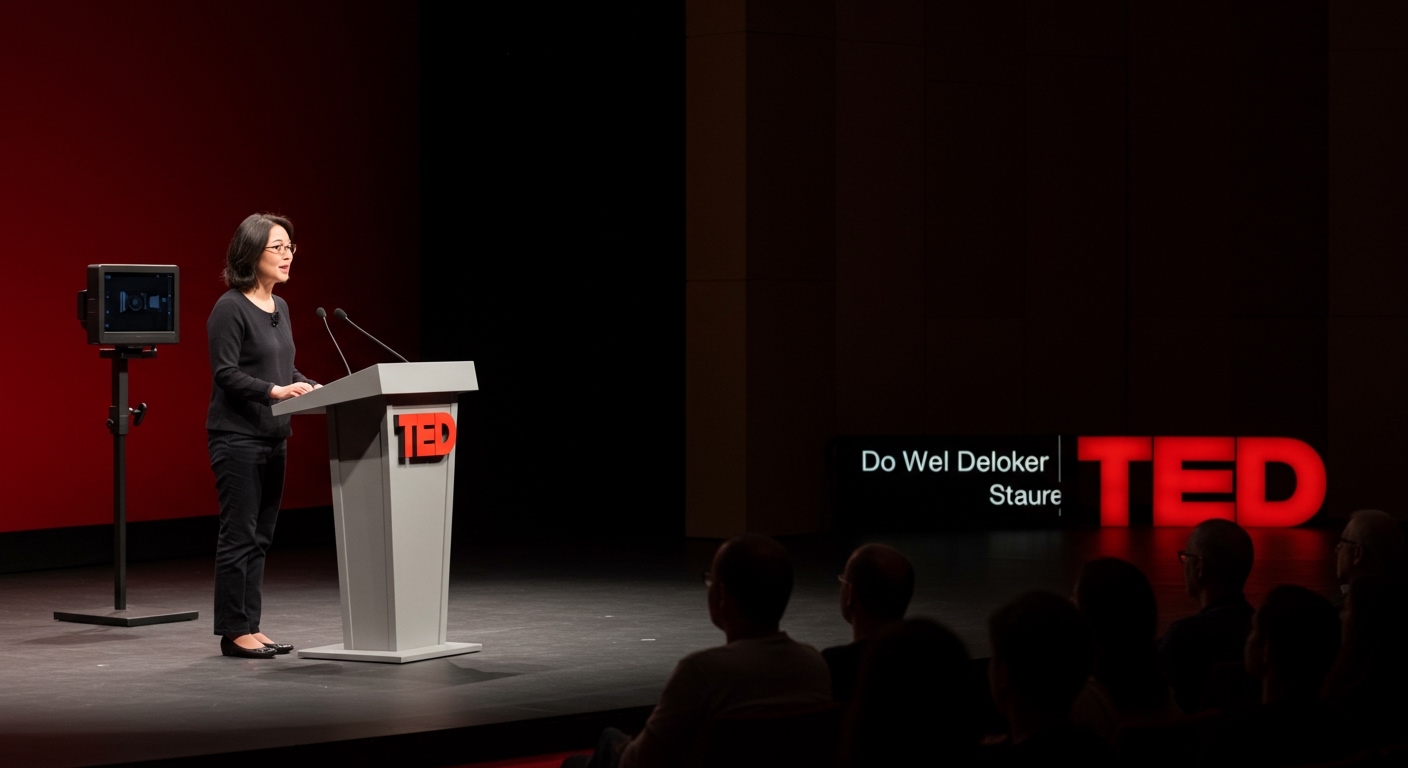
The short answer is yes, but not in the way you think. TED speakers do not use traditional, word-for-word teleprompters like a news anchor. Instead, they have access to special on-stage screens called confidence monitors. These monitors serve as a guide and a safety net, not a script to be read. The real magic behind a memorable TED Talk lies in a rigorous process of scripting, coaching, and relentless rehearsal.
Key Takeaways
- Yes, TED uses aids: Speakers have access to on-stage screens, but they are called confidence monitors.
- Not a full script: These monitors display a speaker’s slides, a timer, and sometimes key bullet points—never a full, scrolling script.
- Focus on connection: The goal is to maintain authentic eye contact and connect with the audience, which reading from a traditional teleprompter would prevent.
- Memorization is key: The real work is in the months of preparation, where speakers internalize their talk through intense practice and coaching.
- TEDx vs. TED: The technology available at independently organized TEDx events can vary greatly, so speakers should always confirm the setup beforehand.
What Are Confidence Monitors and How Do They Work at TED?
When I coach speakers preparing for high-stakes presentations, the biggest fear is always “going blank.” This is where confidence monitors become an invaluable tool. They are strategically placed screens, often low to the ground at the front of the stage, visible only to the speaker.
Unlike a classic teleprompter that projects scrolling text onto a clear panel in front of a camera, confidence monitors are more like a personalized dashboard for the presenter.
Here’s what a typical TED confidence monitor setup displays:
- Current Slide: A large view of the exact slide the audience is currently seeing on the main screen. This confirms what’s behind the speaker without them ever needing to turn around.
- Next Slide: A smaller preview of the upcoming slide. This is a crucial mental cue, allowing the speaker to transition their thoughts smoothly.
- A Countdown Timer: TED Talks are famously strict on time (usually 18 minutes or less). A large, clear clock counts down, helping the speaker manage their pacing.
- Key Phrases (Rarely): In some cases, a speaker might arrange to have a few key phrases or bullet points displayed. However, this is uncommon. TED actively discourages full sentences or paragraphs, as it tempts the speaker to read instead of connect.
From my experience, the most valuable feature for speakers is the “next slide” preview. It acts as a powerful psychological anchor, reminding them of the next section of their talk and preventing the dreaded mental block.
Why TED Prefers Confidence Monitors Over Traditional Teleprompters
The entire philosophy of TED is built on “ideas worth spreading,” delivered with passion and authenticity. A traditional, word-for-word teleprompter is the enemy of this philosophy for several critical reasons.
The Problem with Reading a Script
When a speaker reads from a teleprompter, their delivery changes.
- Broken Eye Contact: The eyes tend to lock onto the screen, shifting back and forth in a subtle but noticeable “reading” pattern. This shatters the crucial connection with the audience.
- Robotic Cadence: Pacing becomes unnatural. People don’t talk the way they read. The conversational, dynamic tone is lost and replaced with a monotonous delivery.
- Lack of Authenticity: The audience can feel when a speaker is simply reciting words rather than sharing a deeply held belief or story. It feels performed, not lived.
The TED Approach: Internalize, Don’t Recite
TED’s speaker coaches work for months with presenters to ensure they internalize their message. The goal isn’t to memorize a script word-for-word, but to know the content, stories, and data so well that it can be delivered naturally.
Chris Anderson, the head of TED, has emphasized that a great talk is a journey the speaker takes the audience on. Confidence monitors support this journey by providing signposts, not a GPS navigator dictating every single turn. This system forces the speaker to do the hard work of preparation, which is what ultimately leads to a powerful and memorable performance.
The Real Secret: How TED Speakers Actually Prepare
The confidence monitor is just the tip of the iceberg. The flawless delivery you see on the red circle is the result of a grueling, multi-stage preparation process. Having worked with individuals on their own “big ideas,” I’ve seen firsthand that the real tool is disciplined practice.
Step 1: Crafting the “Idea Worth Spreading”
Before any memorization begins, there’s the script. This isn’t just writing down what you want to say; it’s an intensive process.
- Core Idea: Speakers work with TED curators to distill their complex topic into a single, powerful, and clear idea.
- Narrative Structure: The talk is structured like a story, with a hook, rising action, a climax, and a resolution.
- Brutal Editing: Scripts are often cut and rewritten dozens of times. TED coaches are famous for slashing anything that doesn’t directly serve the core idea. A 45-minute lecture is painstakingly carved down to a tight 18 minutes.
Step 2: The Intense Memorization Process
Once the script is locked, the real memorization begins. Speakers don’t just read it over and over. They use proven cognitive techniques to embed the talk in their long-term memory.
- Chunking: The speaker breaks the 18-minute talk into 5-7 smaller “chunks” or mini-stories. They master one chunk at a time before linking them together.
- Spaced Repetition: Instead of cramming, they practice the talk over weeks and months. This method, supported by science, moves information from short-term to long-term memory more effectively.
- The “100 Times” Rule: Many successful speakers rehearse their talk over 100 times. They practice it in the car, in the shower, and in front of friends, family, and test audiences.
- Visual Association (Memory Palace): Some speakers use a technique called the Method of Loci, where they associate each part of their talk with a specific location in a familiar place, like their home. To recall the talk, they simply take a mental walk through their “memory palace.”
Step 3: On-Stage Rehearsal and Coaching
The final step happens at the conference itself. Every speaker goes through multiple on-stage rehearsals.
- Blocking and Body Language: Coaches help them use the stage effectively, plan their movements, and refine their gestures.
- Technical Run-Through: This is where they get comfortable with the confidence monitors, the microphone, and the stage lights.
- Pacing and Delivery: The final rehearsals are all about fine-tuning the emotional arc of the talk—knowing when to pause for effect, when to speed up with excitement, and when to speak softly to draw the audience in.
A Comparison of Presentation Aids Used by Speakers
To put the TED method in context, it’s helpful to compare confidence monitors to other common public speaking aids.
| Aid Type | How It Works | Pros | Cons | Best For |
|---|---|---|---|---|
| Confidence Monitor | Screen on the floor showing slides, timer, and cues. | Maintains eye contact, acts as a safety net, encourages internalization. | Requires technical setup, can be distracting if not used properly. | TED Talks, keynotes, professional presentations. |
| Traditional Teleprompter | Scrolling script on a screen in front of the speaker/camera. | Ensures word-for-word accuracy, reduces memorization pressure. | Breaks eye contact, sounds robotic, expensive setup. | News broadcasts, political speeches, video production. |
| Presenter View | Laptop screen showing slides and speaker notes. | Highly accessible, customizable notes, easy to use. | Tethers speaker to one spot, forces them to look down at a screen. | Webinars, business meetings, academic lectures. |
| Cue Cards / Notes | Physical cards with bullet points. | Low-tech, simple, provides a physical anchor. | Can look unprofessional, speaker’s hands are occupied. | Informal talks, workshops, small group settings. |
| Fully Memorized | No aids used at all. | Maximum authenticity and connection, freedom of movement. | High pressure, risk of forgetting content, requires immense practice. | Short speeches, storytelling, toasts. |
Can You Request a Teleprompter for a TEDx Talk?
This is a crucial distinction. TED (the global conference) and TEDx (independently organized local events) are very different in terms of budget and production capabilities.
While the main TED conference has a standardized, professional setup with high-end confidence monitors,









