

How Many Speakers Can a Sonos Amp Power? A Definitive Guide
Struggling to figure out the limits of your Sonos Amp? You’re not alone. Planning a whole-home or outdoor audio system can be confusing, and the last thing you want to do is overload your expensive amplifier. The fear of connecting too many speakers and causing damage is real. This guide provides the definitive, data-backed answer to ensure you get the most out of your setup safely and effectively.
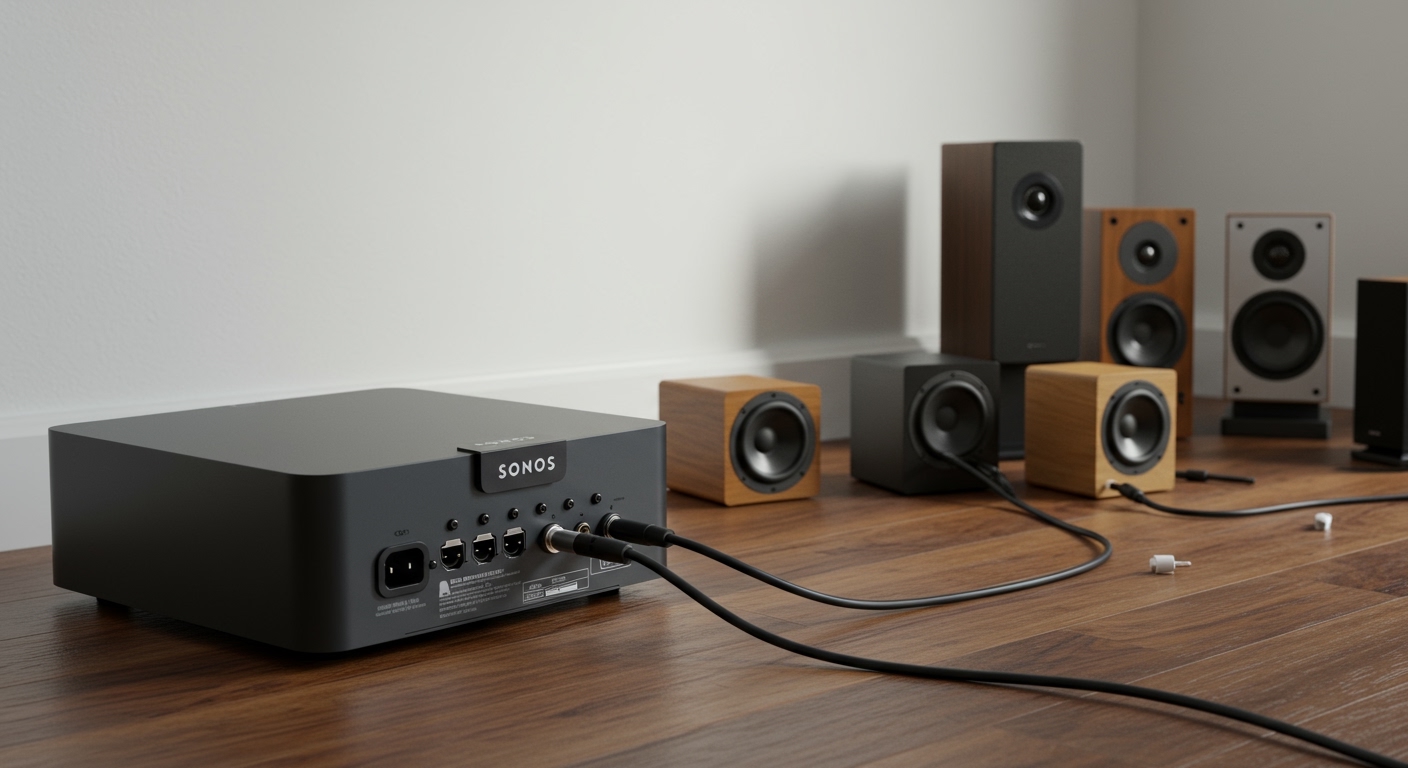
The number of speakers a Sonos Amp can power depends entirely on the speakers’ impedance, measured in ohms. A Sonos Amp can power two 8-ohm speakers in a standard setup, four 8-ohm speakers when wired correctly in parallel, or up to six specific Sonance Architectural speakers designed for this purpose.
Key Takeaways
- Standard Setup: A single Sonos Amp can safely power two passive speakers with a nominal impedance of 8 ohms.
- Expanded Setup: You can power up to four 8-ohm speakers by wiring two speakers in parallel to each of the Amp’s channels.
- Sonance Exception: The Amp can power up to six Sonos Architectural speakers by Sonance, as they are engineered to maintain a stable impedance load.
- Impedance is Critical: The speaker’s impedance (ohms) determines the electrical load on the amplifier. The Sonos Amp is stable down to a 4-ohm load.
- Do Not Mix: Never connect speakers with different impedance ratings to the same Sonos Amp.
Understanding the Sonos Amp’s Power and Specifications
Before we connect any wires, it’s crucial to understand what the Sonos Amp is capable of. Think of this as the foundation for designing your entire sound system. The specifications aren’t just numbers; they are the rules that govern how many speakers you can safely connect.
The Sonos Amp is rated to deliver 125 watts per channel into an 8-ohm load. This is a significant amount of clean power, capable of driving high-quality bookshelf, in-wall, in-ceiling, or outdoor speakers with authority and clarity.
- Watts Per Channel: This tells you the power output available for each speaker in a stereo pair (Left and Right). 125 watts is more than enough for most residential listening environments.
- Impedance (Ohms Ω): This is the most important factor. Impedance is the electrical resistance a speaker presents to the amplifier. A lower impedance means the speaker draws more current (power) from the amp. The Sonos Amp is designed to be stable with speaker loads as low as 4 ohms.
If the total impedance drops below 4 ohms, the Amp will try to deliver more current than it’s designed for. This can cause it to overheat and trigger its protection circuitry, shutting it down to prevent permanent damage.
How Many Speakers Can Sonos Amp Power? The Scenarios
The answer to how many speakers a Sonos Amp can power isn’t just one number. It depends on the speakers you choose and how you wire them. Let’s break down the three officially supported scenarios.
The Standard Setup: Two 8-Ohm Speakers
This is the most common and straightforward configuration. You can connect one passive speaker to the left channel and one to the right channel.
- Best For: High-quality stereo listening, bookshelf speakers, or a pair of tower speakers.
- Impedance Load: Each 8-ohm speaker presents an 8-ohm load to its respective channel, which is well within the Amp’s comfort zone.
- Performance: This setup allows the Sonos Amp to deliver its full 125 watts to each speaker, resulting in optimal performance, dynamic range, and clarity.
The Expanded Setup: Four 8-Ohm Speakers
This is where things get interesting for filling larger spaces or creating multi-speaker zones. You can connect four 8-ohm speakers to a single Sonos Amp.
To do this, you must wire two speakers in parallel to each channel. When you wire two 8-ohm speakers in parallel, their total impedance is halved, resulting in a 4-ohm load on the amplifier channel. Since the Sonos Amp is stable down to 4 ohms, this configuration is perfectly safe.
- Best For: Large living rooms, open-concept spaces, or outdoor patios where you want even sound distribution from four speakers.
- Impedance Load: Two 8-ohm speakers in parallel create a 4-ohm load.
- Performance: The total power (125 watts) of each channel is now shared between two speakers. While each speaker receives less power individually, the combined acoustic output of four speakers easily fills a large area with rich, ambient sound.
The Special Case: Six Sonance Architectural Speakers
Sonos has a unique partnership with Sonance to create a line of “Sonos Architectural” speakers (in-wall, in-ceiling, and outdoor). These speakers are specifically engineered to work with the Sonos Amp.
Because of their specific design, you can connect up to three pairs (six speakers total) in parallel to a single Sonos Amp. These speakers are designed to present a stable impedance load that the Amp can handle without issue.
- Best For: Creating a seamless, multi-speaker whole-home audio system with speakers that are acoustically and aesthetically matched.
- Key Benefit: When the Sonos Amp detects these specific Sonance speakers, it unlocks Trueplay™ tuning. This feature analyzes the room’s acoustics and optimizes the sound for that specific environment—a feature not available with third-party speakers.
Step-by-Step Guide: Wiring Multiple Speakers to Your Sonos Amp
Properly wiring your speakers is essential for safety and sound quality. From my experience setting up dozens of these systems, taking a few extra minutes to make









