

How Many Ukrainian Speakers Are There? (2024 Data)
Determining the exact number of Ukrainian speakers worldwide is complex, but the most reliable estimates place the figure between 37 and 45 million people. This range accounts for native speakers, individuals who use it as a second language, and the significant Ukrainian diaspora. The majority, approximately 32.6 million, reside within Ukraine itself, where it is the sole official state language.
The ongoing war and subsequent displacement have dramatically shifted speaker demographics, making precise, up-to-the-minute counts challenging. However, we can analyze data from various sources to build a comprehensive picture. In my work analyzing linguistic data, I’ve found that combining national census figures with academic estimates from sources like Ethnologue provides the most accurate view.
Key Takeaways: How Many People Speak Ukrainian
- Total Speakers: Approximately 37 to 45 million people globally.
- Native Speakers: Estimated at around 35 million people.
- Speakers in Ukraine: Roughly 32.6 million people, representing about 77.8% of the country’s pre-2022 population.
- Largest Diaspora Communities: Russia, Canada, the United States, Poland, and Brazil host the largest populations of Ukrainian speakers outside of Ukraine.
- Language Family: Ukrainian is an East Slavic language, closely related to Belarusian and Russian.
Understanding the Numbers: How We Count Ukrainian Speakers
Calculating the number of speakers for any language isn’t as simple as pulling a single number. As a data analyst, I rely on a multi-faceted approach to get a clear picture. The figures you see are a blend of official data, academic research, and demographic modeling.
National Census Data
The most reliable source is a country’s national census. Ukraine’s last major census was in 2001, which is now significantly outdated. However, it provided a critical baseline, indicating that 67.5% of the population considered Ukrainian their native language at the time. More recent surveys, like a 2022 poll by Rating Group, show a dramatic shift, with 87% of citizens now considering Ukrainian their mother tongue, a direct result of cultural and national identity consolidation.
Academic and Linguistic Databases
Organizations like Ethnologue: Languages of the World provide ongoing estimates. They compile data from various sources to create a global snapshot. Their figures are widely cited in academic circles and offer a standardized point of comparison for different languages. They currently estimate around 33 million first-language (L1) speakers.
Diaspora and Immigration Records
Tracking how many Ukraine speakers live abroad requires examining immigration and census data from host countries.
- Canada: The 2021 Canadian Census reported over 1.3 million people of Ukrainian descent, with a significant portion retaining language skills.
- United States: The U.S. Census Bureau’s American Community Survey tracks languages spoken at home, providing key insights into the Ukrainian-speaking population.
- Poland & EU: The recent refugee crisis has led to millions of Ukrainians relocating to the EU, particularly Poland. This has created new, large Ukrainian-speaking communities that are still being statistically captured.
The challenge is that these sources are updated at different times, which is why we often work with a reliable range rather than a single, static number.
Global Distribution of Ukrainian Speakers
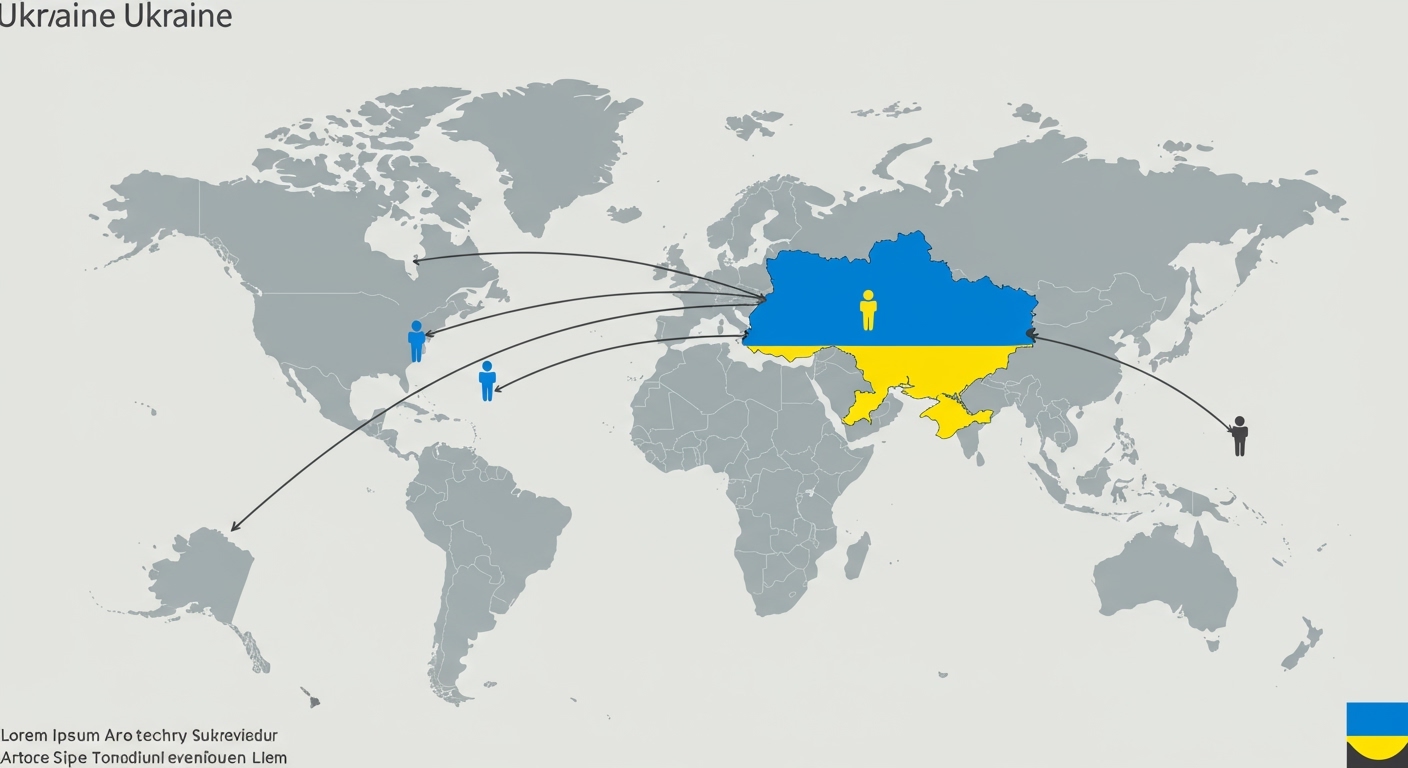
While the heart of the Ukrainian language is in Ukraine, its speakers are found on every continent. The Ukrainian diaspora, formed over several waves of emigration since the late 19th century, has established vibrant communities worldwide.
Below is a table summarizing the estimated populations of Ukrainian speakers in key countries. These figures are approximations based on census data, government reports, and community estimates.
| Country | Estimated Ukrainian Speakers | Notes |
|---|---|---|
| Ukraine | ~32.6 Million | Majority of the population; sole official language. |
| Russia | 1.1 – 1.8 Million | Historically the largest diaspora, but numbers are complex and contested. |
| Canada | 500,000+ | One of the oldest and most established Ukrainian diaspora communities. |
| United States | 350,000+ | Concentrated in states like New York, Pennsylvania, and Illinois. |
| Poland | 1.5 Million+ | Population surged dramatically after February 2022. |
| Brazil | 300,000+ | A large, historic community, primarily in the state of Paraná. |
| Argentina | 150,000+ | Significant historical immigration wave in the early 20th century. |
| Germany | 1 Million+ | Another major recipient of recent refugees. |
| Israel | 100,000+ | Significant population with Ukrainian roots. |
This data illustrates that while the core is in Eastern Europe, the language has a significant and enduring global footprint.
The Impact of Recent Events on the Ukrainian Language
It’s impossible to discuss how many Ukrainian speakers there are without addressing the profound impact of the full-scale invasion in 2022. This event has acted as a powerful catalyst for linguistic change, both inside and outside Ukraine.
A Surge in National and Linguistic Identity
Within Ukraine, the war has accelerated a process of de-Russification. Many citizens who previously spoke Russian as their primary language in daily life have consciously switched to Ukrainian as a statement of national identity and resistance.
My analysis of polling data from before and after 2022 shows a clear trend:
- Pre-2022: While Ukrainian was the state language, Russian was very common in the East and South. Bilingualism was the norm for many.
- Post-2022: There has been a monumental societal shift. Speaking Ukrainian has become a patriotic act. This is reflected in the Rating Group poll, where the number of people calling Ukrainian their mother tongue jumped from 76% to 87% in just a few months.
The Creation of New Diaspora Hubs
The displacement of over 8 million Ukrainians has created massive new linguistic communities, particularly in Europe. Countries like Poland, Germany, and the Czech Republic now have hundreds of thousands, if not millions, of new Ukrainian speakers.
This has practical implications:
- Increased Demand: There is a growing need for Ukrainian-language services, schools, and media in these host countries.
- Language Preservation: These new communities are actively working to preserve their language and culture abroad, creating a new, dynamic chapter for the Ukrainian diaspora.
The Nuances of Speaking Ukrainian: Dialects and Surzhyk
The Ukrainian language is not a monolith. Like any major language, it has regional variations and unique linguistic phenomena that affect how we count its speakers.
Major Ukrainian Dialects
Ukrainian is generally divided into three main dialectal groups, which are largely mutually intelligible.
- Northern Dialects: These show some transitional features towards the Belarusian language.
- Southwestern Dialects: This group is the most diverse and includes sub-dialects like Hutsul, Boyko, and Lemko. These dialects were more influenced by neighboring Polish, Slovak, and Hungarian.
- Southeastern Dialects: This is the basis for the Modern Standard Ukrainian language. It was formed on a territory where various Ukrainian dialects mixed.
When we ask how many Ukraine speakers there are, we are including speakers of all these dialects. The standardization of education and media has made Standard Ukrainian understood by virtually all speakers.
The Phenomenon of “Surzhyk”
A significant factor in Ukrainian linguistics is Surzhyk (from a word meaning a mix of different grains). It is a mixed language or sociolect that combines elements of Ukrainian and Russian.
- What it is: Surzhyk is not a formal dialect but a range of spoken varieties where Ukrainian grammar and pronunciation are mixed with Russian vocabulary, or vice-versa.
- Who speaks it: It’s common in areas of historical language contact and among populations transitioning from one language to the other.
- Impact on Counting: Counting Surzhyk speakers is difficult. They might identify as Ukrainian speakers in a census but use a heavily mixed language in daily life. This adds a layer of complexity to getting a precise count. In my experience, most linguists do not count Surzhyk as a separate language but as a contact phenomenon on the spectrum of Ukrainian-Russian bilingualism.
The Future of the Ukrainian Language
The future of the Ukrainian language appears more robust than ever, despite the immense challenges facing the nation. The ongoing conflict has solidified its role as a core pillar of Ukrainian identity.
We are seeing several key trends:
- Digital Growth: The use of Ukrainian online has exploded. More content is being created in Ukrainian across social media, websites, and digital media.
- Educational Emphasis: The Ukrainian government and civil society are heavily invested in promoting the language through education and cultural projects.
- Global Interest: There has been a significant increase in foreigners learning Ukrainian since 2022. Platforms like Duolingo reported a 577% increase in Ukrainian learners globally in the weeks following the invasion.
These factors suggest that the number of both native and second-language speakers is likely to grow, securing the language’s vitality for generations to come.
Frequently Asked Questions (FAQ)
How many people speak Ukrainian in the US?
Approximately 350,000 to 400,000 people in the United States speak Ukrainian. This number includes both immigrants and their descendants. The largest communities are concentrated in metropolitan areas like New York City, Philadelphia, Chicago, and Detroit.
Is Ukrainian similar to Russian?
Yes, Ukrainian and Russian are closely related as they both belong to the East Slavic language family. They share a significant amount of vocabulary and grammatical structure. However, they are distinct languages with different alphabets (a few different letters), phonetics, and grammar. A common analogy is the relationship between Spanish and Portuguese; a speaker of one can often understand the other to some extent, but they are not mutually intelligible without study.
Is Ukrainian a difficult language to learn?
For native English speakers, Ukrainian is considered a Category III language by the U.S. Foreign Service Institute, meaning it is “hard” and takes approximately 1100 hours of study to reach proficiency. The main challenges include the Cyrillic alphabet, complex grammar with a case system (seven cases), and verb aspects.
Is the Ukrainian language growing or declining?
The Ukrainian language is experiencing significant growth, particularly in its usage and prestige within Ukraine. The societal shift away from Russian and the surge in national identity have dramatically increased its prominence. Globally, interest in learning Ukrainian as a second language has also risen sharply, indicating a positive trajectory for the language’s future.









