The Ultimate Guide on How to Set Up Speakers in a Church
Are you constantly fighting screeching feedback during worship or struggling to understand the sermon through a wall of echo? You’re not alone. Many churches, both large and small, suffer from poor audio quality, which can distract from the message and hinder the worship experience. The problem often isn’t a lack of expensive gear, but a lack of knowledge on how to set up speakers in a church correctly.
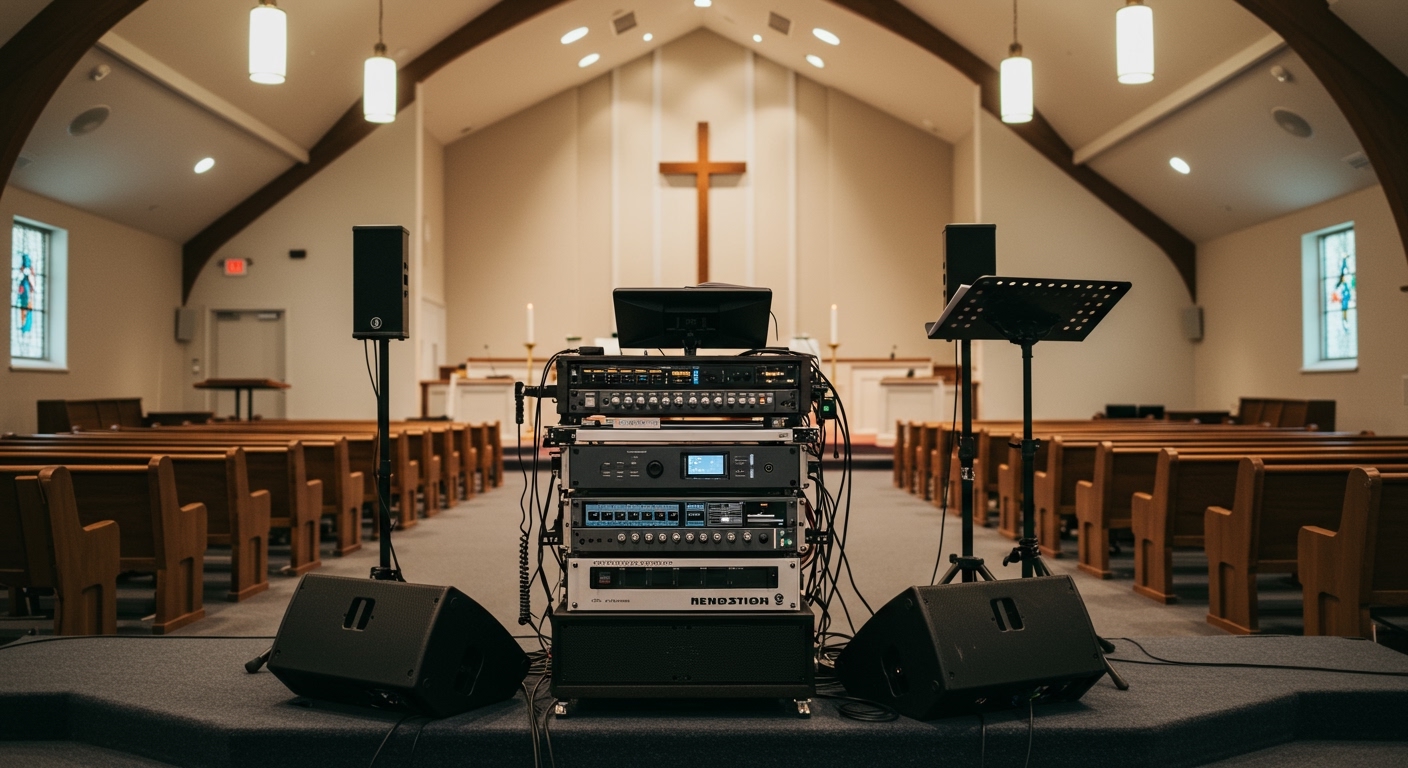
As a professional audio technician who has designed and tuned sound systems for dozens of houses of worship, I’ve seen firsthand how proper setup can transform a room. This comprehensive guide will give you the actionable, step-by-step process to achieve clear, intelligible, and inspiring sound in your sanctuary. We’ll move beyond theory and give you the practical steps our team uses every time.
Key Takeaways (TL;DR)
- Assess Your Space First: Before buying or moving anything, measure your room and understand its unique acoustic challenges, like high ceilings and reflective surfaces.
- Placement is Paramount: The position of your speakers is more important than their price tag. The goal is direct sound to the congregation’s ears, not to walls or ceilings.
- Choose the Right Tool: Select speakers based on your room size and worship style. Point source speakers are great for smaller rooms, while line arrays offer more control in larger spaces.
- Mono is Often Better for Speech: For sermon clarity in long, narrow rooms, a center cluster (mono) setup often outperforms a traditional stereo (Left/Right) configuration.
- Learn to Tune Your System: Proper gain staging and “ringing out” the room to eliminate feedback are non-negotiable skills for any church sound volunteer.
Understanding Your Church’s Unique Audio Needs
Before we touch a single cable, it’s crucial to understand why church sound is so difficult. Sanctuaries are often acoustic nightmares, designed for choirs and organs, not for modern sound reinforcement.
The Challenge: Acoustics and Architecture
Most churches feature hard, reflective surfaces like stone, hardwood, glass, and plaster. These materials cause sound waves to bounce around the room, creating excessive reverberation (reverb) and echoes. While this can sound beautiful for a choir, it wreaks havoc on the spoken word, making it sound muddy and unintelligible.
Our primary goal in a church speaker setup is to overcome the room’s natural acoustics. We want the congregation to hear more of the direct sound from the speakers and less of the reflected, bouncing sound from the room.
Defining Your Goal: Speech Clarity vs. Musical Impact
Your church’s worship style dictates your audio priorities.
- Speech-Dominant Services: If your service is primarily focused on the sermon, your number one goal is intelligibility. The entire system should be optimized to reproduce the human voice clearly and naturally.
- Music-Driven Services: If you have a contemporary worship band with drums, bass, guitars, and keyboards, you need a full-range system. This means you need speakers that can handle the low-end punch of a kick drum and bass guitar (subwoofers) as well as the crisp highs of cymbals and vocals.
Most churches need a balance of both. The good news is that a system designed for excellent speech clarity will almost always provide a great foundation for music.
Step 1: Assess Your Sanctuary and Existing Gear
You can’t map out a journey without knowing your starting point. This assessment phase is the most overlooked but most critical step.
Measure and Diagram Your Room
Get a tape measure and document your sanctuary’s dimensions:
- Length: From the back wall to the stage.
- Width: From side wall to side wall.
- Height: From the floor to the lowest point of the ceiling.
Note the location of key features like balconies, support pillars, and windows. A simple hand-drawn sketch is perfectly fine. This diagram will be your blueprint for deciding how to arrange speakers in a church.
Identify Acoustic Problem Zones
Walk around the room while someone is speaking from the pulpit. You can even use a pre-recorded sermon played through a single, temporary speaker.
- Listen for “Hot Spots”: Are there areas where the sound is uncomfortably loud or harsh? This is often directly in front of the speakers.
- Find the “Dead Spots”: Are there seats where the sound is muffled, quiet, or completely unintelligible? These are often under deep balconies or in the far corners.
- The “Clap Test”: Stand in the middle of the room and give a single, loud clap. Listen to how long the sound rings out. A long, echoing tail indicates high reverberation time (RT60), which is a major enemy of clarity.
In our work, we use professional software and measurement mics, but your ears are surprisingly effective tools for this initial assessment.
Step 2: Choose the Right Speakers for Your Church
If you’re upgrading your system, choosing the right type of speaker is essential. If you’re working with existing gear, understanding its capabilities and limitations is just as important.
Point Source vs. Line Array Speakers
This is the most fundamental choice in speaker systems.
- Point Source Speakers: This is the traditional “box” speaker you’re likely familiar with. They radiate sound in a wide pattern (e.g., 90° horizontal by 60° vertical). They are excellent for smaller to medium-sized rooms (typically under 75 feet deep) and are generally more budget-friendly. A pair of high-quality point source speakers like the QSC K12.2 or Yamaha DZR12 can cover a congregation of 100-300 people effectively.
- Line Array Speakers: These are the long, vertical columns of speakers you see at concerts and in large, modern churches. Their key advantage is precise control over vertical dispersion. They can project sound further with less volume drop-off over distance and can be “steered” to focus sound on the audience and away from ceilings and walls. They are the best solution for large, reverberant spaces but come with a higher cost and complexity.
| Speaker Type | Best For | Coverage Pattern | Cost | Complexity |
| :— | :— | :— | :— | :—