

What Is Quad Speakers? A Deep Dive into 4-Channel Audio
Ever felt that standard stereo sound, while good, is missing something? You hear music coming at you from the left and right, but you’re not truly inside it. This is the exact problem that quadraphonic sound was designed to solve. If you’re a music aficionado, a dedicated gamer, or simply curious about creating a more immersive audio environment, understanding what is quad speakers is your first step toward a revolutionary listening experience. It’s about more than just adding two extra speakers; it’s about fundamentally changing your relationship with sound by placing you directly in the center of the performance.
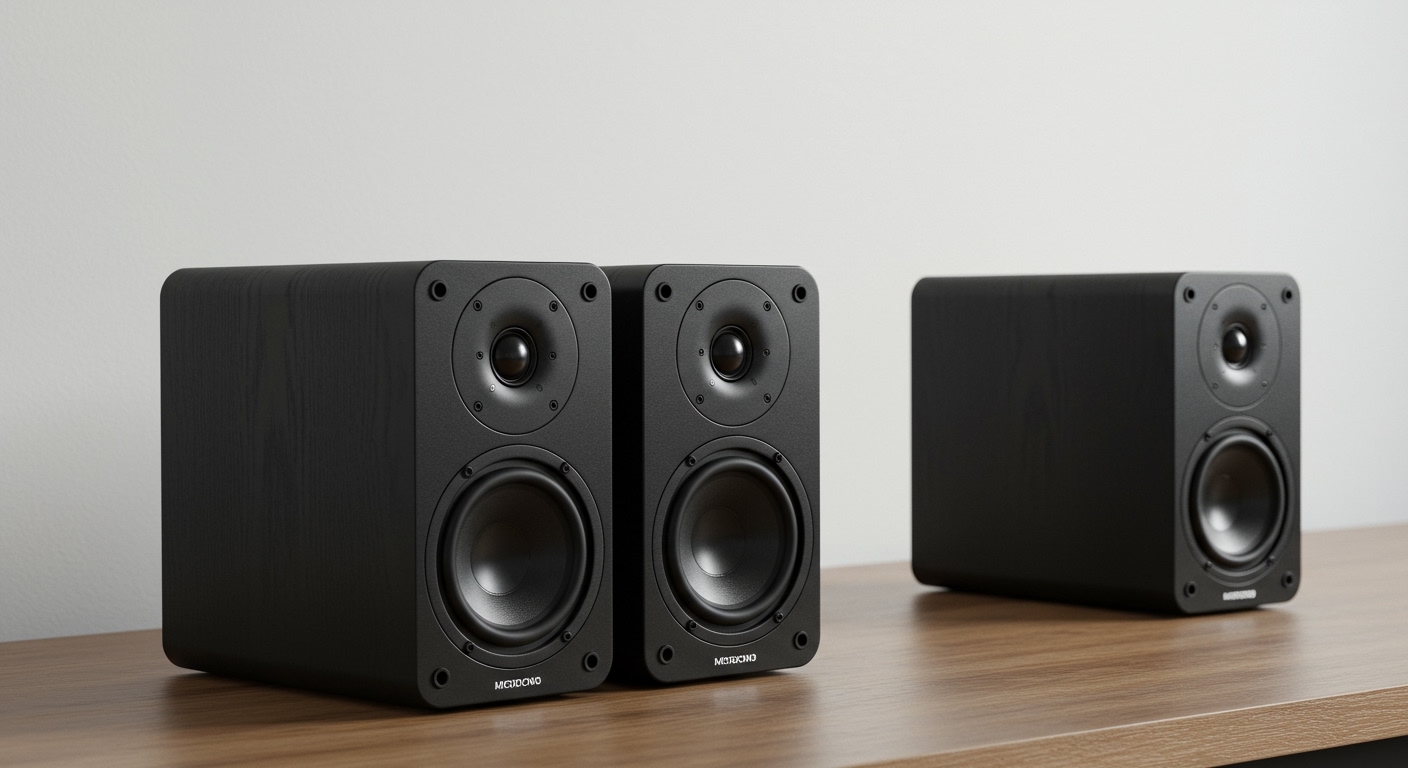
In this guide, we’ll break down everything you need to know. We’ll move beyond the simple definitions to explore how quadraphonic systems work, how to set one up perfectly, and how they stack up against modern surround sound. I’ve spent years experimenting with different audio setups, from basic stereo to complex Dolby Atmos, and the unique charm of a well-calibrated quad system for music is something every audiophile should experience.
TL;DR: Key Takeaways on Quad Speakers
- Core Concept: A quad speaker setup, also known as quadraphonic sound, uses four speakers and four discrete audio channels to create a 360-degree sound field. The speakers are typically placed in the four corners of a room.
- Primary Goal: Its main purpose is to immerse the listener in the sound, especially for music, making it feel like you are in the studio or concert hall with the performers.
- Not the Same as Surround Sound: While related, it’s different from 5.1 or 7.1 surround sound, which is primarily designed for movies and includes a dedicated center channel for dialogue and a subwoofer (the “.1”) for low-frequency effects.
- Requires Specific Gear: To experience true quadraphonic sound, you need a source material mixed in four channels, an amplifier or receiver capable of decoding and powering four channels, and four matched speakers.
- Modern Relevance: Though it peaked in the 1970s, quad audio is seeing a resurgence among audiophiles and gamers seeking a pure, immersive experience without the complexity of home theater systems.
Understanding the Fundamentals: What is Quad Speakers?
At its most basic, what is quad speakers refers to a four-channel audio system. Unlike a standard stereo setup which has two channels (left and right), a quadraphonic system has four:
- Front Left
- Front Right
- Rear Left
- Rear Right
This configuration allows sound engineers to place instruments, vocals, and ambient effects in any of the four corners, creating a “sound bubble” that envelops the listener. Imagine listening to a live recording where you can hear the band in front of you and the crowd’s applause coming from behind you. That’s the magic of quad sound.
A Brief History of Quadraphonic Sound
The concept isn’t new. Quadraphonic sound had its heyday in the 1970s, promoted as the next big thing after stereo. Major artists like Pink Floyd (The Dark Side of the Moon), The Who (Quadrophenia), and Santana released albums in quad formats on vinyl records.
However, the technology was ahead of its time. Competing and incompatible formats (SQ, QS, CD-4) confused consumers, and the high cost of the equipment made it a niche product. By the early 1980s, the market had largely moved on. But the idea never died, and its principles laid the groundwork for the modern surround sound systems we use today.
Quad Speakers vs. Stereo vs. Modern Surround Sound
One of the most common points of confusion is how quad differs from other common audio setups. As someone who has configured and tested all of these systems in my own listening room, the difference is distinct and purpose-driven.
Here’s a simple breakdown:
| Feature | Stereo (2.0) | Quadraphonic (4.0) | Surround Sound (5.1/7.1) |
|---|---|---|---|
| Speaker Count | 2 (Front Left, Front Right) | 4 (Front L/R, Rear L/R) | 6 to 8+ (Includes Center, Subwoofer) |
| Primary Use Case | Music Listening | Immersive Music, Gaming | Movies, TV Shows, Gaming |
| Key Advantage | Simplicity, wide availability | Total musical immersion | Dialogue clarity, explosive effects |
| Center Channel | No | No | Yes (for dialogue) |
| Subwoofer | Optional (2.1) | Optional (4.1) | Yes (the “.1”) |
| Source Material | Virtually all music | Niche (SACD, DVD-A, some vinyl) | Blu-ray, Streaming, Games |
The key takeaway is that quadraphonic sound is music-centric. It aims for a pure and balanced 360-degree musical field. Surround sound is movie-centric, using the center channel to anchor dialogue to the screen and the subwoofer to add dramatic, low-frequency impact.
How a Quad Speaker System Actually Works
Understanding the technology behind quad sound helps you appreciate what it takes to get it right. It’s not as simple as just plugging four speakers into any old amplifier.
The Four Discrete Channels
The heart of true quadraphonic sound is discreteness. Each of the four channels in the original recording is separate and intended for a specific speaker. This is different from “pseudo-surround” modes on some receivers that simply duplicate the front stereo signal to the rear speakers.
When a sound engineer mixes a track for quad, they can pan an instrument from the front-left speaker, across to the front-right, then have it fade into the rear-right, and finally re-emerge from the rear-left. This level of creative control is what creates the deeply immersive effect.
The Role of the Receiver or Amplifier
Your Audio/Video Receiver (AVR) or amplifier is the brain of the operation. To power a quad setup, it needs to be able to:
- Decode the 4-Channel Source: If you’re playing a vintage Quadraphonic vinyl or a modern SACD, the receiver needs to understand the format.
- Provide Four Amplified Channels: The receiver must have at least four built-in amplifiers, one for each speaker. Most modern 5.1 or 7.1 AVRs can easily be configured to run in a 4.0 or 4.1 “multi-channel stereo” mode, making them perfect for this.
In my own setup, I use a Denon AVR-X3700H. While it’s a 9.2 channel receiver, I can run it in a pure four-channel mode that dedicates high-quality power to just my four main speakers, which is ideal for critical music listening.
Finding Quadraphonic Source Material
This is often the biggest challenge. You can have the best equipment in the world, but if you’re playing a standard stereo track, you won’t get a true quad experience. You need media that was specifically mixed for four channels.
- Vintage Media: Quadraphonic 8-track tapes and vinyl records from the 1970s. These are collectors’ items and require specialized playback equipment.
- Modern Physical Media: Super Audio CDs (SACDs) and DVD-Audio (DVD-A) discs often feature 4.0 or 5.1 channel mixes. Many classic rock and jazz albums have been re-released in these high-resolution formats.
- Digital Files: You can find quadraphonic mixes in digital formats like FLAC or DTS. Websites and communities dedicated to surround sound music are a great resource.
- Gaming: Many modern video games have sophisticated audio engines that output in 5.1 or 7.1. By disabling the center channel in your console or PC’s audio settings, you can create an excellent 4.0 or 4.1 quad-like experience that enhances spatial awareness.
Step-by-Step Guide to Setting Up Your Quad Speaker System
Building a quad system is a rewarding project. I remember the first time I properly calibrated my four-speaker setup and played the quad mix of Pink Floyd’s “Money”—the cash register sounds swirled around the room, and it was a genuine “wow” moment. Here’s how you can achieve that.
Step 1: Choose Your Components
- Speakers: The golden rule is to use four speakers that are as identical as possible, or at least from the same brand and series. This ensures timbre-matching, meaning the sonic character of each speaker is the same. Using mismatched speakers can be jarring as sound moves around the room. You can use either bookshelf speakers or floor-standing (tower) speakers.
- Receiver/Amplifier: Look for a modern AVR with at least 5.1 channels. This gives you the flexibility to run a 4.0 setup and potentially add a subwoofer later for a 4.1 system. Key features to look for are “Multi-Channel Stereo” or “All-Zone Stereo” modes and a good room correction system like Audyssey or Dirac Live.
- Speaker Wire: Don’t skimp here. Get a decent gauge of speaker wire (14 or 16-gauge is fine for most rooms) to ensure a clean signal path.
Step 2: Master Speaker Placement
Placement is 80% of the battle for great sound. The goal is to create a perfect square or rectangle with your listening position (the “sweet spot”) at the exact center.
- Front Speakers: Place the front left and right speakers on either side of your TV or listening area. They should form an equilateral triangle with your head. The distance between the speakers should be equal to the distance from each speaker to your ears.
- Rear Speakers: Place the rear left and right speakers behind you, at the same distance from your listening position as the front speakers. They should be positioned at a 110-120 degree angle from the center.
- Height: The tweeters (the small drivers that produce high-frequency sounds) on all four speakers should be at ear-level when you are seated. This is critical for creating a seamless sound field.
Use a tape measure to get this right. Even a few inches can make a difference in the immersiveness and stereo imaging.









