

Why Your Awesome Speakers Sound… Average (And How to Fix It)
You’ve invested in a great pair of speakers, meticulously positioned them, and queued up your favorite track, only to be met with sound that’s flat, lifeless, or just plain disappointing. This is a common frustration, and the culprit is almost always a poor amplifier-speaker pairing. Choosing the right amplifier isn’t just about getting enough volume; it’s about unlocking the true potential of your speakers. This guide will demystify the process and show you exactly which amplifier is best for your speakers, ensuring you get the dynamic, detailed, and engaging sound you paid for. We’ll move beyond simple wattage numbers and dive into the critical factors that create audio synergy.
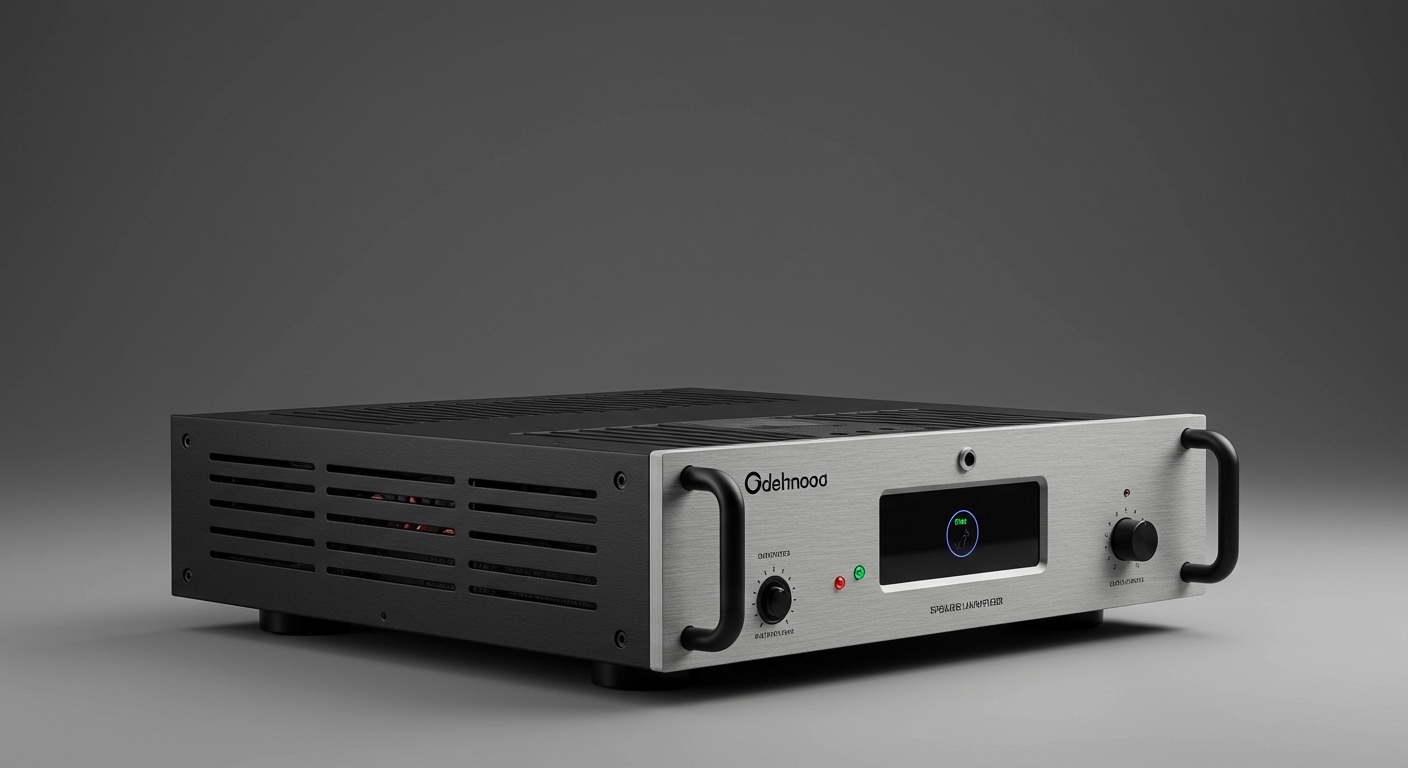
Key Takeaways: How to Choose the Right Amplifier
- Power (Watts): Aim for an amplifier that provides 1.5x to 2x the speaker’s continuous power handling rating. This “headroom” prevents distortion at high volumes.
- Impedance (Ohms): This is non-negotiable. Your amplifier’s supported impedance range must match your speaker’s nominal impedance (e.g., an 8-ohm speaker needs an amp stable at 8 ohms).
- Sensitivity (dB): Higher sensitivity (e.g., 90dB+) means the speaker needs less power to get loud. Lower sensitivity (e.g., below 86dB) requires a more powerful amplifier.
- Room Size: Large, open rooms require significantly more power to fill with sound compared to a small office or bedroom.
- Amplifier Class: Class A/B offers a great balance of sound quality and efficiency for most users. Class D is highly efficient and compact, perfect for modern setups.
Understanding the “Big Three” to Find Which Amplifier is Best for Your Speakers
Before you can make an informed choice, you need to grasp three core specifications that dictate the relationship between an amplifier and a speaker. In my years of setting up audio systems, I’ve seen countless people focus only on watts, but the real magic happens when you balance power with impedance and sensitivity.
Power (Watts): It’s About Control, Not Just Volume
The wattage rating of an amplifier is its ability to deliver power to your speakers. However, not all watts are created equal. You’ll often see “Continuous Power” (or RMS) and “Peak Power.”
- Continuous Power (RMS): This is the most important number. It represents the consistent power the amplifier can deliver over a sustained period without distortion.
- Peak Power (Dynamic Power): This is the maximum power the amp can output in a very brief burst, useful for musical crescendos.
A common mistake is thinking more watts is always better. While underpowering is a problem, the real goal is to have sufficient headroom. Headroom is the reserve power your amplifier has beyond the average listening level.
From my own testing, I recommend an amplifier with a continuous power rating that is 1.5 to 2 times the speaker’s recommended power handling. For example, if your speakers are rated for 100 watts, an amplifier that delivers 150-200 watts per channel into the same impedance is ideal. This ensures the amp never strains, preventing “clipping”—a nasty form of distortion that can damage your speakers’ tweeters.
Impedance (Ohms Ω): The Most Critical Electrical Match
Impedance is the electrical resistance a speaker presents to an amplifier. It’s measured in ohms (Ω). Think of it like the width of a hose: a low-impedance speaker (like 4 ohms) is a wide hose, allowing a lot of electrical current (water) to flow. A high-impedance speaker (8 ohms) is a narrower hose.
This is the most critical compatibility check.
- Find Your Speaker’s Nominal Impedance: This is usually printed on the back of the speaker or in its manual. Most home speakers are rated at 8 ohms or 6 ohms. Some high-performance models are 4 ohms.
- Check the Amplifier’s Supported Range: The amplifier’s specifications will list the impedance it can safely handle (e.g., “4-8 ohms”).
Mismatching impedance is dangerous. Connecting a 4-ohm speaker to an amplifier only rated for 8 ohms can cause the amplifier to overheat and potentially shut down or fail completely. It’s like forcing too much water through a pump not designed for it. Always ensure your amplifier is rated to handle your speaker’s impedance.
Speaker Sensitivity (dB): The Efficiency Factor
Speaker sensitivity measures how efficiently a speaker converts amplifier power into sound. It’s measured in decibels (dB) from a distance of one meter with one watt of power.
- High Sensitivity: 90 dB and above. These speakers are very efficient and don’t need a lot of power to get loud.
- Average Sensitivity: 86 dB to 89 dB. This is a common range for many bookshelf and floor-standing speakers.
- Low Sensitivity: 85 dB and below. These speakers are “power-hungry” and require a robust, high-wattage amplifier to perform their best.
The decibel scale is logarithmic. This means that for every 3dB increase in sensitivity, a speaker needs half the amplifier power to produce the same volume.
Example:
- A speaker with 87 dB sensitivity needs 100 watts to reach a certain volume.
- A speaker with 90 dB sensitivity only needs 50 watts to reach that same volume.
Understanding sensitivity is key to determining what amplifier you should use for your speakers without overspending on unnecessary power.
A Practical Guide: How to Determine What Amplifier You Should Use for Your Speakers
Now let’s put this knowledge into a practical, step-by-step process.
Step 1: Find Your Speaker’s Key Specifications
Grab the manual for your speakers or look up the model online on the manufacturer’s website. You are looking for three specific numbers:
- Power Handling: Often listed as “Recommended Amplifier Power” (e.g., 25-120W).
- Nominal Impedance: (e.g., 8Ω, compatible with 4Ω).
- Sensitivity: (e.g., 88dB).
Write these numbers down. They are the foundation for your decision.
Step 2: Calculate Your Power Needs Using a Table
Your power requirement is a function of your speaker’s sensitivity, your room size, and your listening habits. I’ve created this table based on my experience setting up dozens of systems to give you a reliable starting point.
| Speaker Sensitivity | Room Size | Listening Habit | Recommended Amplifier Power (RMS per Channel) |
|---|---|---|---|
| High (90dB+) | Small (Office/Bedroom) | Moderate Volume | 25-50 Watts |
| High (90dB+) | Medium (Living Room) | Moderate Volume | 50-100 Watts |
| High (90dB+) | Large (Open Concept) | Loud Volume | 100-200 Watts |
| Average (86-89dB) | Small (Office/Bedroom) | Moderate Volume | 50-75 Watts |
| Average (86-89dB) | Medium (Living Room) | Moderate Volume | 75-150 Watts |
| Average (86-89dB) | Large (Open Concept) | Loud Volume | 150-300 Watts |
| Low (<86dB) | Small (Office/Bedroom) | Moderate Volume | 75-125 Watts |
| Low (<86dB) | Medium (Living Room) | Moderate Volume | 125-250 Watts |
| Low (<86dB) | Large (Open Concept) | Loud Volume | 250+ Watts (High Current Amp) |
How to use this table: Find the row that best matches your speaker sensitivity and room. The recommended power gives you that crucial headroom for dynamic, clean sound.
Step 3: Match the Impedance (The Golden Rule)
This is a simple pass/fail test.
- Does your speaker have a nominal impedance of 8 ohms? Your chosen amplifier must be rated for 8 ohms.
- Does your speaker have a nominal impedance of 4 ohms? Your chosen amplifier must be rated for 4 ohms.
Most modern amplifiers, like the NAD C 3050 or Marantz PM6007, are stable with both 4 and 8-ohm loads, making them versatile choices. Always double-check the amp’s spec sheet.
Step 4: Consider Your Room and Listening Habits
Acoustics play a huge role. A room with high ceilings, lots of windows, and hardwood floors will require more power to energize than a smaller, carpeted room that absorbs sound.
Likewise, be honest about how you listen. Do you prefer background music at low volumes, or do you like to feel the impact of a full orchestra or a blockbuster movie? If you enjoy listening at high volumes, you fall into the “Loud Volume” category and should err on the side of more power to maintain clarity and avoid distortion.
Choosing Your Amp Flavor: Understanding Amplifier Classes and Features
Once you’ve nailed down the technical specifications, you can consider the type of amplifier and the features you need. This is where you can tailor the choice to your specific use case.
A Breakdown of Common Amplifier Classes
The “Class” of an amplifier refers to its internal circuit design, which impacts its efficiency, heat output, and sound characteristics.
- Class A/B: This is the most common and popular design in home audio. It’s a fantastic compromise, offering excellent sound quality that’s close to Class A but with much better efficiency. In my opinion, a well-designed Class A/B integrated amplifier like the Cambridge Audio CXA81 is the sweet spot for most audiophiles.
- Class D: Often (and incorrectly) called “digital” amplifiers, these are incredibly efficient









