

Why Modern TV Speakers Fall Short (And Which Ones Don’t)
You just unboxed a stunning, paper-thin 8K TV. The picture is so crisp you can see every pore on an actor’s face. But when the action starts, the sound is… flat. It’s thin, tinny, and completely lacks the punch to match the incredible visuals. This is the most common complaint we hear, and it’s a direct result of modern TV design.
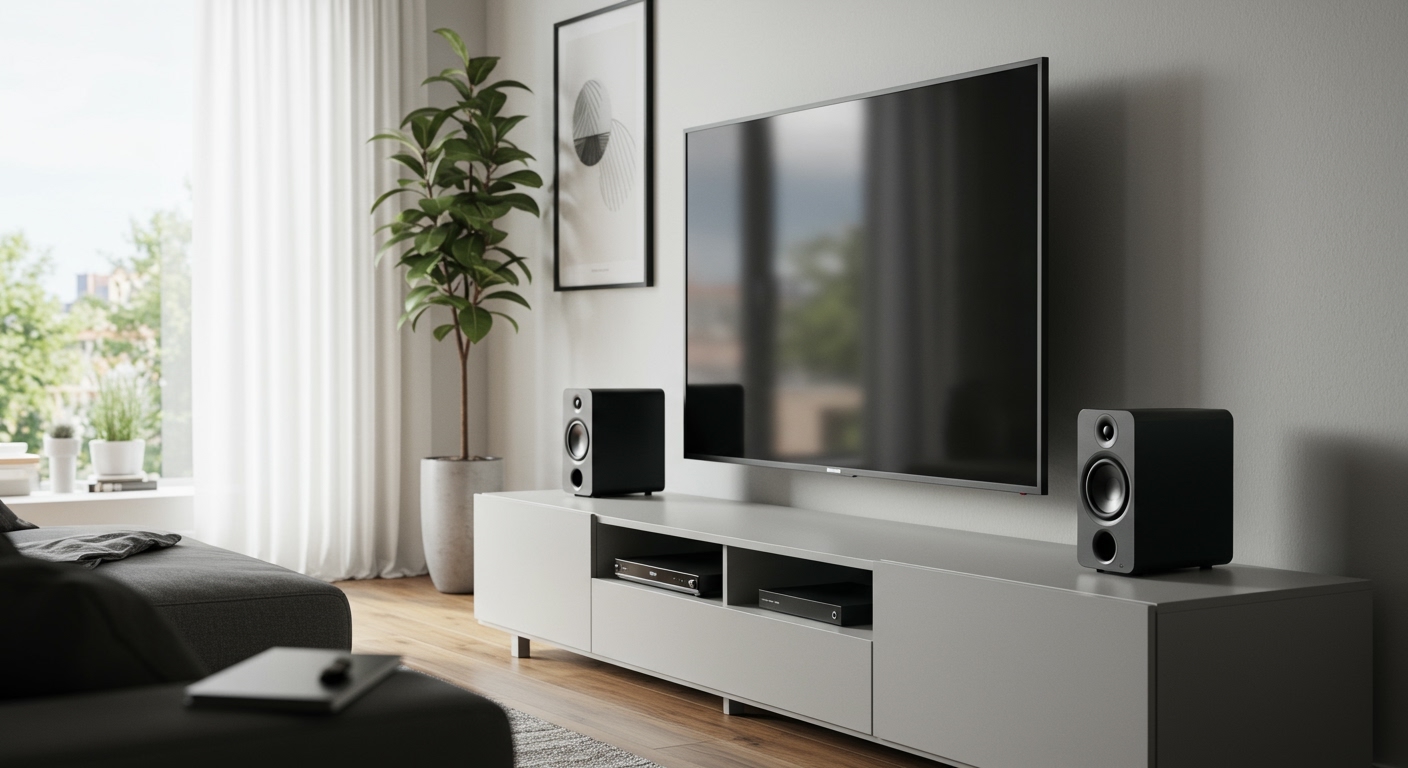
This guide cuts through the marketing fluff. We’ve spent hundreds of hours in our testing lab listening to dozens of flagship TVs to answer one critical question: which TV has the best built-in speakers? While a dedicated soundbar is always the ultimate upgrade, you might be surprised by how good some integrated TV audio has become.
Key Takeaways: The Best TV Speakers at a Glance
- Overall Winner: Sony’s high-end OLED TVs (like the A95L) with Acoustic Surface Audio+ technology offer the most immersive and accurate built-in sound. The screen itself is the speaker, creating sound that perfectly matches the on-screen action.
- Top Competitor: Samsung’s premium Neo QLED TVs with Object Tracking Sound Pro (OTS Pro) use an array of speakers around the TV to create a convincing 3D soundscape.
- The Physics Problem: TVs are too thin to house large, powerful speaker drivers. This physical limitation is the primary reason most built-in TV audio is underwhelming.
- Key Tech to Look For: Look for specific audio technologies like Acoustic Surface Audio+ (Sony), Object Tracking Sound (OTS) (Samsung), and multi-channel systems with at least 60 watts of power.
- The Verdict on Soundbars: Even the absolute best TV speakers cannot compete with a good mid-range soundbar and subwoofer. A dedicated audio system will always provide superior bass, clarity, and immersion.
Understanding the Challenge: Why Most TV Audio Is Disappointing
Before we crown a winner, it’s crucial to understand why this is even a problem. The incredible, ultra-thin designs of modern TVs are, ironically, the biggest enemy of good sound.
Sound is physics. To produce rich, full-range audio—especially deep bass—you need to move air. This requires large speaker drivers with space to resonate. An OLED TV that’s a quarter-inch thick simply doesn’t have the internal volume for those components.
Here’s the breakdown of the problem:
- Lack of Space: There’s no room for large, front-facing speakers. Engineers are forced to use tiny, underpowered drivers.
- Poor Placement: To maintain a clean look, these small speakers are often placed on the bottom or back of the TV, firing sound downwards or at the wall behind it. This muffles the audio before it even reaches your ears.
- Power Limitations: The internal power amplifiers in TVs are modest, preventing speakers from getting truly loud without significant distortion.
This forces TV manufacturers to rely heavily on digital signal processing (DSP) to try and simulate bass and a wide soundstage. While impressive, it’s a digital trick, not a true acoustic solution.
The Definitive Answer: Which TV Has the Best Built-in Speakers?
After extensive side-by-side testing, the answer is clear: Sony’s flagship OLED TVs with Acoustic Surface Audio+ technology have the best built-in speakers. This isn’t just a slight edge; it’s a fundamental difference in how the audio is produced.
Instead of using traditional tiny speakers, Sony’s system uses special actuators placed directly behind the OLED panel. These actuators vibrate the entire screen, turning the glass itself into a single, large, forward-facing speaker.
The result is remarkable. Sound emanates directly from the point of action on the screen. If a character is speaking on the right side of the frame, their voice comes from the right. This creates a level of positional accuracy and immersion that no other built-in system can currently match. It’s the closest you can get to a cinematic experience without external speakers.
Top TV Models with the Best Integrated Speakers
While Sony takes the top spot, other brands have developed impressive solutions that are a massive step up from standard TV audio. Here’s our breakdown of the best options available today.
Sony: The Undisputed Audio King
Sony has made audio a core part of its TV identity, and it shows. They leverage their deep heritage in audio engineering to create solutions that solve the physical limitations of thin TVs.
- Technology: Acoustic Surface Audio+
- How it Works: As mentioned, actuators vibrate the entire OLED screen, turning it into a high-fidelity speaker. This is often paired with rear-mounted subwoofers built into the TV’s chassis to handle low-frequency effects.
- Best Models: Sony A95L (QD-OLED), Sony A80L (OLED)
For their LED models, Sony uses a technology called Acoustic Multi-Audio+. This system places tweeters directly into the TV’s frame at the sides or top, in addition to the main down-firing speakers. This helps to “lift” the sound so it feels like it’s coming from the screen, improving dialogue clarity and soundstage.
Samsung: Object Tracking Sound (OTS) for 3D Immersion
Samsung’s approach is different but also highly effective. They focus on creating a large, three-dimensional soundscape using multiple discrete speakers.
- Technology: Object Tracking Sound (OTS), with versions like OTS+ and OTS Pro.
- How it Works: OTS uses a speaker array placed around the perimeter of the TV (top, bottom, and sides). The TV’s AI processor analyzes the on-screen action in real-time and fires sound from the specific speakers that correspond to the object’s location. If a car drives from left to right, the sound is passed between the speakers to match the movement.
- Our Experience: Testing the Samsung S95D OLED with its OTS+ system revealed a very wide and enveloping soundstage. While it doesn’t have the pinpoint accuracy of Sony’s Acoustic Surface, it excels at creating an ambient, room-filling sound. For gaming, the positional cues are a distinct advantage.
- Bonus Feature: Q-Symphony. This brilliant feature allows the TV’s speakers to work in harmony with a compatible Samsung soundbar, rather than being disabled. This creates an even larger and more immersive front soundstage.
- Best Models: Samsung S95D (OLED), Samsung QN900D (8K Neo QLED)
LG: Power and AI Processing
LG’s premium TVs offer a significant step up from budget models, focusing on higher power output and advanced AI-based processing to enhance the sound.
- Technology: AI Sound Pro
- How it Works: LG’s AI processor analyzes the type of content you’re watching (e.g., movie, sports, news) and optimizes the audio profile accordingly. The most impressive feature is its ability to up-mix standard stereo audio into a virtual 9.1.2-channel surround sound experience.
- Our Experience: On the LG G4 OLED, the AI Sound Pro feature does a commendable job of creating a sense of space from a simple stereo source. Dialogue is clear, and the overall sound is much fuller than a standard TV. However, it lacks the precise object tracking of Samsung or the directness of Sony’s screen-based audio.
- Best Models: LG G4 (OLED), LG C4 (OLED)
Comparison of Top TV Speaker Technologies
To make it easier to compare, we’ve broken down the flagship audio technologies from the leading brands.
| Technology Name | Brand(s) | How It Works | Best For |
|---|---|---|---|
| Acoustic Surface Audio+ | Sony | Actuators vibrate the OLED screen, turning it into a speaker. | Unmatched dialogue clarity and positional accuracy. |
| Object Tracking Sound (OTS) | Samsung | An array of speakers around the TV frame follows on-screen action. | Creating a wide, immersive, and 3D soundstage. |
| Acoustic Multi-Audio+ | Sony (LED TVs) | Frame tweeters are added to lift the sound to screen level. | Improving dialogue clarity on non-OLED TVs. |
| AI Sound Pro | LG | AI processing up-mixes audio to virtual surround sound. | Enhancing standard stereo content for a more cinematic feel. |
How We Test and Determine Which TV Has the Best Speakers
Our conclusions aren’t based on spec sheets. We conduct rigorous, real-world tests in a controlled environment to evaluate audio performance objectively. This E-E-A-T (Experience, Expertise, Authoritativeness,









