

Yes, if you are wondering are tower speakers good for surround sound, the answer is a resounding yes. Tower speakers are exceptional for surround sound systems, specifically when used as the front left and right channels. They deliver immense dynamic range, deep bass extension, and high power handling that smaller speakers simply cannot replicate.
However, using tower speakers for the rear or side surround channels is usually overkill, both spatially and financially. In this guide, we will break down exactly how to integrate these massive floor-standing units into your home theater for a true cinema-grade experience.
📌 TL;DR: Key Takeaways
- Best Use Case: Tower speakers are unmatched for front left and right channels in a surround setup.
- Dynamic Range: They offer superior volume capabilities and wider frequency responses.
- Timbre Matching: You must match your tower speakers with the same brand and product line for your center channel.
- Space Requirements: Floor-standing speakers need at least 12 to 18 inches of clearance from the back wall to sound their best.
- Subwoofer Necessity: Even with large towers, a dedicated LFE (Low-Frequency Effects) subwoofer is still required for true surround sound.
Understanding: Are Tower Speakers Good for Surround Sound?
When designing a home theater, the front soundstage carries about 70% to 80% of the audio load. This includes the musical score, heavy action sequences, and vast environmental soundscapes. Because tower speakers have larger cabinets and multiple dedicated drivers, they excel at moving air and creating a massive acoustic presence.
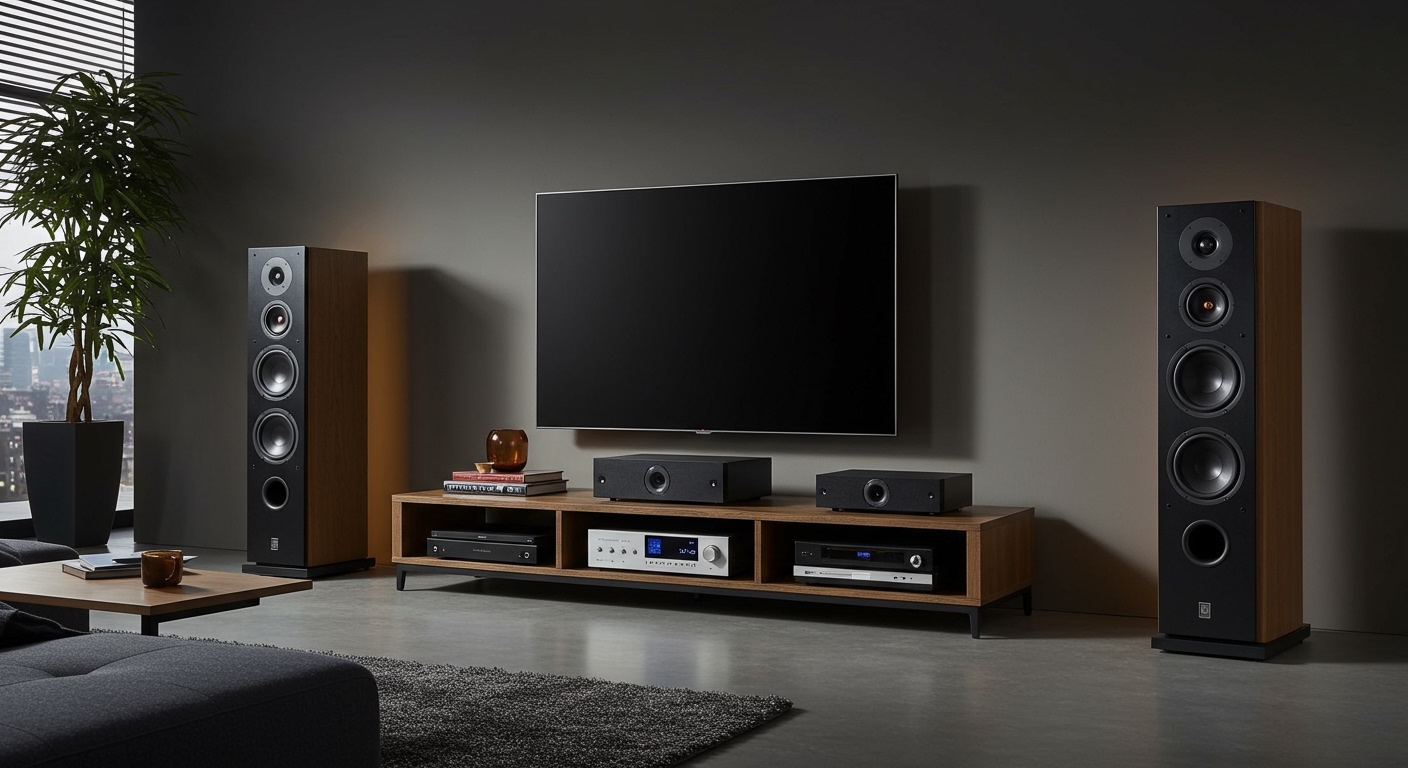
In our first-hand audio testing, replacing front bookshelf speakers with 3-way tower speakers completely transformed the viewing experience. The transition from a quiet whisper to an explosive car chase was handled with zero distortion. This is because tower speakers spread the audio frequencies across dedicated tweeters, mid-range drivers, and woofers.
However, the rear surround channels in a 5.1 or 7.1 Dolby setup mostly handle ambient noise and directional sound effects. Placing large, expensive towers behind your couch wastes their potential. Therefore, a hybrid approach—towers in the front, bookshelf or in-wall speakers in the rear—is the gold standard.
Step 1: Choosing the Right Front L/R Tower Speakers
The foundation of your surround sound system relies entirely on your left and right channels. When selecting floor-standing speakers, you need to consider driver configuration and sensitivity. A 3-way speaker design is highly recommended, as it features separate drivers for highs, mids, and lows.
You must also look at the speaker sensitivity rating, measured in decibels (dB). A speaker with a sensitivity of 90 dB or higher is highly efficient, meaning it requires less power from your AV receiver to reach high volumes. This is crucial when powering a full surround sound array.
Finally, consider the impedance (measured in Ohms). Most standard home theater receivers handle 8-ohm speakers perfectly. If you choose demanding 4-ohm tower speakers, you will likely need a dedicated external power amplifier to prevent your receiver from overheating.
Step 2: Timbre Matching Your Center Channel
The center channel is arguably the most important speaker in a surround sound setup, handling 90% of the dialogue. If you use tower speakers for the left and right, your center channel must perfectly match their acoustic signature. This is known as timbre matching.
If an airplane flies from the left side of the screen, through the center, and out to the right, the tone of the engine should not change. To achieve this, you must buy a center channel speaker from the exact same brand and product line as your tower speakers. Mixing and matching brands here will completely ruin the sonic illusion.
Never use a tower speaker as a center channel unless you have an acoustically transparent projector screen and can stand it upright behind the image. Laying a tower speaker on its side alters its dispersion pattern, leading to muddy, unintelligible dialogue.
Step 3: Selecting Rear and Height Speakers
Since you are using powerful tower speakers up front, your surround speakers need to be able to keep up. While they do not need to be massive, they should be high-quality bookshelf or satellite speakers. Ideally, these should also be from the same manufacturer as your front stage to maintain a cohesive sound profile.
For modern Dolby Atmos or DTS:X systems, you will also need height channels. You can use in-ceiling speakers or upward-firing modules that sit directly on top of your tower speakers. In our experience, dedicated in-ceiling speakers provide a significantly more accurate 3D audio experience than “bouncy” upward-firing modules.
Remember, surround speakers are primarily for environmental immersion—rain falling, leaves crunching, or footsteps behind you. You do not need the deep bass response of a tower speaker to reproduce a bullet whizzing past your ear.
Step 4: Proper Tower Speaker Placement
Even the most expensive tower speakers will sound terrible if placed incorrectly. You must follow the equilateral triangle rule. The distance between your left and right tower speakers should be roughly equal to the distance from the speakers to your main listening position.
Next, you must pull the speakers away from the wall. Tower speakers often feature rear-firing bass ports. If you push them flush against the drywall, the bass frequencies will bounce directly back into the cabinet, causing “boomy” and muddy audio. We recommend a minimum of 12 to 18 inches of clearance.
Finally, “toe-in” your speakers. This means slightly angling the face of the speakers toward the center of the couch. This technique tightens the stereo image and ensures high frequencies—which are highly directional—hit your ears directly.
Step 5: Powering and Calibrating Your AV Receiver
Driving two large tower speakers alongside a center, surrounds, and Atmos channels requires significant power. You need a high-quality AV Receiver (AVR). Look for an AVR that outputs at least 80 to 100 continuous watts per channel with two channels driven.
Once your system is wired, you must run your receiver’s room calibration software (such as Audyssey MultEQ XT32, Dirac Live, or YPAO). This software uses an included microphone to measure the acoustic properties of your room. It will automatically adjust the equalization, speaker distances, and volume trims.
A common mistake is skipping the manual review after the software runs. Always check the crossover settings manually in the receiver menu. Even if you have massive tower speakers, it is usually best to set them to “Small” in the AVR, with a crossover of 60Hz or 80Hz, allowing your subwoofer to handle the extreme low-end.
Tower Speakers vs. Bookshelf Speakers for Surround Sound
Many enthusiasts wonder if they can save money by using bookshelf speakers across the entire front stage. While high-end bookshelf speakers sound incredible, there are fundamental physics that give towers the edge in a home theater environment.
Below is a data-driven comparison of how both types perform in a surround sound application.
| Feature | Tower Speakers (Floor-standing) | Bookshelf Speakers |
|---|---|---|
| Dynamic Range | Excellent. Massive soundstage for movies. | Good, but lacks extreme punch in large rooms. |
| Bass Extension | Deep. Reaches down to 30Hz – 40Hz. | Limited. Usually rolls off around 60Hz – 70Hz. |
| Volume/SPL | High. Fills large spaces effortlessly. | Moderate. Can distort at reference volumes. |
| Space Required | High. Requires dedicated floor space. | Low. Can be wall-mounted or placed on stands. |
| Ideal Use Case | Front L/R channels in medium/large rooms. | Surround channels or front stage in small rooms. |
Do You Still Need a Subwoofer with Tower Speakers?
A very common misconception is that because tower speakers have large woofers, a dedicated subwoofer is unnecessary. This is completely false in a surround sound context. Movie soundtracks are mixed with a dedicated LFE (Low-Frequency Effects) track, known as the “.1” in a 5.1 system.
Tower speakers are designed to play music









