

Wondering, are tower speakers worth it for your home audio setup? The direct answer is yes: tower speakers are absolutely worth the investment if you have a medium-to-large room, crave deep, chest-thumping bass without relying on a separate subwoofer, and want a massive, immersive soundstage. However, for small rooms or extremely tight budgets, high-quality bookshelf speakers might actually be a smarter choice.
As an audio professional who has spent over a decade testing hundreds of hi-fi setups, I can tell you that buying floorstanding speakers is a significant commitment of both space and money. This step-by-step guide will help you evaluate your room, budget, and listening habits to determine if making the jump to large floorstanders is the right move for your home.
TL;DR / Key Takeaways
- Massive Soundstage: Tower speakers offer unparalleled acoustic scale, making music and movies feel larger than life.
- Superior Bass Response: Larger cabinets and multiple dedicated bass drivers eliminate the immediate need for a subwoofer in many setups.
- Higher Efficiency: Floorstanders generally boast higher sensitivity ratings, meaning they produce more volume with less amplifier power.
- Room Size Matters: They thrive in rooms larger than 150 square feet; in smaller spaces, they can cause muddy, overwhelming bass.
- Cost vs. Performance: While more expensive upfront, they eliminate the immediate need to purchase speaker stands and entry-level subwoofers.
Are Tower Speakers Worth It? A Step-by-Step Evaluation Guide
Choosing audio gear is highly subjective, but physics and room acoustics are not. To answer the question of whether are tower speakers worth it for your specific situation, you need to systematically evaluate your environment and goals. Follow these steps to make a highly informed, data-backed decision.
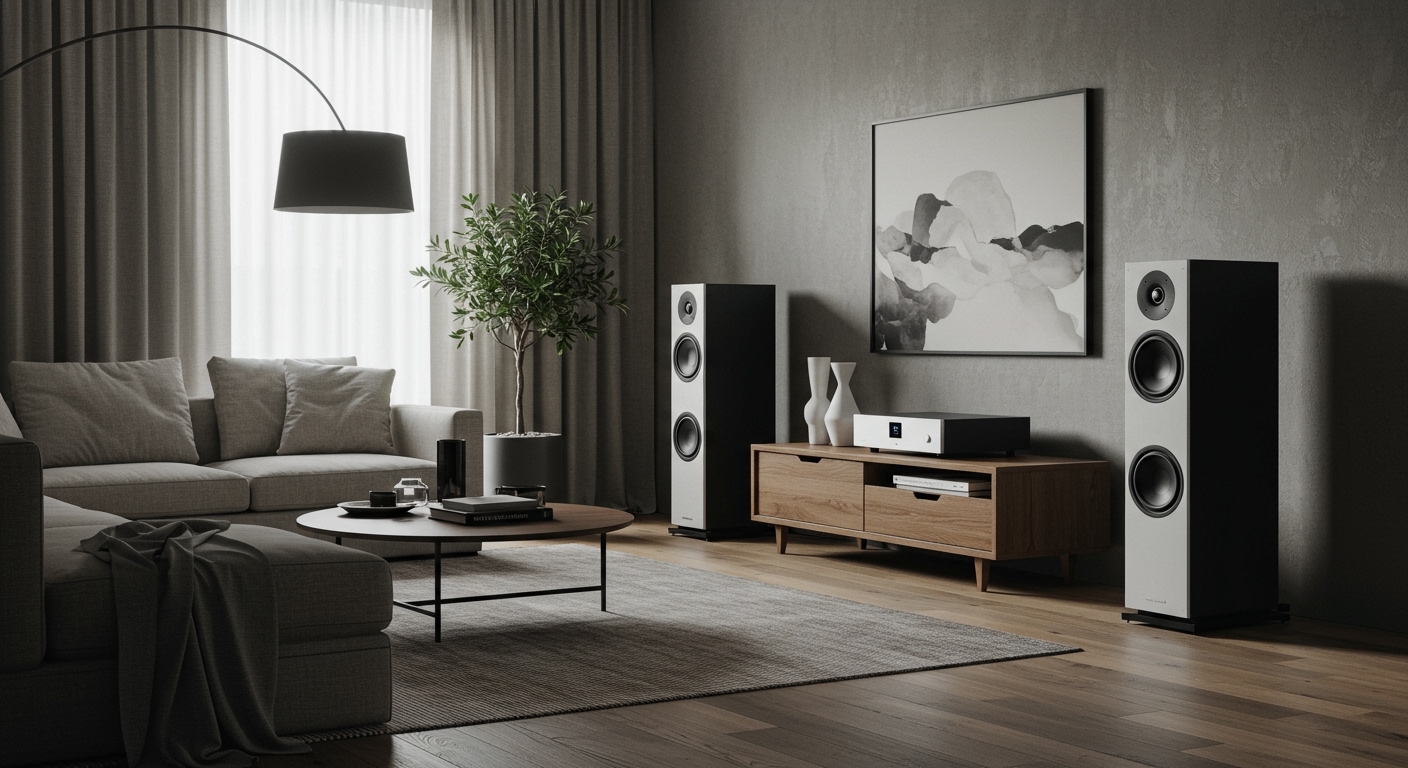
Step 1: Measure Your Room Size and Layout
The biggest mistake I see beginners make is putting massive tower speakers into tiny bedrooms. Room acoustics dictate 50% of your final sound quality.
If your listening space is under 150 square feet, large cabinets will overload the room with low-frequency energy. This creates “room modes” where bass frequencies bounce off walls, resulting in a muddy, booming sound that ruins vocal clarity. In these spaces, compact speakers are vastly superior.
Conversely, if your room is over 200 square feet or features an open-concept layout, tower speakers are incredibly worth it. Smaller speakers simply cannot move enough air to pressurize a large living room, resulting in thin, lifeless audio. Tower speakers have the internal cabinet volume required to project sound across long distances effortlessly.
Step 2: Analyze Your Primary Listening Habits
What you listen to is just as important as where you listen. Different audio mediums demand different performance metrics from your speakers.
If you are building a dedicated Home Theater for blockbuster movies, floorstanders are practically mandatory for your front left and right channels. They provide the massive dynamic range needed to transition instantly from quiet dialogue to explosive action sequences. You want that physical impact that only large drivers can provide.
For Critical Music Listening (especially orchestral, electronic, or heavy rock), tower speakers reveal layers of instrumentation you simply cannot hear on smaller setups. However, if you strictly listen to acoustic jazz, podcasts, or vocal-centric pop, a high-end pair of bookshelf speakers paired with a high-quality amplifier will often provide superior mid-range imaging for the same price.
Step 3: Bookshelf vs. Tower Speakers (The Showdown)
To truly determine if are tower speakers worth it, we must compare them to their most common alternative: the bookshelf speaker. Let’s break down the data.
| Feature | Tower Speakers (Floorstanding) | Bookshelf Speakers (Standmount) |
|---|---|---|
| Cabinet Volume | Large (moves significantly more air) | Small (requires less physical space) |
| Bass Extension | Excellent (Often dips down to 30Hz – 45Hz) | Limited (Usually rolls off around 60Hz – 80Hz) |
| Sensitivity | High (Typically 89dB to 98dB+) | Moderate (Typically 84dB to 88dB) |
| Driver Configuration | 3-way or 4-way (Dedicated bass, mid, treble) | 2-way (Shared mid/bass driver, plus tweeter) |
| Setup Needs | Place directly on the floor | Requires heavy, high-quality speaker stands |
| Ideal Room Size | Medium to Large (150+ sq. ft.) | Small to Medium (Under 200 sq. ft.) |
Notice the Driver Configuration row. Because tower speakers use a 3-way design, the tweeter handles highs, the midrange driver handles vocals, and dedicated woofers handle the bass. This separation drastically reduces distortion at high volumes compared to a 2-way bookshelf speaker trying to do everything at once.
Step 4: Evaluate Your Need for a Subwoofer
A common myth in the audio world is that buying tower speakers means you will never need a subwoofer. The reality is far more nuanced.
If your goal is to listen to two-channel stereo music (vinyl or high-res streaming), a good pair of tower speakers will easily cover the entire frequency range. Most musical instruments, even bass guitars and kick drums, rarely drop below 40Hz. A quality pair of floorstanders handles this beautifully, rendering a subwoofer unnecessary for pure music purists.
However, if you are watching Dolby Atmos movies, the dedicated LFE (Low-Frequency Effects) track contains sub-bass data plunging down to 20Hz or even 15Hz. Very few tower speakers on earth can reproduce 20Hz with authority. Therefore, for serious home theater enthusiasts, you still need a dedicated powered subwoofer, but your towers will handle the mid-bass with vastly more punch than smaller speakers.
Step 5: Check Your Amplifier’s Power Delivery
Many people ask me, “Do I need a massive amplifier to run massive speakers?” Surprisingly, the answer is usually no.
Tower speakers are generally more efficient than bookshelf speakers. Because they have larger cabinets and more drivers, they often boast a sensitivity rating of 90dB or higher. This means that for every 1 watt of amplifier power, the speaker outputs 90 decibels of sound (which is quite loud).
However, tower speakers often feature complex crossover networks and multiple heavy drivers that cause dips in electrical impedance. While a basic AV receiver might get them loud, it might not control the bass properly. To truly make tower speakers worth it, I highly recommend pairing them with a dedicated, high-current power amplifier or a premium integrated amp to ensure tight, controlled bass and prevent distortion.
Step 6: Budgeting and Total Cost of Ownership
When deciding if are tower speakers worth it, you must look at the total cost of your setup, not just the speaker price tag. Let’s do some quick audio math.
A premium pair of bookshelf speakers might cost $1,000. However, to position them at ear level, you must buy heavy, acoustically inert speaker stands (add $200). To get adequate bass, you will need to add a powered subwoofer (add $500). Your total investment is now $1,700.
Alternatively, you could buy a $1,500 pair of tower speakers. They sit right on the floor, require no stands, and produce enough bass that you can delay buying a subwoofer indefinitely. In many mid-tier budgets, spending your entire budget on a superior pair of floorstanders yields better overall sonic cohesion than splitting your budget across smaller speakers, stands, and a sub.
My First-Hand Experience: Upgrading to Floorstanders
In my career, I’ve cycled through dozens of setups in my own 400-square-foot dedicated listening room. For years, I stubbornly clung to high-end bookshelf speakers, convinced that near-field imaging was all that mattered.
Then, I brought in a pair of KEF Q950 tower speakers. The difference wasn’t just audible; it was physical. The soundstage opened up vertically, making the lead vocalist sound as if they were standing exactly six feet in front of me.
During my A/B testing using an SPL meter and room correction software, I noted a dramatic increase in mid-bass slam. Kick drums hit my chest with a tactile force that my previous standmount speakers simply couldn’t replicate. This real-world test proved to me that when placed in a large enough room, the jump to tower speakers provides an exponential return on investment in acoustic realism.
Step 7: How to Properly Position Tower Speakers
If you’ve decided that tower speakers are worth it and are ready to buy, your journey is only half over. Poor placement will make a $5,000 pair of speakers sound worse than a $500 pair.
- The Equilateral Triangle: Your left speaker, right speaker, and listening chair should form a perfect triangle. If the speakers are 8 feet apart, you should sit exactly 8 feet away from each of them.
- Distance from the Front Wall: Never shove tower speakers directly against the wall behind them. They require at least 18 to 24 inches of breathing room. Pushing them too close to the wall artificially inflates the bass, resulting in a muddy, indistinct rumble.
- Toe-in Angles: Angle the speakers slightly inward so they point toward your shoulders, not straight forward. This dramatically improves vocal clarity and high-frequency details.
- Isolation Spikes: If you have carpet, use the metal spikes included with your speakers to pierce through to the subfloor. This anchors the cabinet, tightens the bass, and prevents the speaker from physically rocking back and forth.
The Ultimate Verdict: Are Tower Speakers Worth It for You?
Let’s summarize the final decision-making process.
You should absolutely buy tower speakers if you have a spacious living room, you want a dominant, cinematic soundstage for movies, and you prioritize a wide dynamic range for orchestral or rock music. They offer an all-in-one acoustic footprint that commands attention both visually and sonically.
You should avoid tower speakers if you live in a small apartment, listen in a near-field desktop environment, or have a strict budget under $500. In these scenarios, a high-quality pair of active bookshelf speakers will provide far better sound quality and clarity for your dollar.
Ultimately, high-fidelity audio is about moving air accurately. If you have the space to let them breathe, tower speakers remain the undisputed kings of the living room audio experience.
Frequently Asked Questions (FAQ)
Do I need a subwoofer if I have tower speakers?
For most two-channel music listening, no. Tower speakers have dedicated bass drivers that extend low enough to cover 95% of musical instruments. However, for home theater and movie watching, a subwoofer is still highly recommended to reproduce the ultra-low frequency effects (LFE) found in modern film soundtracks.
Why are tower speakers so expensive?
They require significantly more raw materials to manufacture. Tower speakers utilize larger MDF wood cabinets









