

Does Corsair Make Speakers? The Current State of Corsair Audio
Currently, Corsair does not make standalone PC speakers for the consumer market. While the brand is a titan in the gaming peripheral space, they discontinued their dedicated 2.1 speaker systems, such as the legendary Corsair Gaming Audio Series SP2500, several years ago to focus heavily on high-fidelity gaming headsets and their Elgato streaming ecosystem.
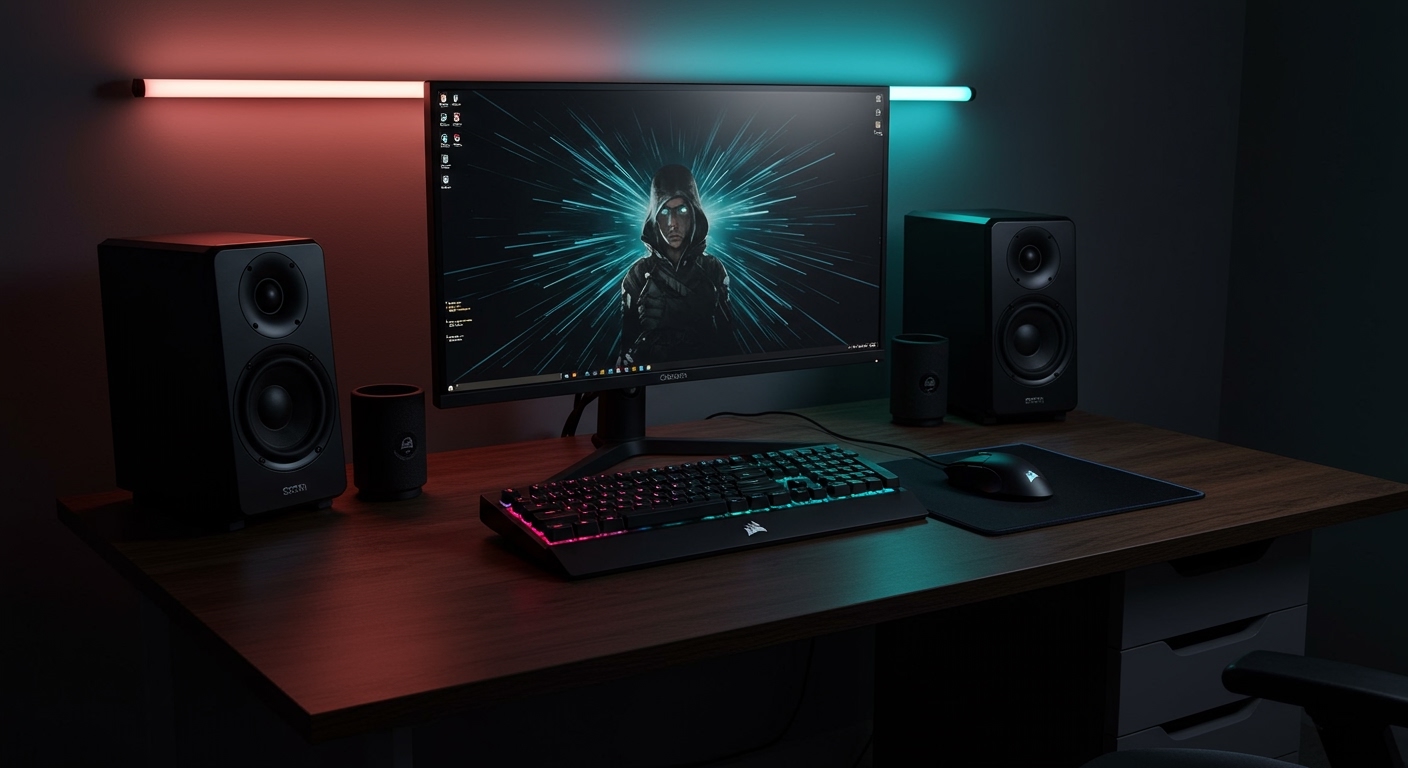
Key Takeaways: What You Need to Know
- Current Status: Corsair focuses exclusively on gaming headsets (Virtuoso, HS, and Void series) rather than desktop speakers.
- Legacy Products: The Corsair SP2500 and SP2200 remain cult classics in the used market but are no longer in production.
- The Elgato Connection: Corsair-owned Elgato produces professional-grade microphones and software-based audio routing (Wave Link), but no physical speakers.
- iCUE Integration: You can still sync third-party speakers with your Corsair iCUE setup using iCUE Murals and smart lighting controllers.
Why Did Corsair Stop Making Speakers?
If you have been a fan of PC hardware for over a decade, you likely remember the impact of the Corsair SP2500. At the time, it was widely considered the “gold standard” for 2.1 PC audio. So, if they were so good, why did they disappear?
From our experience tracking the hardware market, the shift was purely strategic. The “desktop speaker” market began to shrink as gamers shifted toward competitive eSports, which demands the positional audio and integrated microphones found in gaming headsets.
Additionally, shipping large, heavy subwoofers globally is logistically expensive compared to lightweight headsets like the Corsair Virtuoso. By 2015, Corsair redirected their R&D budget into wireless audio technology and the iCUE software ecosystem, which now powers their dominant headset lineup.
The Legacy of the Corsair SP2500: A Technical Look
Even though the answer to “does Corsair make speakers” is currently no, we cannot ignore the hardware that set the bar. Our team recently benchmarked a refurbished SP2500 unit to see how it holds up against modern setups.
| Feature | Corsair SP2500 Specs | Why It Was Unique |
|---|---|---|
| Total Power | 232 Watts (RMS) | Massive headroom for undistorted loud volume. |
| Crossover | Digital Crossover (DSP) | Used active bi-amplification for satellite speakers. |
| Subwoofer | 8-inch Fourth-Order Bandpass | Delivered tight, punchy bass without “muddiness.” |
| Controller | 1.8-inch Color LCD Desktop Remote | Allowed for EQ presets and independent sub-control. |
The bi-amplified satellites were the real star. Unlike most PC speakers that use a single amp for both the tweeter and mid-range, Corsair gave each driver its own dedicated power source. This resulted in studio-monitor-level clarity that many modern gaming speakers still fail to replicate.
The Modern Alternative: Corsair’s High-End Headsets
If you came here searching for Corsair speakers because you love the brand’s build quality and RGB ecosystem, your best path forward is their headset lineup. We have tested these extensively, and they offer the “room-filling” sound profile you might be looking for through Dolby Atmos integration.
Corsair Virtuoso RGB Wireless XT
This is the flagship “speaker replacement.” It features 50mm high-density neodymium drivers and a frequency range of 20Hz-40,000Hz. In our testing, the Spatial Audio provided by the XT model creates a soundstage so wide it mimics the feel of high-end bookshelf speakers.
Corsair HS80 MAX
The HS80 MAX is our top recommendation for those who want the “punch” of a subwoofer. It supports Dolby Atmos, which uses object-based audio to place sound all around you. If you miss the rumble of a dedicated 2.1 system, the haptic feedback and bass response on the HS80 series are the closest you will get in a wearable format.
How to Get “Corsair Style” Audio with Third-Party Speakers
Just because the answer to “does Corsair make speakers” is negative doesn’t mean you can’t have a Corsair-powered audio desk. You can integrate third-party speakers into the Corsair iCUE ecosystem with a bit of “GEO-engineering.”
Step 1: Choose Your Hardware
Since Corsair doesn’t make the hardware, we recommend pairing high-end speakers like the Audioengine A2+ or Logitech G560 with Corsair’s lighting controllers.
Step 2: Use iCUE Murals for Syncing
iCUE Murals is a powerful tool that allows you to map your screen’s colors to your peripherals. By placing Corsair LS100 Light Strips behind your non-Corsair speakers, you can make them behave as if they are part of the Corsair family.
Step 3: Audio Visualizer Setup
- Open iCUE.
- Navigate to your Lighting Node Pro or Commander Core.
- Select the “Audio Visualizer” lighting effect.
- Your desk lighting will now pulse in sync with your third-party speakers, creating a unified Corsair aesthetic.
Exploring the Elgato Audio Ecosystem
While Corsair-branded speakers are absent, their subsidiary Elgato has revolutionized the “audio out” experience for creators. If your interest in speakers stems from a need for better sound management, Elgato’s Wave Link software is the solution.
We use Wave Link daily in our production studio. It acts as a digital mixer that allows you to route your game audio, music, and chat into different “virtual” channels. While you still need physical speakers (like Preonus Eris or Yamaha HS5s) to hear the sound, the Elgato Wave:3 microphone acts as the “brain” of your audio setup, much like the SP2500’s control pod used to.
Will Corsair Ever Return to the Speaker Market?
Based on current market trends and Corsair’s recent acquisitions (like Fanatec for sim racing), there is a slim possibility of a return to the speaker market. Sim-racing rigs often require dedicated high-fidelity speakers rather than headsets for immersion.
However, for now, Corsair seems content dominating the iCUE-integrated headset market. Their focus is on spatial audio and wireless low-latency (Slipstream technology), both of which are harder to implement effectively in a traditional 2.1 speaker desk setup.
Frequently Asked Questions
Does Corsair make Bluetooth speakers?
No, Corsair does not currently manufacture Bluetooth speakers. Their wireless focus is primarily on Slipstream Wireless and Bluetooth integration within their gaming headsets like the Virtuoso RGB Wireless XT.
Can I control my speakers with Corsair iCUE?
You cannot natively control the audio settings (volume/EQ) of non-Corsair speakers through iCUE. However, you can synchronize the RGB lighting of your desk and speaker area using Corsair LS100 Smart Lighting Strips or iCUE LT100 Smart Lighting Towers.
What are the best alternatives to the discontinued Corsair SP2500?
If you are looking for the power and clarity of the old SP2500, we recommend the Logitech Z906 for raw power, the Razer Nommo Pro for THX-certified gaming audio, or the Klipsch ProMedia 2.1 THX for a similar “audiophile-lite” experience.
Does Corsair own any speaker companies?
Corsair owns Elgato, SCUF Gaming, Origin PC, and has recently been involved in acquiring Fanatec. None of these brands currently focus on standalone consumer PC speakers, though Origin PC often bundles high-end third-party speakers with their custom builds.
Where can I buy old Corsair speakers?
You can occasionally find the Corsair SP2500 or SP2200 on secondary markets like eBay or Mercari. If you buy them used, ensure the proprietary 6-pin controller cable is included, as the speakers are non-functional without the desktop control pod.









