

Finding the Perfect Soundstage: How Far Apart Should Hi Fi Speakers Be?
For the best sound quality, hi-fi speakers should typically be placed 4 to 12 feet apart (1.2 to 3.7 meters), depending on your room size and seating distance. The goal is to create an equilateral triangle where the distance between the two speakers is equal to the distance from each speaker to your primary listening position.
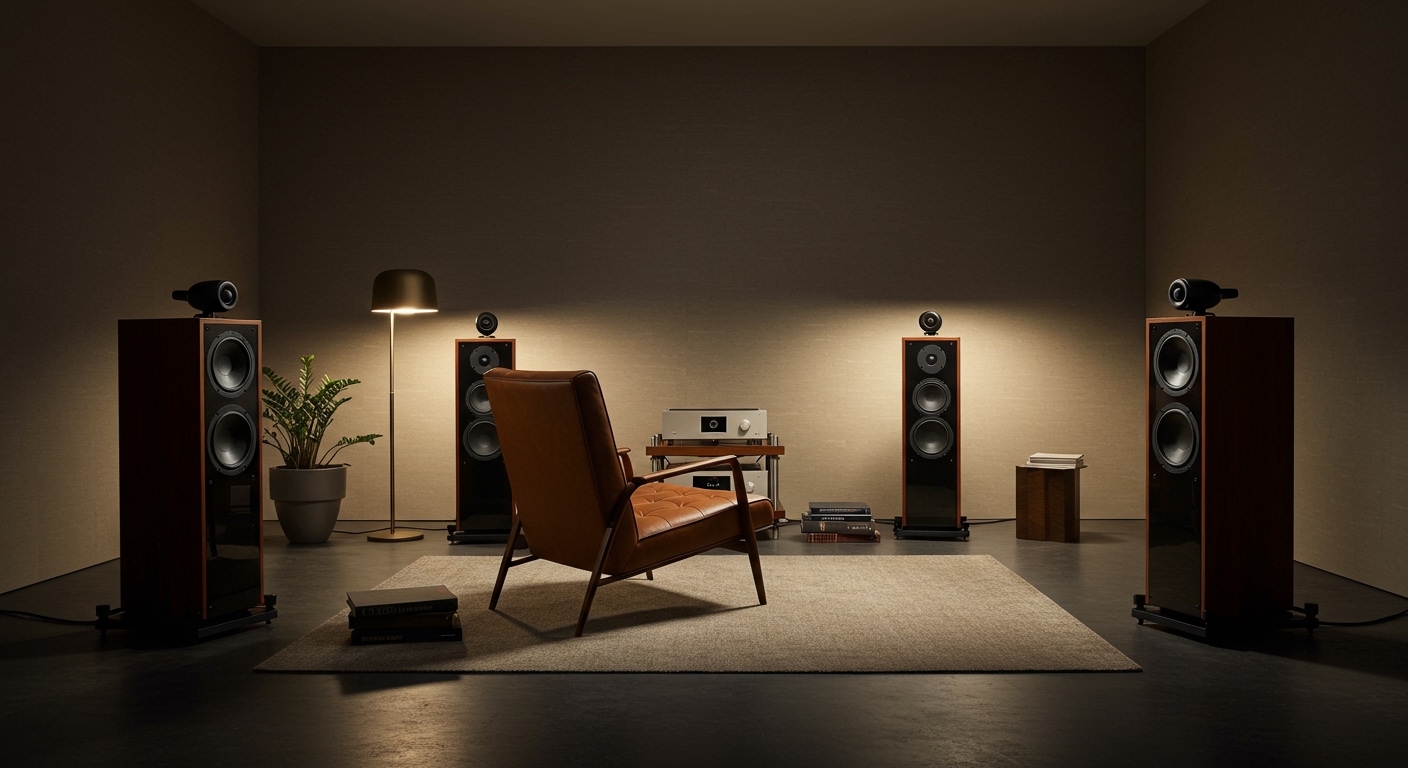
Achieving the perfect “stereo image” requires more than just eyeballing it. I have spent countless hours in listening rooms, moving floorstanding speakers and bookshelf monitors by mere fractions of an inch to find the “sweet spot” where the artist seems to appear right in front of you. When speakers are too close, the soundstage collapses into a mono-like mush; too far apart, and you lose the “phantom center,” creating a hollow gap in the music.
🚀 TL;DR: Quick Placement Rules
- Ideal Distance: 4–12 feet apart, mirroring your distance from the speakers.
- The Golden Ratio: Use the equilateral triangle method as your starting point.
- Wall Clearance: Keep speakers at least 2–3 feet away from side and front walls to prevent boomy bass.
- Toe-In: Angle speakers slightly toward your ears to improve high-frequency clarity and imaging.
- Height Matters: Ensure tweeters are at ear level when you are seated.
The Core Physics: Understanding the Equilateral Triangle
The most important rule in audiophile circles is the equilateral triangle. This geometric setup ensures that the time alignment of the sound reaching your ears is consistent, which is crucial for creating a realistic soundstage.
If you are wondering exactly how far apart should hi fi speakers be, start by measuring the distance from your favorite chair to the spot where you plan to place the speakers. If that distance is 8 feet, your speakers should also be 8 feet apart from each other.
Why the Triangle Works
When speakers are positioned this way, the stereo imaging (the ability to “place” instruments in a 3D space) is most accurate. In my experience testing high-end systems from Bowers & Wilkins and KEF, straying too far from this ratio causes the sound to either feel congested or disconnected.
| Room Size | Recommended Distance Apart | Recommended Distance from Seat |
|---|---|---|
| Small (Desktop/Office) | 3 – 5 Feet | 3 – 5 Feet |
| Medium (Bedroom/Den) | 6 – 8 Feet | 6 – 8 Feet |
| Large (Living Room) | 8 – 12+ Feet | 8 – 12+ Feet |
Boundary Reinforcement: How Walls Affect Your Setup
You cannot determine how far apart should hi fi speakers be without considering the walls. This phenomenon is known as boundary reinforcement.
When a speaker is placed too close to a corner or a back wall, the low-frequency energy bounces off the surface and combines with the direct sound. This often results in “one-note bass” or a muddy sound profile.
The Rule of Thirds
One professional trick I frequently use is the Rule of Thirds. If possible, try to place your speakers one-third of the way into the room from the front wall. This significantly reduces standing waves and room modes that can distort your music.
- Front Wall Distance: Aim for at least 2 feet of clearance.
- Side Wall Distance: Ensure the distance to the side walls is different from the distance to the front wall to avoid acoustic interference.
- Rear-Ported Speakers: These are especially sensitive. If your speaker has a hole in the back, it needs “room to breathe” to avoid bloated bass.
Step-by-Step Guide to Positioning Your Hi-Fi Speakers
Setting up a system is an iterative process. Follow these steps that I use during professional calibrations to nail the placement on the first try.
Identify Your Primary Listening Position
Before moving the heavy lifting, decide where you will actually sit. This is your Reference Point. Mark it with a piece of painter’s tape if necessary.
The Initial “Rough-In”
Place your speakers according to the equilateral triangle rule mentioned above. If your seat is 10 feet away, place the speakers 10 feet apart. Ensure they are at least 2 feet away from the side walls.
Check the Tweeter Height
The tweeter (the small driver responsible for high frequencies) is highly directional. For the best treble response, the tweeters must be at the same height as your ears when you are sitting down. If you use bookshelf speakers, invest in high-quality speaker stands.
Adjust the “Toe-In”
“Toe-in” refers to angling the speakers inward toward the listener rather than having them point straight ahead.
- No Toe-In: Provides a wider, more spacious soundstage but may lack a sharp center image.
- Extreme Toe-In: The speakers point directly at your ears. This sharpens the stereo image and increases detail but can make the “sweet spot” very narrow.
- The 15-Degree Rule: Start with the speakers pointing straight, then slowly angle them in 5-degree increments until the vocals sound like they are coming from a single point in the center of the wall.
Advanced Placement Techniques: The Rule of Fifths
If the Rule of Thirds is too intrusive for your living space, many experts recommend the Rule of Fifths. This is a mathematical approach to minimize room resonances.
- Divide your room’s total length into 5 equal segments.
- Place your speakers on the first “fifth” line from the wall.
- Place your listening chair on the fourth “fifth” line.
This creates a balanced distribution of bass frequencies and helps eliminate the “boomy” effect often found in square rooms. In my testing, this setup provides a much flatter frequency response without the need for expensive digital room correction software.
Common Mistakes to Avoid in Speaker Placement
Even with the best gear from McIntosh or Sonos, poor placement will ruin the experience. Avoid these common pitfalls:
- Asymmetry: Having one speaker in a corner and the other in an open space. This causes an unbalanced soundstage where one side sounds much louder and bassier than the other.
- Hard Surfaces: Placing speakers directly on a hardwood floor or next to a large glass window. This causes first reflections that smear the sound. Use rugs or curtains to dampen these reflections.
- Obstructions: Placing your speakers behind a sofa or inside a cabinet. High-frequency sound waves are short and easily blocked; if you can’t see the tweeter, you aren’t hearing the full detail of the recording.
Troubleshooting Your Hi-Fi Sound
| Symptom | Likely Cause | Recommended Fix |
|---|---|---|
| Weak Center Image | Speakers are too far apart. | Move speakers closer together by 6 inches at a time. |
| Boomy/Muddy Bass | Speakers are too close to walls. | Pull speakers further into the room. |
| Dull/Dark Sound | Tweeters are not at ear level. | Use stands or tilt the speakers upward. |
| Harsh/Thin Sound | Too many hard reflections. | Add a rug between you and the speakers. |
Frequently Asked Questions
Does room size change how far apart speakers should be?
Yes. In a small room (under 120 sq ft), speakers may only be 4–6 feet apart to avoid overwhelming the space with reflections. In large, open-concept rooms, you may need 10–12 feet of separation to fill the air properly and maintain a wide soundstage.
Should I use the same distance for home theater and Hi-Fi?
While similar, home theater setups often prioritize a wider placement to accommodate a large screen. However, for a dedicated 2-channel hi-fi system, adhering to the equilateral triangle is much more important for musical accuracy.
Can I place my speakers on a bookshelf?
You can, but it is not ideal. Bookshelves often vibrate, adding “coloration” to the sound. If you must use a shelf, place the speakers on isolation pads or small rubber feet to decouple them from the furniture. Ensure they are pulled forward to the very edge of the shelf to prevent diffraction issues.
How does “Toe-in” affect the sound?
Toe-in primarily affects the high frequencies and the focus of the center image. If your room is very “live” (lots of echoes), more toe-in can help by directing more sound to your ears and less to the side walls.









