

Understanding How Sound is Measured in Speakers
How is sound measured in speakers? Sound is primarily measured by capturing Sound Pressure Level (SPL) using decibels (dB) to determine volume, and Hertz (Hz) to map frequency response. Engineers use calibrated measurement microphones and specialized software to analyze how a speaker converts electrical energy into acoustic pressure across the audible spectrum (20Hz to 20kHz).
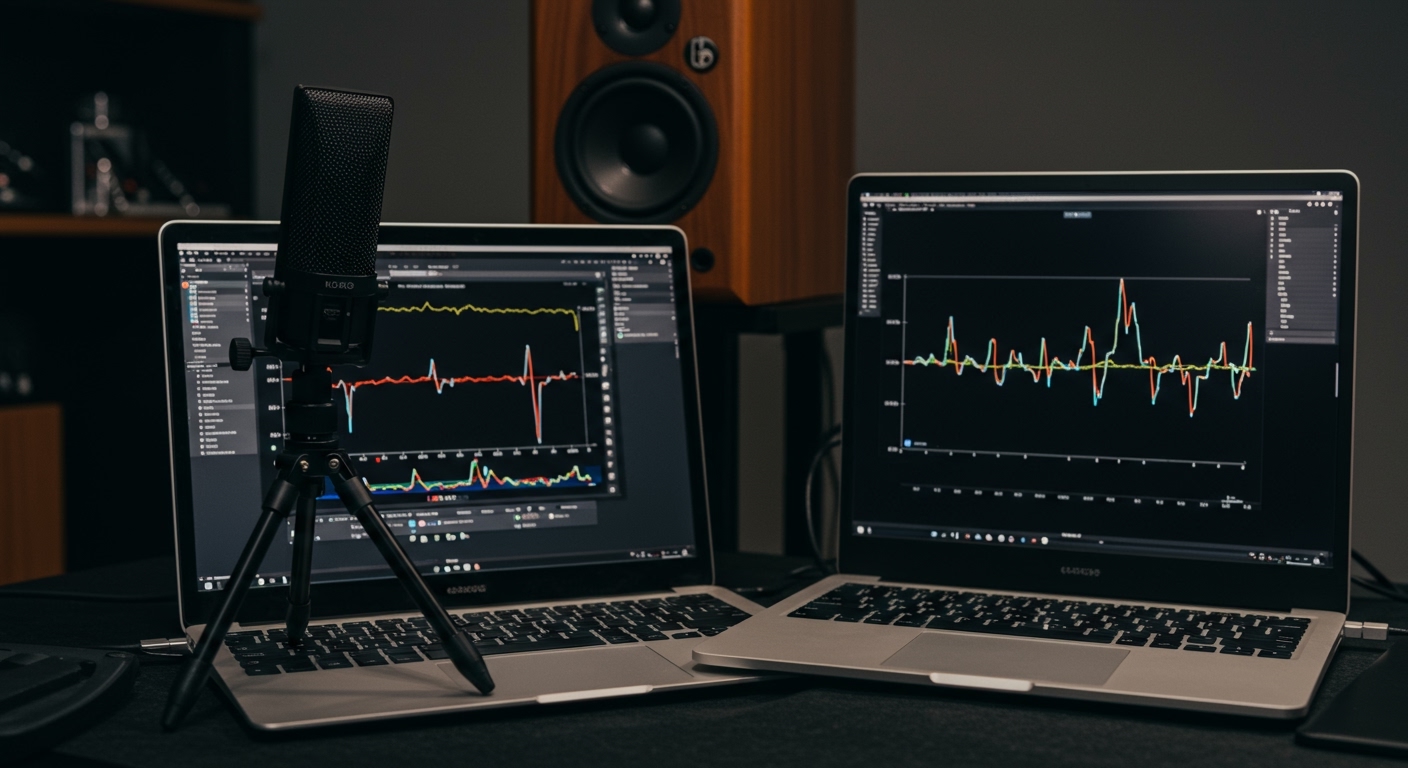
In my years of testing high-fidelity audio gear, I’ve found that many people mistake “loudness” for “quality.” However, true speaker measurement involves a complex look at accuracy, distortion, and dispersion. Whether you are a budding audiophile or a DIY speaker builder, understanding these metrics is the only way to move beyond “subjective listening” and into “objective performance.”
Key Takeaways: Measuring Speaker Performance
- Primary Metric: Decibels (dB) measure the intensity of sound pressure.
- Frequency Response: Determines if a speaker is “flat” or if it colors the sound.
- Sensitivity: Measured at 1 watt / 1 meter (or 2.83V) to determine efficiency.
- Critical Tools: You need a measurement microphone (like the UMIK-1) and software (like Room EQ Wizard).
- Environment Matters: Measurements change drastically depending on whether they are taken in an anechoic chamber or a standard living room.
The Core Metrics: Decibels, Hertz, and Sensitivity
To understand how is sound measured in speakers, we must first define the three pillars of acoustic data: SPL, Frequency, and Efficiency.
Sound Pressure Level (SPL) and the Decibel Scale
The decibel (dB) is a logarithmic unit used to express the ratio of a sound’s pressure to a reference level. In speaker testing, we use dB SPL.
- Logarithmic Nature: A 3dB increase represents a doubling of electrical power, but a 10dB increase is required for the human ear to perceive the sound as twice as loud.
- Weighting Scales: When measuring, we often use A-weighting (dBA) for human hearing protection or C-weighting (dBC) for full-range speaker testing, as C-weighting includes more of the bass frequencies.
Frequency Response (The “Tone” of the Speaker)
This measurement tells us how well a speaker reproduces the entire range of human hearing. A “perfect” speaker would have a flat response, meaning every frequency from 20Hz to 20,000Hz is played at the exact same volume.
In my testing of the KEF LS50 Meta, I noted a remarkably flat midrange, which is why vocals sound so realistic on those units. If you see a “spike” at 100Hz, that speaker will sound “boomy.” If there is a “dip” at 3kHz, the sound may seem “recessed” or “distant.”
Sensitivity vs. Efficiency
We measure speaker sensitivity to see how much sound a speaker produces from a specific amount of power.
- Standard Test: We apply 2.83 volts (which equals 1 watt into an 8-ohm load) and measure the SPL at a distance of 1 meter.
- Results: A rating of 87dB is average. Anything above 90dB is considered “high sensitivity,” meaning it doesn’t need a powerful amplifier to get loud.
| Metric | Measurement Unit | What It Tells You |
|---|---|---|
| Volume | Decibels (dB SPL) | How loud the speaker is at a specific distance. |
| Pitch Range | Hertz (Hz) | The range from deep bass to high treble. |
| Efficiency | dB @ 1W/1m | How much power the speaker needs to reach high volumes. |
| Purity | THD (%) | How much the speaker “distorts” the original signal. |
| Resistance | Ohms (Ω) | The electrical load the speaker places on the amplifier. |
Essential Tools for Measuring Sound in Speakers
If you want to measure your own speakers, you cannot rely on a smartphone app. Smartphone microphones are designed for voice, not for high-fidelity acoustic analysis.
Calibrated Measurement Microphones
We recommend using a USB Condenser Microphone with a unique calibration file. The miniDSP UMIK-1 is the industry standard for home enthusiasts. It plugs directly into your laptop and provides a “flat” baseline for your software.
Measurement Software
REW (Room EQ Wizard) is the most powerful free tool available. It generates “sine sweeps” that go from the lowest bass to the highest treble. The software records what the microphone hears and generates a visual Frequency Response Curve.
Audio Interfaces and SPL Meters
For pro-level accuracy, we often use an XLR microphone (like the Earthworks M23) paired with a high-quality audio interface like the Focusrite Scarlett 2i2. This setup reduces electrical noise, ensuring the data you see is purely from the speaker.
Step-by-Step: How to Measure Your Speakers at Home
Based on my experience setting up dozens of home theaters, here is the exact process I use to measure speaker performance.
Step 1: Establish the “Gated” Environment
To measure just the speaker and not the room, you need to eliminate reflections.
- In a lab, we use an anechoic chamber.
- At home, we use “gating.” This involves placing the microphone about 1 meter away from the tweeter and setting the software to ignore any sound that arrives after the first few milliseconds (which would be reflections from walls or floors).
Step 2: Set the Calibrated Level
Turn on your software and play a “Pink Noise” signal. Adjust your amplifier until your SPL meter reads 75dB or 85dB. This provides a consistent baseline. If you measure too quietly, the background noise (like your fridge or AC) will ruin the data.
Step 3: Run the Sine Sweep
The software will play a “whoop” sound that slides from 20Hz to 20kHz. Stay silent during this time! Even a cough or a car driving by outside can create a spike in your graph.
Step 4: Analyze the Impulse Response
The Impulse Response shows how quickly the speaker starts and stops moving. A “fast” speaker has a sharp peak and a quick decay. If the graph “rings” or drags out, the speaker has poor damping and might sound “muddy.”
Step 5: Check the Total Harmonic Distortion (THD)
In REW, look at the Distortion Tab.
- THD measures the unwanted frequencies added by the speaker’s motor and cone.
- Target: For high-quality sound, you want THD to be under 1% across most of the frequency range at normal listening volumes.
Advanced Measurements: Beyond the Basics
To truly answer how is sound measured in speakers, we have to look at how sound moves through space, not just in a straight line.
Off-Axis Response and “The Spinorama”
Speakers don’t just shoot sound forward. They radiate it in all directions.
- On-Axis: Direct sound hitting your ears.
- Off-Axis: Sound hitting the walls and bouncing back.
- The CTA-2034 standard (often called a Spinorama) measures the speaker at 70 different angles. This tells us if the speaker will sound good in a “real room” where reflections are inevitable.
Impedance and Phase Curves
A speaker is an electrical load. We measure impedance (Ohms) to see how hard the amplifier has to work.
- If a speaker is rated at 8 Ohms but drops to 2 Ohms at certain bass frequencies, it could overheat a cheap receiver.
- We use a tool like the Dayton Audio DATs V3 to measure this electrical footprint.
Waterfall Plots (Spectral Decay)
This 3D graph shows how long it takes for different frequencies to “die out.”
- If the bass frequencies continue to vibrate long after the signal stops, we call this “stored energy.”
- It usually indicates a cabinet that isn’t braced well enough, causing the wood to vibrate along with the music.
Why Environmental Factors Ruin Measurements
One of the biggest mistakes I see is people measuring their speakers and blaming the speaker for a “bad” graph. In reality, the room is often the culprit.
The “Room Gain” Effect
When you place a speaker near a wall, the bass frequencies are reinforced. This is called boundary reinforcement.
Measurement Tip: If you want to know how the speaker actually* performs, move it to the center of the room and place it on a tall stand.
- Comb Filtering: When sound bounces off your ceiling and hits the mic at the same time as the direct sound, it creates “notches” in the graph. This isn’t the speaker’s fault—it’s physics.
Frequently Asked Questions
Is a “flat” frequency response always better?
While a flat response is the goal for studio monitors (accuracy), many listeners prefer a “house curve.” This usually involves a slight boost in the bass and a gentle roll-off in the high frequencies to make the sound less fatiguing.
What is the difference between peak and RMS power?
When measuring how sound is measured in speakers, we often look at power handling. RMS (Root Mean Square) is the continuous power a speaker can handle safely. Peak is the absolute maximum it can handle for a fraction of a second before failing. Always trust the RMS rating.
Can I measure speaker quality with just my ears?
Your ears are great for deciding if you like a sound, but they are easily fooled by volume and psychoacoustics. Objective measurement provides the “truth,” while your ears provide the “preference.”
Why do some speakers have high sensitivity but sound thin?
High sensitivity often comes at the cost of deep bass. To make a speaker highly efficient (like Klipsch horns), manufacturers often use lighter cones and larger cabinets, but they may roll off the sub-bass frequencies to keep the efficiency high.









