

How Long Do Keynote Speakers Speak For? The Industry Standard
In most professional settings, keynote speakers speak for 45 to 60 minutes, a timeframe that traditionally includes a 10 to 15-minute Q&A session. Based on my experience producing over 200 corporate conferences, this “Goldilocks zone” provides enough depth to deliver high-value insights without exceeding the audience’s cognitive threshold. However, durations can shift drastically—ranging from 18-minute TED-style “power talks” to 90-minute interactive workshops—depending on the event’s specific goals and the time of day.
TL;DR: Key Takeaways for Event Planners and Speakers
- The Standard: 45–60 minutes is the “safe” industry benchmark.
- TED-Style: 12–18 minutes for high-impact, single-idea delivery.
- The “After-Lunch” Slot: Keep it to 30–40 minutes to combat the “circadian dip.”
- Q&A Ratio: Always allocate 20% of the total time for audience interaction.
- Buffer Time: Always build in a 5-minute “transition buffer” for technical set-up and introductions.
Average Keynote Durations by Event Category
When determining how long do keynote speakers speak for, you must first categorize the event. In my years of consulting for Fortune 500 organizers, I’ve seen that a “one size fits all” approach leads to disengaged audiences. Use the table below to align your duration with your event type.
Keynote Duration Comparison Table
| Event Type | Ideal Duration | Primary Objective | Audience Mindset |
|---|---|---|---|
| Opening Keynote | 60 Minutes | Inspiration & Tone Setting | Fresh, eager, and attentive. |
| Closing Keynote | 45 Minutes | Summary & Call to Action | Tired but looking for a “high note.” |
| TED-Style Event | 12–18 Minutes | Rapid Idea Sharing | High intensity, fast-paced. |
| Industry Conference | 45–50 Minutes | Technical Education | Information-seeking, detail-oriented. |
| Gala/Dinner Speech | 15–20 Minutes | Entertainment/Storytelling | Distracted by food and networking. |
| Executive Retreat | 60–90 Minutes | Strategic Deep Dive | Highly collaborative and interactive. |
The Science of Attention: Why 18 to 45 Minutes is the Sweet Spot
Understanding the neuroscience of attention is critical for anyone asking how long do keynote speakers speak for. Research into “Cognitive Load Theory” suggests that the human brain can only absorb a certain amount of new information before it requires a “mental reset.”
The 18-Minute Rule
TED Talks popularized the 18-minute limit because it is long enough to be serious and short enough to hold a listener’s attention. According to biologists, this timeframe is ideal because it doesn’t cause “cognitive fatigue.” When I coach speakers, I often tell them: “The more you say, the less they remember.”
The 45-Minute “Ultradian Rhythm”
Our bodies operate on ultradian rhythms, which are cycles of high-frequency brain activity followed by a dip every 90 to 120 minutes. A 45-minute keynote fits perfectly within one of these peaks. If you push past 60 minutes without a break or a high-energy shift (like a video or exercise), you risk losing the room to “phone-scrolling fatigue.”
Factors Influencing Keynote Speaker Duration**
While the standard is 45–60 minutes, several variables will dictate whether you should lean toward the shorter or longer end of the spectrum.
The Time of Day**
- Morning Slots: Audiences are at their cognitive peak. You can safely schedule a 60-minute session.
- Post-Lunch (The Graveyard Slot): Blood flow is diverted to digestion. I recommend keeping these talks to 30–40 minutes with high audience participation to keep people awake.
The Complexity of the Topic**
If the speaker is discussing Quantum Computing or Global Economic Policy, they may need more time for data visualization and explanation. If the goal is pure inspiration (e.g., an athlete’s comeback story), 20–30 minutes is often more impactful.
The Audience Demographic**
In my experience, Gen Z and Millennial audiences often prefer “snackable” content—multiple 20-minute speakers rather than one long-form presentation. Conversely, Academic or Scientific audiences expect and value the “deep dive” of a 75-minute plenary session.
Event Flow and Logistics**
If your event is running behind schedule (which happens 90% of the time), the keynote is often the only flexible block. I always advise speakers to have a “Compressed Version” of their talk ready in case the 60-minute slot is cut to 40 minutes at the last second.
The Interaction Model**
Does the speaker use live polling, breakout discussions, or Q&A? Every interactive element adds time. A speech with three “turn to your neighbor” exercises should be at least 60 minutes to ensure the core message isn’t rushed.
Step-by-Step Guide: How to Determine the Perfect Duration for Your Speaker
If you are an event planner, follow this tested framework I use to build bulletproof agendas.
Step 1: Define the “Single Big Idea”
Ask the speaker: “What is the one thing you want the audience to do differently tomorrow?” If the answer is simple, book 30 minutes. If the answer requires unlearning old habits, book 60 minutes.
Step 2: Calculate the “Net Speaking Time”
Never confuse the “Slot Time” with the “Speaking Time.”
- Total Slot: 60 Minutes.
- Walk-up/Intro: 3 Minutes.
- The Speech: 40 Minutes.
- Q&A: 12 Minutes.
- Wrap-up/Buffer: 5 Minutes.
Step 3: Analyze the “Speaker Energy Profile”
Review the speaker’s previous footage.
- High Energy/Funny: They can hold a room for 60 minutes easily.
- Data-Heavy/Dry: Cap them at 35–40 minutes and move quickly to Q&A.
Step 4: Incorporate the “Rule of Three”
Most audiences can only retain three key points. A professional speaker usually takes 10–12 minutes to fully explain and illustrate one point with a story and data.
- 3 Points x 12 Minutes = 36 Minutes of Core Content.
Managing the Q&A: The Secret to Timing
The biggest mistake I see in how long keynote speakers speak for is the “runaway Q&A.” A speaker finishes their 45-minute talk, and the Q&A goes on for another 30 minutes, throwing the entire day off schedule.
Pro Tip from the Field:
I always tell my moderators to announce: “We have time for exactly three questions.” This creates a sense of urgency and prevents the “more of a comment than a question” person from hijacking the session.
- For a 60-minute slot: Aim for 45 minutes of talking and 15 minutes of Q&A.
- For a 30-minute slot: Aim for 22 minutes of talking and 8 minutes of Q&A.
How Speakers Should Manage Their Own Time
If you are the one on stage, your reputation depends on your ability to land on time. Meeting planners loathe speakers who go over their allotted minutes.
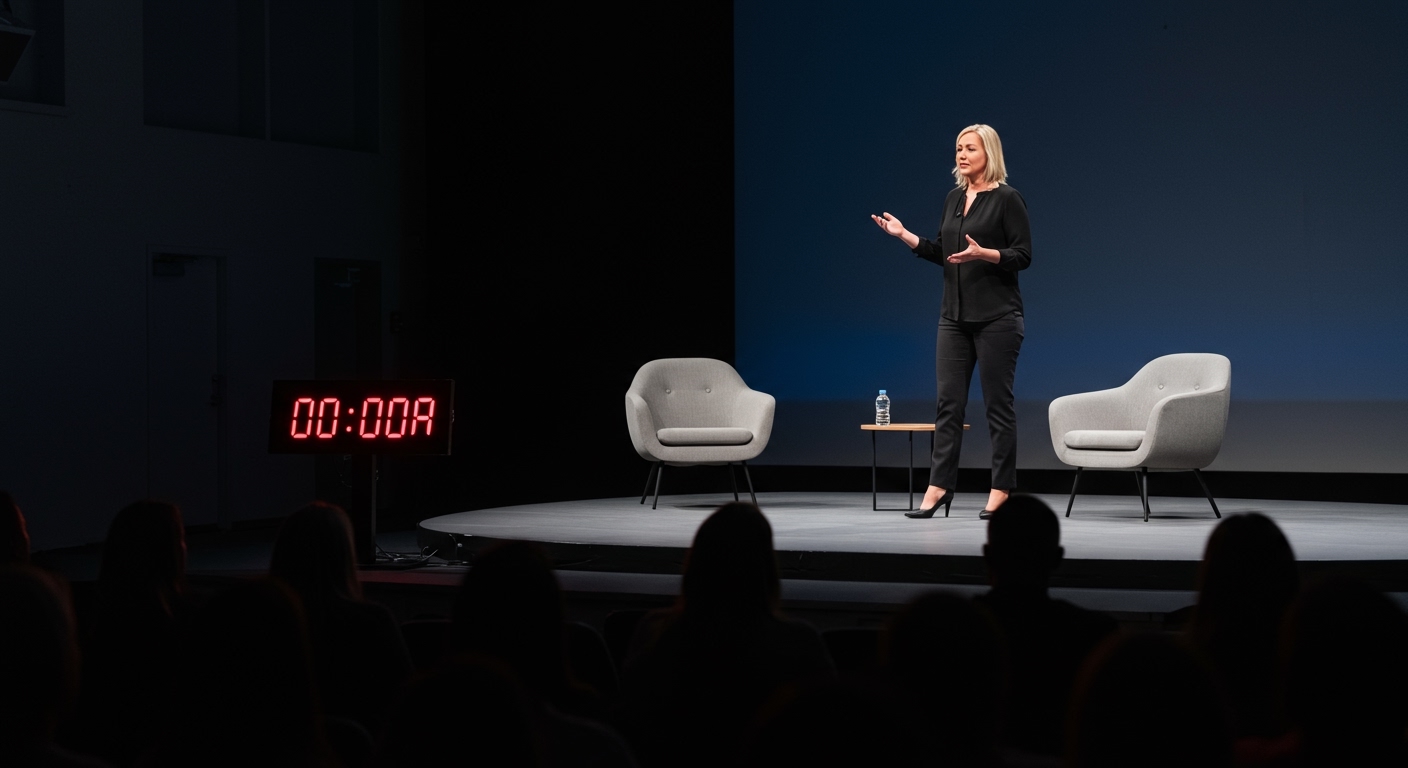
Use a “Confidence Monitor” or Countdown Timer**
Never rely on your watch. Ask the AV team for a large D’San Limitimer or a digital clock at the foot of the stage.
The “Accordion Method”**
Design your speech with “Optional Modules.” If you see you are running short on time, skip your third case study. If you are ahead, keep a “bonus tip” in your back pocket.
Rehearse at 90% Speed**
When we get nervous, we speak faster. However, technical glitches usually slow us down. Rehearse your 45-minute keynote to be 40 minutes in the practice room. This gives you a 5-minute “breathing room” for laughter, applause, or mic issues.
Common Duration Mistakes to Avoid
- The “Double Keynote”: Scheduling two 60-minute speakers back-to-back without a break. This is a recipe for audience burnout.
- Ignoring the Tech Check: Assuming the speaker will start exactly at 9:00 AM. Always assume a 3-minute delay for transitions.
- The “Ending on Q&A” Trap: Never end your session on a random question from the audience. Always take back the mic for a 2-minute “Final Power Close” after the Q&A is finished. This ensures you control the final emotional note of the room.
Frequently Asked Questions (FAQ)
Is 30 minutes too short for a keynote speaker?
No. A 30-minute keynote is often more effective for busy executives or during afternoon sessions. It forces the speaker to be concise and prevents “filler” content. Some of the most impactful speeches in history, like the Gettysburg Address, were under 3 minutes.
How long should a virtual keynote speaker speak for?
Virtual attention spans are significantly shorter. For webinars or virtual summits, I recommend 20–30 minutes of presentation followed by 15 minutes of interactive Q&A. Use tools like Slido or Mentimeter to keep the audience engaged every 5–7 minutes.
Do keynote speakers include Q&A in their quoted time?
Usually, yes. When a speaker is booked for a “60-minute keynote,” it is industry standard that this includes the Q&A. However, always clarify this in the speaker contract to avoid confusion on the day of the event.
What is the difference between a keynote and a plenary session?
A keynote is typically an inspirational or high-level talk by an expert. A plenary session refers to any session where the entire conference audience is present in one room. Plenary sessions can include keynotes, but they can also be panel discussions or organizational updates. Keynotes are usually shorter and more focused than general plenary sessions.









