

Understanding the Modern Multiplex: How Many Speakers Are in a Movie Theater?
A standard commercial movie theater typically features between 16 and 64 speakers, though premium large-format auditoriums like Dolby Cinema or IMAX can utilize up to 128 discrete audio channels. The exact number depends on the theater’s dimensions and the specific sound format, such as 5.1, 7.1, or the object-based Dolby Atmos system. In my experience auditing commercial AV installations, the goal isn’t just quantity, but achieving uniform Sound Pressure Level (SPL) across every seat in the house.
TL;DR: Key Takeaways for Cinema Sound
- Standard Setup: 16–24 speakers (usually 7.1 Surround Sound).
- Premium Setup: 64–128 speakers (Dolby Atmos or DTS:X).
- Behind the Screen: 3–5 massive Screen Channels (Left, Center, Right) and Subwoofers.
- The Goal: To create a “sweet spot” that covers the entire room using Acoustic Treatment and Time Alignment.
- Key Brands: Look for JBL Professional, QSC, Meyer Sound, and Alcons Audio in high-end rooms.
The Core Configuration: How Many Speakers Are in a Movie Theater Room?
When you walk into a modern Cinemark or AMC, you are surrounded by a complex array of transducers designed to disappear into the movie’s atmosphere. To understand how many speakers are in a movie theater, we must break the room down into three distinct zones: the screen array, the surround walls, and the ceiling.
In a traditional 5.1 setup, which was the industry standard for decades, you would find three speakers behind the screen and two arrays of surround speakers on the side walls. However, modern digital cinema has pushed those numbers much higher to ensure that a person sitting in the front left corner hears the same detail as someone in the “king seat” (center-middle).
The Essential Speaker Count Table
| Theater Format | Screen Channels | Surround Speakers | Subwoofers | Total Est. Speakers |
|---|---|---|---|---|
| Standard 5.1 | 3 | 10–14 (split into 2 zones) | 2–4 | 15–21 |
| Standard 7.1 | 3 | 16–24 (split into 4 zones) | 4–6 | 23–33 |
| Dolby Atmos | 5 | 30–50 (discrete) | 8–12 | 43–67+ |
| IMAX (12nd Gen) | 5 | 6 | 1 (massive array) | 12 (Point Source) |
Behind the Screen: The Powerhouse “LCR” Array
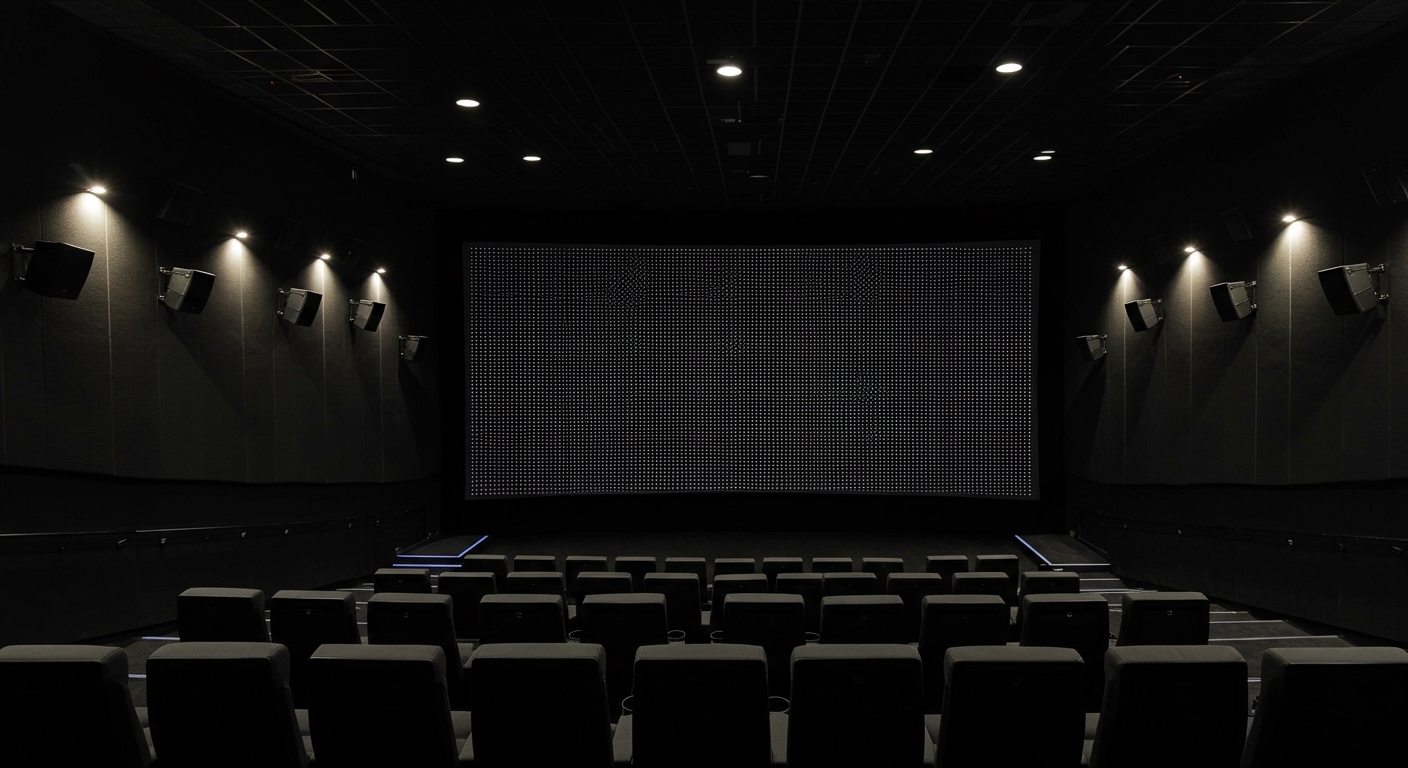
The most important speakers in any theater are those you never see. Behind the perforated screen (which is filled with thousands of tiny holes to let sound through), lies the LCR system (Left, Center, Right).
During my time consulting on theater acoustics, we always prioritized the Center Channel. This single speaker handles roughly 95% of the film’s dialogue. If this speaker isn’t powerful enough, the music and sound effects will “wash out” the actors’ voices.
- Left and Right Channels: These handle the wide-stage music and localized sound effects.
- Center Channel: Dedicated almost exclusively to dialogue and “on-screen” action.
- Screen Subwoofers: Usually 18-inch or 21-inch drivers housed in massive wooden cabinets to provide the “thump” you feel in your chest.
Why Surround Sound Density Matters
If you look at the side walls, you will see a long line of smaller speakers. When people ask how many speakers are in a movie theater, they are usually counting these visible units. In a 7.1 system, these are grouped into “arrays.”
Even though there might be 10 speakers on the left wall, they are all playing the same “Left Surround” signal. This is done to ensure that the sound fills the entire length of the room. In Dolby Atmos, however, every single one of those speakers can play a unique sound, allowing an object—like a helicopter—to move precisely from one individual speaker to the next.
Discrete vs. Arrayed Sound
- Arrayed (Standard): Multiple speakers play the same sound to cover a large area.
- Discrete (Atmos): Each speaker has its own dedicated amplifier channel and unique audio feed.
The Subwoofer Setup: Feeling the Bass
A movie theater doesn’t just use one “sub.” They use a Low-Frequency Effects (LFE) array. Usually located behind the screen at the bottom, these subwoofers are often paired with “surround subs” at the back of the room in premium formats.
In high-end installations, we often use Double Bass Arrays (DBA) to prevent “bass traps” where the sound waves bounce off the back wall and cancel each other out. This ensures that even the back row feels the rumble of an explosion without it sounding “boomy” or “muddy.”
How Many Speakers Are in a Movie Theater for Dolby Atmos?
Dolby Atmos changed the math entirely. Instead of “channels” (Left, Right, etc.), Atmos uses “audio objects.” To make this work, the theater needs Overhead Speakers.
In a typical Dolby Atmos cinema, you will see two parallel rows of speakers on the ceiling. Because Atmos can support up to 128 simultaneous audio paths, the speaker count can skyrocket. In a large Premium Large Format (PLF) room, you might count over 60 individual speaker cabinets including the overheads and the additional rear surrounds.
The IMAX Difference
Interestingly, IMAX takes a different approach. While Dolby focuses on quantity and “object tracking,” IMAX uses Point Source Technology. An IMAX theater typically has fewer speakers—usually 6 or 12—but they are significantly larger and custom-engineered to cover the entire room with extreme precision and higher volume levels.
Expert Perspective: How to Spot a High-Quality Setup
When I enter a theater, I look for three specific things to judge the audio quality:
- Acoustic Treatment: Look for fabric panels on the walls. These hide Rigid Fiberglass or Rockwool that prevents echoes. If the walls are bare, the sound will be “bright” and fatiguing.
- Baffle Walls: In the best theaters, the speakers behind the screen are mounted into a solid “baffle wall.” This prevents sound from reflecting off the back wall of the building and interfering with the audio coming through the screen.
- Speaker Aiming: Notice if the surround speakers are tilted downward toward the audience. If they are pointed straight across, the sound is being wasted on the ceiling.
Frequently Asked Questions
Why can’t I see the speakers behind the screen?
The screen is made of a translucent, perforated material (often vinyl). This allows the sound waves from the Left, Center, and Right speakers to pass through the screen directly toward the audience, which makes the voices sound like they are coming from the actors’ mouths.
Is more speakers always better?
Not necessarily. How many speakers are in a movie theater matters less than the calibration. A well-calibrated 5.1 system with high-end JBL speakers will sound much better than a poorly tuned 7.1 system with cheap components. The key is “coverage”—ensuring every seat gets the same quality of sound.
How many subwoofers does a theater have?
A standard theater has 2 to 4 large subwoofers behind the screen. Premium theaters like Dolby Cinema may have 8 to 16 subs, including “vibration transducers” or “shakers” built into the seats to simulate physical impact.
Can I replicate a movie theater speaker count at home?
While you probably don’t need 64 speakers, you can replicate the experience with a 7.1.4 setup. This includes 7 floor-level speakers, 1 subwoofer, and 4 ceiling-mounted speakers for Dolby Atmos. This provides the same “3D audio” effect used in commercial cinemas but on a smaller scale.









