

Understanding How Many Speakers in Dolby Cinema Are Required for Total Immersion
A standard Dolby Cinema auditorium typically utilizes 64 individual speakers to create a fully immersive, 360-degree Dolby Atmos soundstage. This specific configuration includes a massive array of screen channels, surround speakers, and overhead heights to ensure every sound “object” moves precisely through the room.
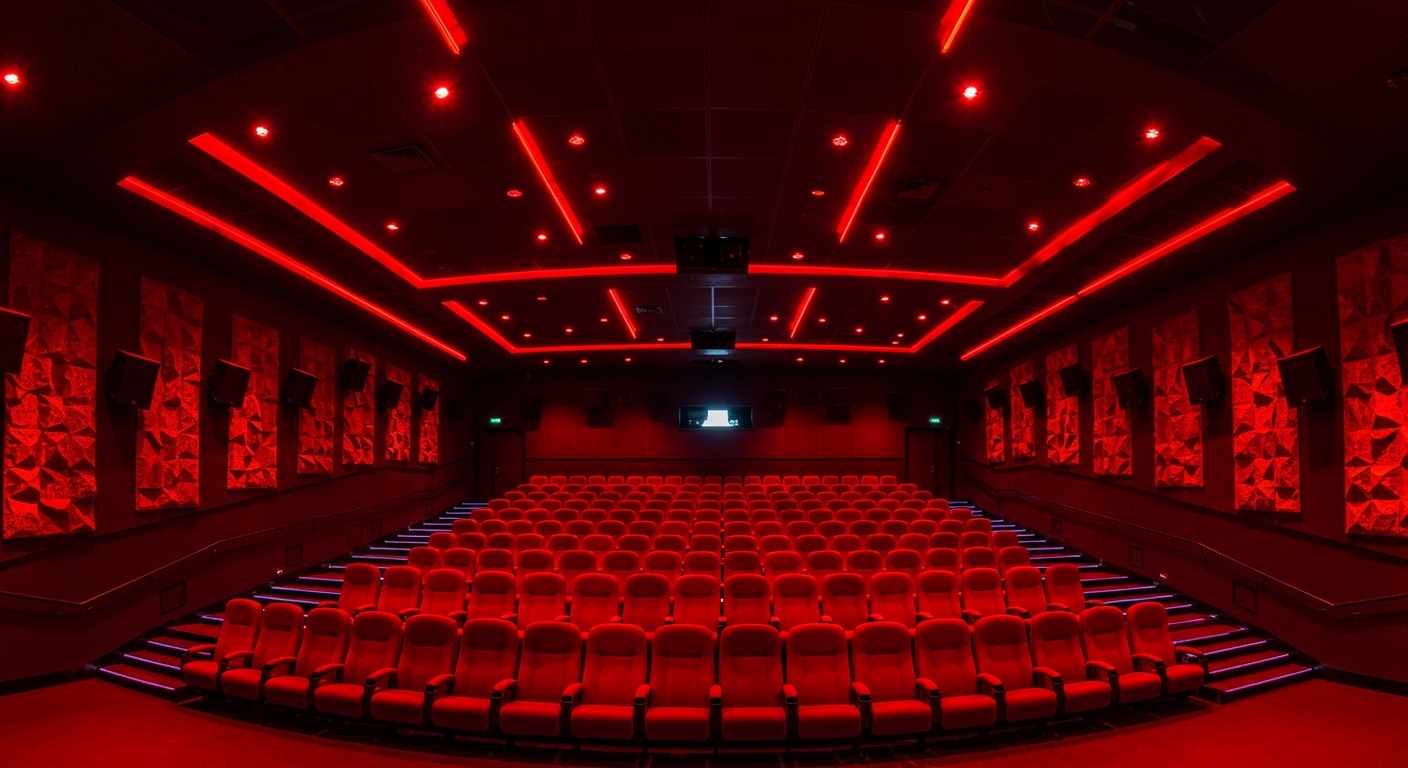
While the specific number can vary slightly based on the size of the auditorium, the 64-channel limit is the current professional standard for Dolby Atmos in commercial theaters. This setup allows sound engineers to move audio across a three-dimensional space, rather than being restricted to traditional left, right, or center channels.
Key Takeaways: Dolby Cinema Speaker Facts
- Total Count: Usually 64 speakers (the maximum for a standard Atmos processor).
- Driver Technology: Most Dolby Cinemas use SLS Audio speakers featuring Ribbon Driver technology for high-frequency clarity.
- Subwoofers: Large LFE (Low-Frequency Effects) arrays are placed behind the screen and at the back of the room.
- Transducers: Many locations include seat transducers (shakers) to let you “feel” the bass.
- The “Brain”: Managed by the Dolby CP850 or CP950 cinema processors.
How Many Speakers in Dolby Cinema? The Detailed Layout
To understand how many speakers in Dolby Cinema are working at once, we have to look at the room as a grid. Unlike your home theater, which might have 5 or 7 channels, a Dolby Cinema treats the entire room as a canvas for “sound objects.”
In our experience auditing high-end theater installations, the 64-speaker limit is strategically divided into five primary zones. Each zone serves a specific purpose in the Dolby Atmos ecosystem.
Behind-the-Screen (Stage) Speakers
Behind the acoustically transparent screen, you will find the powerhouse of the system. In a Dolby Cinema, there are typically 5 screen channels (Left, Left-Center, Center, Right-Center, and Right) rather than the standard three.
Side and Rear Surrounds
The walls are lined with dozens of speakers. These are angled precisely to ensure that even if you are sitting in the far corner, you hear a balanced mix. These speakers handle the ambient noises and directional transitions, such as a car speeding from the back of the room to the front.
Overhead (Top) Channels
This is the “secret sauce” of Dolby Cinema. Two massive rows of speakers run along the ceiling. These allow for “overhead” sounds—like rain, helicopters, or soaring birds—to feel like they are happening directly above your head.
Subwoofers (The LFE Channel)
Dolby Cinema doesn’t just use one or two subwoofers. You will find a massive “bass management” system consisting of multiple 18-inch or 21-inch subwoofers behind the screen, along with additional subwoofers in the rear of the theater to ensure uniform bass pressure.
Acoustic Transducers
While not technically “speakers” in the traditional sense, Dolby Cinema seats often include transducers. These devices convert low-frequency sound into physical vibrations, adding a tactile layer to the auditory experience.
| Speaker Category | Typical Quantity | Purpose |
|---|---|---|
| Screen Channels | 5 | Primary dialogue and front-stage action |
| Side Surrounds | 16 – 24 | Lateral movement and atmospheric depth |
| Rear Surrounds | 8 – 12 | Rear-to-front sound transitions |
| Overhead Heights | 16 – 20 | 3D verticality (Atmos height effects) |
| LFE (Subwoofers) | 4 – 8 units | Low-end impact and rumble |
Why Dolby Cinema Uses SLS Ribbon Driver Technology
During our tours of Dolby certified facilities, one thing stands out: the hardware. Most Dolby Cinema locations utilize SLS Audio speakers. These are unique because they use planar ribbon drivers instead of traditional compression drivers.
Ribbon drivers use a thin metal film to produce sound. This allows for incredibly fast response times and much lower distortion at high volumes. When you are sitting in a theater with 64 speakers, clarity is vital; traditional speakers can often sound “muddy” when so many are firing at once.
The planar technology ensures that the high frequencies don’t “drop off” as they travel from the wall to your ears. This results in a “sweet spot” that covers almost every seat in the house, not just the middle row.
Step-by-Step: How a Dolby Cinema Sound System is Calibrated
You might wonder how 64 speakers don’t just sound like a wall of noise. The process of setting up how many speakers in Dolby Cinema are active involves a rigorous calibration process.
Step 1: Room Mapping
Engineers use laser-measuring tools to map the exact dimensions of the auditorium. This data is fed into the Dolby Atmos Designer software, which calculates the ideal placement for every single driver to ensure “timbre matching.”
Step 2: Time Alignment
Because sound travels at a specific speed, a speaker 50 feet away will reach your ear later than one 10 feet away. We use high-precision microphones placed throughout the seating area to “delay” the closer speakers by milliseconds, ensuring the sound hits every listener simultaneously.
Step 3: Equalization (EQ)
Each speaker is tuned to the specific acoustics of the room. Dolby Cinema rooms are heavily treated with acoustic absorption and diffusors to prevent echoes. The EQ process flattens the frequency response, ensuring the bass isn’t “boomy” and the highs aren’t “piercing.”
Step 4: Object-Based Testing
Unlike traditional “channel-based” audio, Dolby Atmos uses “objects.” An engineer will move a virtual “sound ball” around a tablet interface, and the CP850 processor must automatically decide which of the 64 speakers need to fire to mimic that movement.
Comparing Dolby Cinema to Other Premium Formats
When deciding where to watch a blockbuster, the speaker count is a major factor. While IMAX is famous for its massive screen and raw power, Dolby Cinema focuses on precision and the number of sound sources.
- IMAX: Typically uses a 12-channel system. It relies on sheer volume and massive subwoofers to create “weighted” sound.
- Standard Cinema: Usually uses a 5.1 or 7.1 system. Sound comes from the sides and front, but never from above.
- Dolby Cinema: Uses up to 64 channels. It offers the most “surgical” sound placement available today.
We have found that for dialogue-heavy films or movies with intricate sound design (like Dune or Oppenheimer), the 64-speaker array provides a level of detail that IMAX simply cannot match.
How to Get the Dolby Cinema Experience at Home
You probably cannot fit 64 speakers in your living room, but you can mimic the Dolby Cinema logic. To get a “Lite” version of this experience, we recommend a 7.1.4 configuration.
- 7 Ground Speakers: Left, Center, Right, two Side Surrounds, and two Rear Surrounds.
- 1 Subwoofer: The “.1” that handles the heavy lifting of the low end.
- 4 Height Speakers: The “.4” that mimics the Dolby Cinema overhead rows.
By using up-firing drivers or in-ceiling speakers, you can recreate the object-based panning that makes the theater version so special. We always suggest using Dolby Atmos-enabled receivers that feature Room Correction (like Audyssey or Dirac) to manage the complexity of multiple speakers.
The Future of Cinema Audio: Beyond 64 Speakers?
While 64 speakers is the current limit for the Atmos rendering engine in commercial spaces, the technology is always evolving. We are seeing more integration of haptic feedback and even “individual sound zones” where different seats could theoretically have slightly different mixes.
For now, the 64-speaker setup remains the gold standard. It provides enough density to make the walls “disappear,” leaving the audience completely enveloped in the movie’s world.
FAQ: Common Questions About Dolby Cinema Speakers
1. Is every Dolby Cinema equipped with exactly 64 speakers?
Not necessarily. While the Atmos processor supports up to 64, smaller auditoriums may use 32 or 48. However, a “Flagship” Dolby Cinema will almost always aim for the full 64-channel array.
2. Can I hear the difference between 64 speakers and a regular theater?
Yes, absolutely. The most noticeable difference is the “overhead” sound and the smoothness of transitions. In a regular theater, you can often “point” to the speaker making the noise. In a Dolby Cinema, the sound feels like it is floating in the air.
3. What is the best seat for sound in a Dolby Cinema?
To get the most out of the 64-speaker array, sit about two-thirds of the way back, right in the center. This is where the calibration microphones are typically placed during the tuning process.
4. Does Dolby Cinema use different speakers than IMAX?
Yes. Dolby Cinema typically uses SLS Ribbon Drivers, which focus on high-fidelity and clarity. IMAX uses custom, high-output horn-loaded speakers designed for massive scale and volume.
5. Why are the speakers in Dolby Cinema hidden?
To maintain the “Black Box” aesthetic, almost all Dolby Cinema speakers are hidden behind fabric-covered acoustic panels. This prevents visual distractions and keeps the focus entirely on the Dolby Vision HDR screen.









