

Understanding How Many Watts for Boat Speakers
To determine how many watts for boat speakers you need, you should aim for a minimum of 60 to 100 watts RMS per channel for standard cabin or cockpit areas. If you are installing wakeboard tower speakers or need to overcome significant engine and wind noise at high speeds, you will likely require 150 to 300 watts RMS per speaker to maintain clear, undistorted audio.
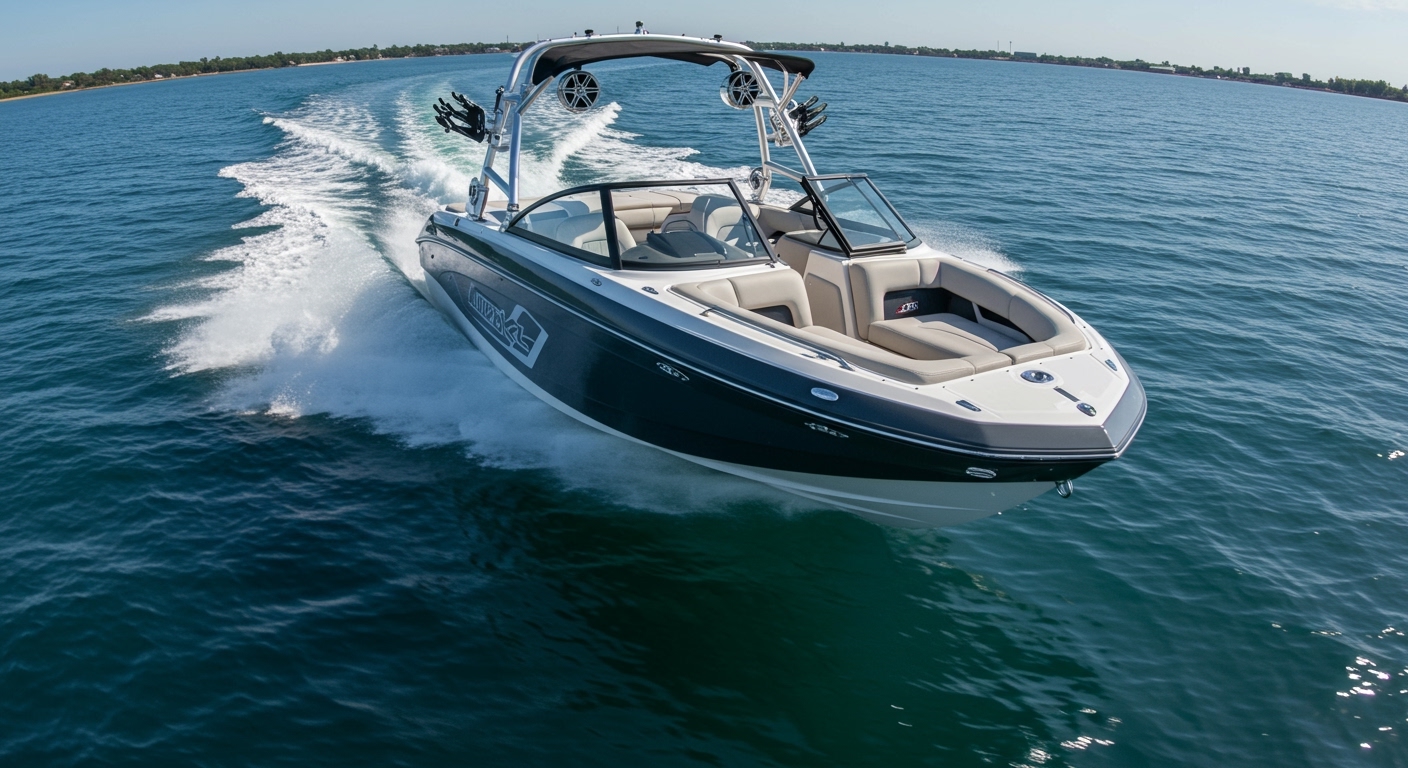
The open-air environment of a boat lacks the reflective surfaces of a car or home, meaning sound dissipates rapidly. To achieve the same perceived volume as a 50-watt car stereo, a marine system often needs double the power. Always prioritize RMS (Root Mean Square) ratings over Peak Power ratings to ensure long-term reliability and sound quality.
Key Takeaways: Marine Audio Power
- Minimum Power: 60W RMS per speaker for small boats or low speeds.
- Ideal Power: 100W–150W RMS for high-quality, “crystal clear” sound while cruising.
- Tower Speakers: 200W+ RMS is often necessary to reach riders behind the wake.
- The Golden Rule: Always match your Amplifier RMS output to the Speaker RMS handling (within 75% to 150% of the rating).
- Environmental Factor: You are fighting wind, water, and engine noise; “headroom” (extra power) prevents distortion.
Why Boat Speakers Require More Wattage Than Car Speakers
When we test marine audio systems in our shop, the first thing owners notice is how much quieter their “powerful” speakers sound once the boat hits 25 knots. This is due to the open-air environment. In a car, sound waves bounce off the glass and upholstery, creating an enclosed acoustic chamber.
On a boat, there are no walls to contain the sound. This is known as free-air dissipation. Because the sound waves travel away from you into the horizon, you need significantly more wattage to achieve a satisfying volume level.
Furthermore, you are competing with ambient noise. A typical outboard engine can produce 85 to 100 decibels (dB). To hear music clearly over that roar, your speakers must be able to produce a higher “Signal-to-Noise” ratio without clipping or distorting.
RMS vs. Peak Power: Which Metric Matters?
If you look at the packaging for a pair of JL Audio or Rockford Fosgate marine speakers, you’ll see two numbers: RMS and Peak.
- RMS Power (The Real Number): This is the amount of continuous power a speaker can handle without damage. This is the only number we use when calculating how many watts for boat speakers.
- Peak Power (The Marketing Number): This represents the maximum “burst” of energy a speaker can handle for a fraction of a second. It is largely irrelevant for choosing an amplifier or gauging performance.
Expert Tip: If a budget brand advertises “1000 Watts!” but the fine print says “50W RMS,” it is a 50-watt speaker. Always buy based on the RMS rating.
Recommended Wattage by Boat Type and Usage
Every vessel has different acoustic needs. Based on our installations, here is a breakdown of how many watts you should aim for based on your specific boating style.
| Boat Type | Recommended RMS per Speaker | Total System Setup |
|---|---|---|
| Small Fishing Boat / Pontoon | 50W – 75W RMS | 2-4 Coaxial Speakers |
| Mid-Sized Runabout (20-25ft) | 75W – 125W RMS | 4 Speakers + 10″ Subwoofer |
| Wakeboard / Ski Boat | 150W – 300W RMS | 4 Cockpit + 2 Tower Speakers |
| Luxury Yacht / Center Console | 100W – 150W RMS | Multi-zone system (8+ speakers) |
Step-by-Step Guide: How to Calculate Your Power Needs
Choosing the right power level involves more than just picking a high number. Follow these steps to ensure you don’t blow your speakers or underpower your system.
Step 1: Check the Speaker Sensitivity (dB)
Wattage is only half the story. Look for the Sensitivity rating (usually expressed as XX dB @ 1W/1M).
- A speaker with 90dB sensitivity requires less power to sound loud than one with 86dB sensitivity.
- For every 3dB increase in sensitivity, you effectively double your perceived volume without increasing wattage.
Step 2: Identify the “Power Band”
Most high-end marine speakers, such as the Fusion Signature Series, list a recommended power range (e.g., 30W to 200W RMS). We recommend targeting the top 75% of that range. If a speaker is rated for 100W RMS, feeding it 75W to 90W is the “sweet spot” for longevity and clarity.
Step 3: Match the Amplifier Impedance (Ohms)
Most boat speakers are 4-ohm speakers. Ensure your amplifier is rated to deliver your desired wattage at 4 ohms.
- If you wire two 4-ohm speakers in parallel, the load drops to 2 ohms.
- If your amp isn’t “2-ohm stable,” it will overheat and shut down.
The Role of the Marine Amplifier
You cannot achieve high-volume clarity using only the built-in power of a Marine Head Unit (Radio). Most head units only provide about 15W to 22W RMS per channel, regardless of what the “50W x 4” sticker says.
To truly answer how many watts for boat speakers, you must consider an external Marine Grade Amplifier.
- Class D Amps: These are highly efficient, run cooler, and draw less current from your boat’s batteries. They are the standard for modern marine audio.
- Headroom: Having an amp that can provide 20% more power than the speaker’s RMS rating allows you to play music at high volumes without the amplifier “clipping” (which is what actually kills speakers).
Why “Underpowering” is More Dangerous Than “Overpowering”
A common myth in the boating world is that too much wattage will “blow” the speakers. In reality, more speakers are destroyed by underpowering.
When an amplifier is too weak to drive a speaker to the desired volume, the user turns the volume up too high, causing the amp to send a “clipped” or square-wave signal. This creates massive heat in the voice coil, leading to permanent failure. We always suggest “over-provisioning” your power to ensure a clean signal.
Installation Factors: Wire Gauge and Battery Health
When pushing 100+ watts to multiple speakers, the “plumbing” of your electrical system matters.
- Wire Gauge: Use Oxygen-Free Copper (OFC) marine-grade tinned wire. For runs under 20 feet at 100W, 16-gauge is usually sufficient. For tower speakers or high-wattage subs, use 14-gauge or 12-gauge.
- Battery Capacity: High-wattage systems drain batteries fast. If you plan on playing a 600W+ RMS system while the engine is off (at a sandbar), we recommend installing a dedicated Deep Cycle House Battery and a battery isolator.
Frequently Asked Questions
Can I run 100W speakers off a 50W head unit?
Yes, you can, but you won’t get the full performance of the speaker. The sound will likely distort at higher volumes because the head unit’s small internal amplifier will “clip” long before the speaker reaches its physical limits.
Do tower speakers need more watts than cockpit speakers?
Absolutely. Tower speakers are designed to project sound 50 to 80 feet behind the boat. To maintain sound pressure over that distance and through wind resistance, they typically require 150W to 300W RMS each, whereas cockpit speakers are fine with 60W to 100W.
Does more wattage mean better sound quality?
Not necessarily, but it provides clarity at volume. High wattage allows the speaker to reproduce low-end frequencies (bass) and sharp transients (drums) more accurately when the volume is turned up.
Is it okay if my amp has more RMS than my speakers?
Yes, this is actually preferred by many professionals. Having “headroom” means the amplifier works less hard to produce the desired volume, leading to a cleaner signal. Just be careful not to turn the gain up so high that you physically exceed the speaker’s mechanical limits.









