How to Cover Speakers: A Professional Guide to Protection and Style
To cover speakers effectively, you must use acoustically transparent fabric stretched tightly over a dedicated wooden or plastic frame to protect the drivers while allowing sound waves to pass through unobstructed. The process involves measuring the speaker baffle, building a frame (if one isn’t present), and securing the cloth using high-strength adhesive or a pneumatic stapler for a professional, wrinkle-free finish.
Whether you are restoring a pair of vintage bookshelf speakers or finishing a custom home theater build, the cover—often called a speaker grill—serves two purposes: protecting delicate tweeter domes and woofer surrounds from dust and physical damage, and blending the hardware into your room’s decor. Based on my years of experience building custom audio enclosures, the difference between a DIY project and a professional-grade finish lies in the tension of the fabric and the quality of the frame.
TL;DR: Key Takeaways for Covering Speakers
- Fabric Choice is Critical: Only use acoustically transparent materials like Mellotone or specialized polyester mesh to avoid “muffling” high frequencies.
- Frame Stability: Use MDF (Medium Density Fiberboard) or plywood for the frame to prevent warping under the tension of the fabric.
- The Secret is in the Corners: Use a “hospital fold” technique to ensure corners are flat and don’t interfere with the speaker’s fit.
- Attachment Methods: Use Neodymium magnets for a modern, “floating” look, or traditional plastic grill pegs for a secure, classic fit.
Essential Materials for Covering Your Speakers
Before you begin the process of how to cover speakers, you need the right tools. Using standard upholstery fabric or heavy burlap will dampen your sound quality by as much as 3-5 decibels in the high-frequency range, which ruins the “sparkle” of your audio.
| Material / Tool | Purpose | Expert Recommendation |
|---|---|---|
| Speaker Grill Cloth | Sound transparency | Polyester Mesh or Mellotone |
| Frame Material | Structural support | 1/4″ or 1/2″ MDF |
| Adhesive | Securing fabric | 3M Super 77 Spray Adhesive |
| Fasteners | Attaching grill to speaker | Neodymium Magnets or Ball-and-Socket Pegs |
| Cutting Tool | Precise fabric trimming | Rotary Cutter or Fabric Shears |
| Staple Gun | Mechanical fastening | Electric or Pneumatic Stapler (1/4″ staples) |
Step 1: Measuring and Building the Speaker Frame
If your speakers didn’t come with grills, or if the old ones are broken, you’ll need to build a new frame. This is the foundation of how to cover speakers properly.
- Measure the Baffle: Measure the front face (the baffle) of your speaker cabinet. Subtract about 1/16th of an inch from each side to ensure the grill doesn’t rub against the cabinet edges.
- Cut the Outer Frame: Using a table saw or a jigsaw, cut your MDF to the measured dimensions.
- Create the Cutouts: Mark the locations of your woofers and tweeters. Use a jigsaw to cut out the center of the frame, leaving a “border” or “skeleton” that is roughly 0.75 to 1 inch wide.
- Sand the Edges: I always recommend rounding over the outer edges with sandpaper or a router. This prevents the fabric from tearing on sharp corners and improves the diffraction of sound waves around the cabinet.
Step 2: Selecting the Best Acoustically Transparent Fabric
You cannot use just any cloth when learning how to cover speakers. Sound is a physical wave; if the weave of the fabric is too tight, it acts as a filter.
- Polyester Knit: This is the industry standard. It is stretchy, durable, and has a wide-open weave that allows sound to pass through with almost zero insertion loss.
- Retro Linen/Burlap: Often seen on vintage Guitar Amps or Fender cabinets. While stylish, these are thicker and can slightly roll off frequencies above 15kHz.
- Metal Mesh: Best for subwoofers or car audio where physical impact protection is the priority over pure audiophile transparency.
Pro Tip: To test a fabric’s transparency, hold it up to a light source. If you can clearly see light passing through the pores, it is likely safe for audio use. Better yet, try to breathe through it. If you feel significant resistance, your speaker will “struggle” to push sound through it too.
Step 3: Preparing the Fabric and Adhesive
When covering speakers, cleanliness is paramount. Dust or wood shavings trapped under the cloth will create visible bumps.
- Iron the Fabric: If your speaker grill cloth has creases from shipping, use a low-heat iron. Creases are nearly impossible to “pull out” once the fabric is glued down.
- Oversize the Cut: Lay your frame on the fabric and cut the cloth so you have at least 2 inches of overhang on all four sides. This gives you enough “meat” to pull and tension the material.
- Apply Adhesive: If using spray adhesive like 3M Super 77, apply a light coat to the front face and sides of the frame. Wait 30-60 seconds until it becomes tacky. Do not spray the fabric directly, as it can soak through and create ugly wet spots.
Step 4: The Stretching and Securing Process
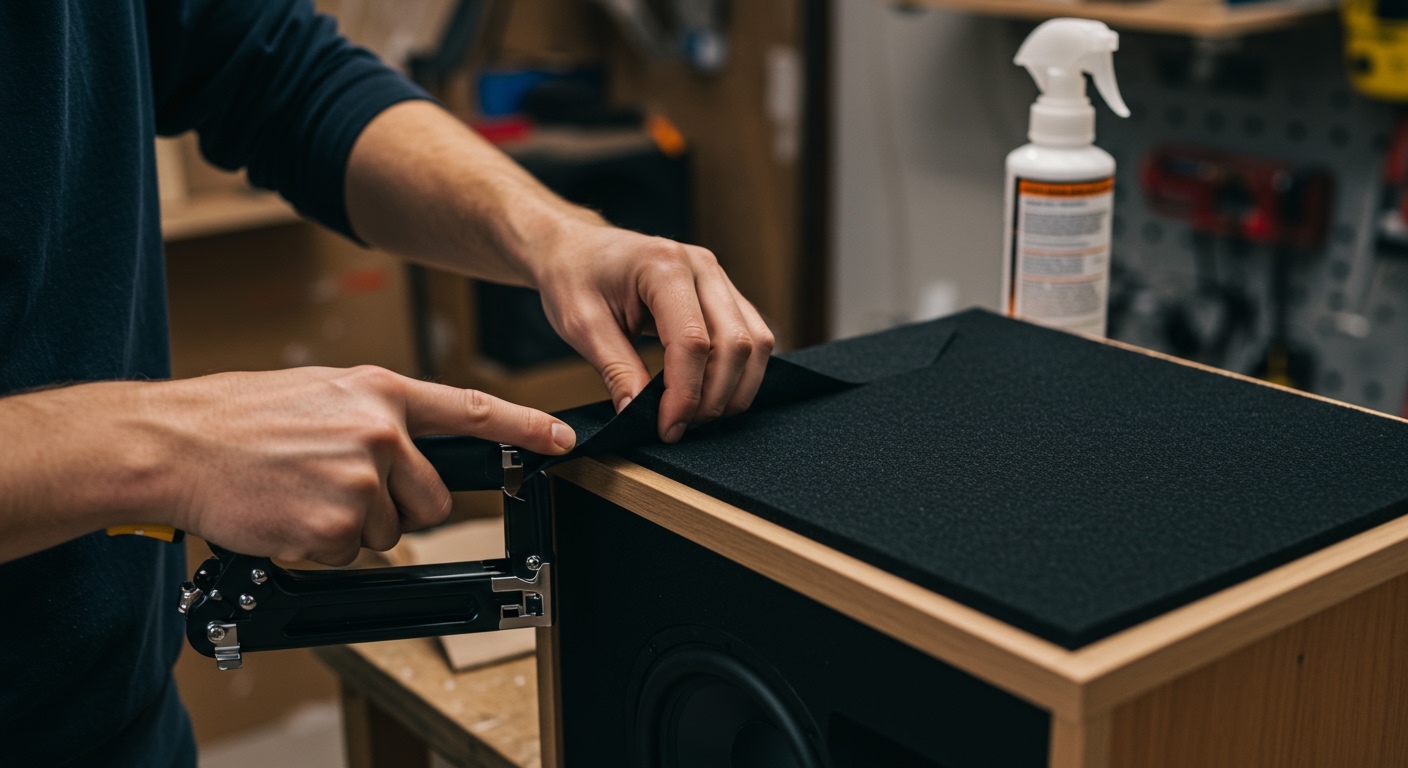
This is where the magic happens. A loose speaker cover looks amateur and may even rattle or vibrate (chatter) against the frame during heavy bass notes.
- The “North-South” Stretch: Tack the center of the top edge, then pull the fabric tight and tack the center of the bottom edge. Ensure the grain of the fabric is straight.
- The “East-West” Stretch: Repeat this for the left and right sides. You should now have a “diamond” tension pattern.
- Work Toward the Corners: Gradually work from the center out toward the corners, stapling or gluing every 1-2 inches.
- The Hospital Fold: When you reach the corner, pull the fabric toward the center of the frame, fold the excess neatly (like a gift wrap or a hotel bed sheet), and secure it. This ensures the corner remains flush and doesn’t protrude.
Step 5: Mounting the Cover to the Speaker Cabinet
Once you have mastered how to cover speakers with fabric, you need to attach the grill to the cabinet. We use three primary methods in the shop:
Comparison of Mounting Methods
| Method | Best For | Pros | Cons |
|---|---|---|---|
| Friction Pegs | Traditional Speakers | Very secure; cheap | Requires drilling holes in the baffle |
| Neodymium Magnets | High-end / Modern | Invisible; very “clean” look | Requires precise alignment; can be pricey |
| Hook and Loop (Velcro) | Budget / DIY | Easy to install | Can look bulky; adhesive may fail over time |
Expert Insight: If you use magnets, ensure you countersink them into the frame and the cabinet baffle. Use a drop of 2-part epoxy to secure them. There is nothing more frustrating than a magnet pulling out of the wood and sticking to its partner when you try to remove the grill!
Maintaining and Cleaning Your Speaker Covers
Knowing how to cover speakers also involves knowing how to keep them looking new.
- Dusting: Use a lint roller or a soft brush vacuum attachment once a month.
- Deep Cleaning: If the fabric becomes stained, remove the grill from the speaker. Use a mixture of warm water and a drop of mild dish soap. Dab (don’t rub) the area with a microfiber cloth.
- Avoid Sunlight: Prolonged exposure to UV rays will fade black polyester grill cloth to a dull grey. If your speakers are near a window, consider using UV-resistant fabric or keeping the blinds closed during peak hours.
Troubleshooting Common Speaker Covering Issues
The Fabric is Sagging
If your fabric sags after a few weeks, it likely wasn’t tensioned enough during the initial install or the humidity has affected the fibers. To fix this without a full rebuild, you can sometimes use a hairdryer on a medium-heat setting. Gently heat the polyester fabric; it has a slight heat-shrink property that can tighten up minor sags.
The Grill Rattles at High Volume
This usually happens if the frame is touching the speaker surround. Ensure your frame is thick enough (at least 1/2 inch) to provide clearance for the “throw” or excursion of the woofer. If it still rattles, add small felt pads or rubber bumpers to the corners of the frame where it meets the cabinet.
Visible Glue Seepage
If you see glue spots on the front of the fabric, you used too much adhesive or didn’t let it “off-gas” enough before applying the cloth. Unfortunately, the only real fix for this is to strip the fabric and start over. Always use light, misty coats.
Frequently Asked Questions
Does covering speakers affect sound quality?
If you use acoustically transparent grill cloth, the effect is negligible (usually less than 0.5dB loss). However, using thick fabrics like denim or heavy canvas will significantly muffle the high frequencies, making the audio sound “dark” or “muddy.”
Can I paint my speaker covers?
You can paint metal mesh grills using spray paint. However, you should never paint fabric covers. The paint will fill the pores of the weave, effectively turning the fabric into a solid wall that reflects sound rather than letting it pass through.
What is the best way to cut speaker grill cloth?
I recommend using a rotary cutter (like those used in quilting) and a straight edge. This prevents the fabric from “bunching” or “fraying” which often happens when using standard household scissors.
How do I cover speakers that have a curved front?
Curved baffles require flexible MDF or thin layers of plywood laminated together. When stretching fabric over a curve, you must pull from the center of the curve outward to avoid “puckering” at the edges.