

Understanding How to Hang Speakers from Truss Safely
To hang speakers from truss, you must utilize load-rated rigging hardware—specifically truss clamps, shackles, or spansets—attached directly to the speaker’s integrated fly points. Always ensure the total weight of the speaker and cabling does not exceed the Working Load Limit (WLL) of the truss or the individual rigging points. Safety is paramount; every overhead speaker must have a secondary safety cable secured to a structural member of the truss.
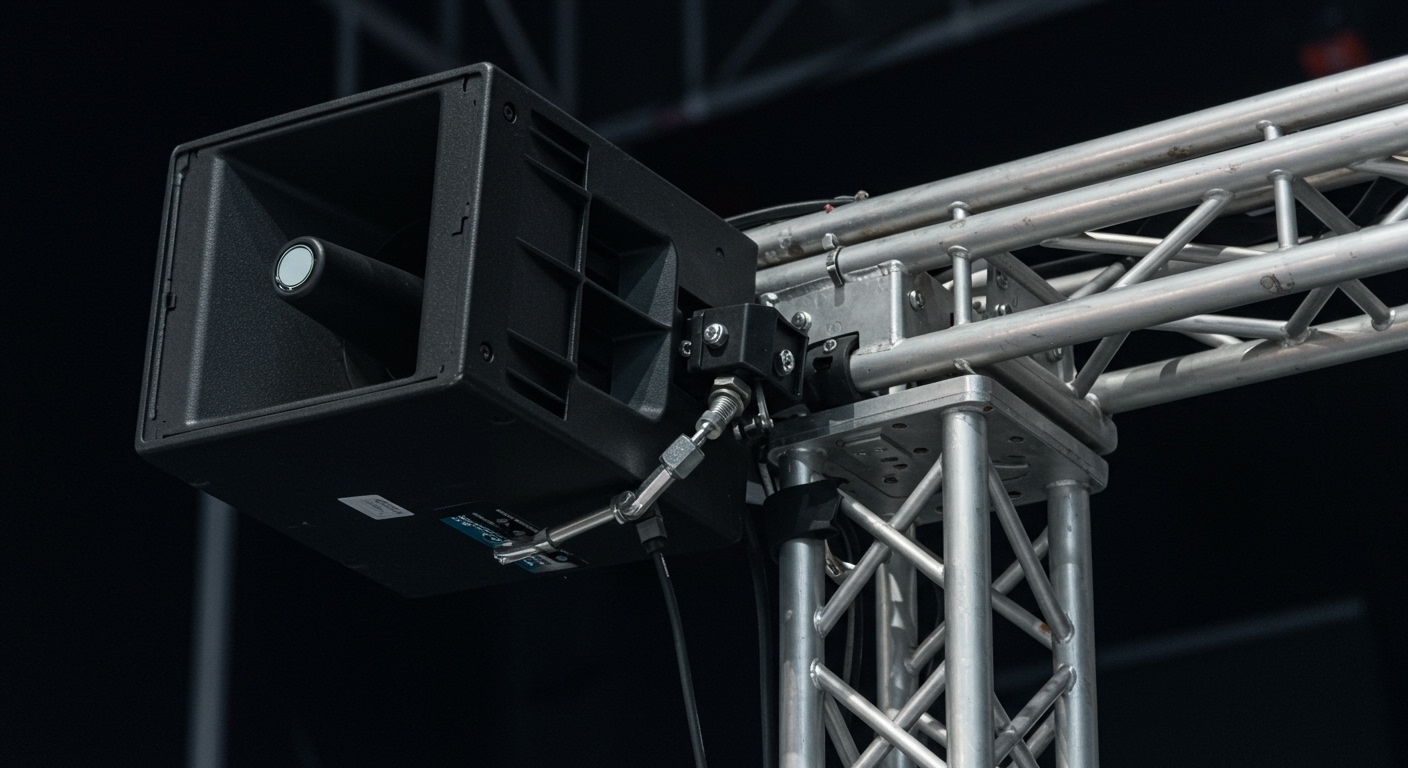
TL;DR: Key Takeaways for Truss Rigging
- Safety First: Never use hardware from a hardware store; only use rated rigging gear.
- Calculate Loads: Verify the Point Load capacity of your truss before lifting.
- Redundancy: Every speaker requires a secondary safety bond (safety cable).
- Orientation: Ensure the speaker’s fly-ware is designed for the angle you intend to hang it.
- Inspection: Check all bolts, clamps, and cables for wear or “bird-caging” before every event.
Why Professional Rigging Standards Matter
Over the last decade of managing live event productions, I have seen that the most overlooked aspect of stage setup is often the mechanical stress placed on overhead structures. Learning how to hang speakers from truss isn’t just about making things look clean; it is about preventing catastrophic structural failure.
When you suspend a point-source speaker or a line array, you are dealing with “overhead suspension.” This falls under strict OSHA and ESTA (Entertainment Services and Technology Association) standards. If a piece of gear fails, the consequences are life-threatening. We always follow a 5:1 or 10:1 Design Factor, meaning the hardware must be capable of holding 5 to 10 times the actual weight of the speaker.
Essential Hardware for Hanging Speakers
Before you begin, you must gather the correct tools. Using “good enough” hardware is the fastest way to cause an accident. We only use forged steel or high-grade aluminum components from reputable brands like Global Truss, Chauvet, or CML.
| Hardware Item | Purpose | Key Specification |
|---|---|---|
| Truss Clamp | Connects the speaker bracket to the truss cord. | 50mm (2-inch) for standard truss. |
| Eye Bolt | Screws into the speaker’s M10 or M12 fly points. | Must be Forged Shouldered eye bolts. |
| Shackle | Connects eye bolts to chains or wire rope. | Look for the Screw Pin variety. |
| Safety Cable | Provides a secondary fail-safe attachment. | Usually 3mm to 6mm galvanized steel. |
| Spanset | A polyester round-sling used for “choking” the truss. | Black is industry standard for invisibility. |
Step 1: Inspecting Your Rigging Points
Every professional PA speaker intended for suspension has internal reinforcement called fly points. These are usually threaded inserts (often M10 or M12).
I recommend physically checking these inserts before every show. Look for any cross-threading or looseness in the cabinet. If the internal bracing of the speaker is compromised, it cannot be safely hung, regardless of how strong your truss clamps are.
Step 2: Choosing the Right Truss Clamps
When learning how to hang speakers from truss, the choice of clamp is your most critical decision. Most mobile DJ and stage trussing uses a 50mm (2-inch) outer diameter tube.
- Trigger Clamps: These are excellent for one-person setups. They allow you to “hook” the speaker onto the truss before tightening the bolt.
- Wrap-Around Clamps: These provide the most security as they fully encircle the truss chord, distributing the weight evenly.
- Couplers: These are heavy-duty and best for permanent installations or heavy line array blocks.
Step 3: Attaching Hardware to the Speaker
First, remove the decorative plastic caps from the speaker’s fly points. Screw in your forged shoulder eye bolts. It is vital that the shoulder of the eye bolt is flush against the speaker cabinet to prevent bending.
Once the eye bolts are secure, attach a shackle to the eye bolt. If you are using a yoke mount (a U-shaped bracket), you will bolt the truss clamp directly to the center hole of the yoke using a Grade 8 bolt and a nylon locking nut.
Step 4: Lifting and Securing to the Truss
This is a two-person job. While one person steadies the speaker, the other guides the truss clamp over the cord.
Pro Tip: Always hang speakers from the main chords (the thick outer tubes) of the truss, never the thin diagonal webbing. The diagonal braces are not designed to support direct vertical loads and can bend under the weight of a heavy 15-inch powered speaker.
Tighten the wing nut or bolt on the clamp until it is hand-tight, then give it a quarter-turn with a wrench or C-wrench. Do not over-tighten, as you can crush the aluminum tubing of the truss.
Step 5: Implementing the Secondary Safety Bond
The safety cable is your “insurance policy.” Even if the main clamp fails or the bolt snaps, the safety cable should prevent the speaker from hitting the ground.
Loop the safety cable through the speaker’s handle or a secondary fly point and wrap it around the main chord of the truss. Keep the “drop” as short as possible. If the speaker falls, a long cable will allow it to gain momentum, potentially snapping the cable or pulling the entire truss down.
Understanding Truss Load Capacities
You cannot simply hang as many speakers as you want. Every truss manufacturer provides a Load Table. You must differentiate between Uniformly Distributed Load (UDL) and Center Point Load (CPL).
- Uniformly Distributed Load: Weight spread evenly across the entire span.
- Point Load: A heavy weight (like a speaker) concentrated in one spot.
- Cantilever Load: Weight hanging off an overhanging section of truss.
I have found that most 12-inch square aluminum truss can handle a CPL of about 500-800 lbs over a 10-foot span, but this decreases significantly as the span increases. Always subtract the weight of your moving head lights and cabling before calculating how many speakers you can hang.
Cable Management for Flown Speakers
Once the speaker is hung, the dangling power and XLR cables can look messy and create a trip hazard. Use black electrical tape or hook-and-loop fasteners (Velcro) to secure the cables along the truss chords.
Always leave a small “drip loop” at the back of the speaker. This prevents moisture from running down the cable into the electronics and provides a bit of slack in case the speaker needs to be re-aimed.
Common Mistakes to Avoid
In my experience, these four mistakes cause 90% of rigging failures:
- Using Carabiners: Never use climbing carabiners for overhead lifting. Use rated shackles with screw pins.
- Side-Loading Eye Bolts: Standard eye bolts lose up to 75% of their strength if pulled at an angle. Use swivel hoist rings if you need to angle the speaker sharply.
- Mixing Metals: Be careful when using steel clamps on aluminum truss without protection, as it can cause “galvanic corrosion” over time in permanent installs.
- Ignoring the Wind: If you are hanging speakers from truss outdoors, the speaker acts like a sail. Wind loads can easily double the effective weight on your truss.
Advanced: Hanging Line Arrays vs. Point Source
If you are moving beyond a single speaker to a line array, the process changes. You will typically use a Grid or Fly Bar.
The Fly Bar is attached to the truss using electric chain hoists (like CM Lodestars). This allows you to build the array on the ground and lift it into the air. When doing this, ensure your truss is supported by heavy-duty crank stands or motorized lifts that are rated for the total weight of the array plus the motors themselves.
Maintenance and Logbooks
If you own your rigging gear, keep a logbook. We inspect our slings, clamps, and cables every six months. If a cable has a “kink” or a clamp has a cracked weld, we destroy it immediately. It is never worth “taking a chance” with overhead gear.
Frequently Asked Questions
Q: Can I use ratcheting tie-down straps to hang speakers?
A: Absolutely not. Ratchet straps are designed for securing loads on trucks and are not rated for overhead suspension. The webbing can degrade under UV light, and the ratcheting mechanism can fail under constant tension.
Q: How do I know if my speaker is “flyable”?
A: Check the manufacturer’s manual. A flyable speaker will have internal metal reinforcement and specified fly points. If the speaker cabinet is just plastic or wood with no threaded inserts, it is not designed to be hung.
Q: Is it better to use a yoke mount or eye bolts?
A: For most single speakers, a yoke mount is superior because it allows for easy “tilt and pan” adjustments. However, eye bolts with a 3-point bridle are often used for permanent installs to achieve very specific downward angles.
Q: What is the best height to hang speakers from truss?
A: For most events, the bottom of the speaker should be at least 7 to 8 feet above the floor to avoid deafening guests in the front row. However, you must ensure your truss stands are rated to be stable at that height.









