

Understanding How to Install Bluetooth Speakers in a Golf Cart
To install Bluetooth speakers in a golf cart, you must first select a mounting location (like the dash or roof), connect the speakers to a 12V power source, and secure the wiring to prevent damage during movement. If your cart runs on a 36V or 48V battery system, you will specifically need a voltage reducer to avoid frying your new audio equipment. Following these steps ensures a professional-grade sound system that withstands the vibrations and weather conditions of the golf course.
🚀 Key Takeaways: Quick Install Guide
- Power Requirements: Most Bluetooth speakers require 12 Volts. Always use a voltage reducer on 36V or 48V carts.
- Speaker Types: Choose Marine Grade (IPX6/7) speakers to protect against rain, dust, and UV rays.
- Mounting Options: Soundbars are easiest for DIYers, while component speakers offer a sleek, factory-integrated look.
- Safety First: Always disconnect the Main Negative battery cable before starting any electrical work.
- Wiring: Use 16-gauge marine-grade wire and heat-shrink connectors to prevent corrosion.
Choosing the Right Audio System for Your Golf Cart
Before we dive into the physical labor, we need to pick the hardware. In my years of custom cart builds, I have found that “one size fits all” rarely works. Your choice depends on your technical skill and how much space you are willing to sacrifice.
Bluetooth Soundbars vs. Pod Speakers
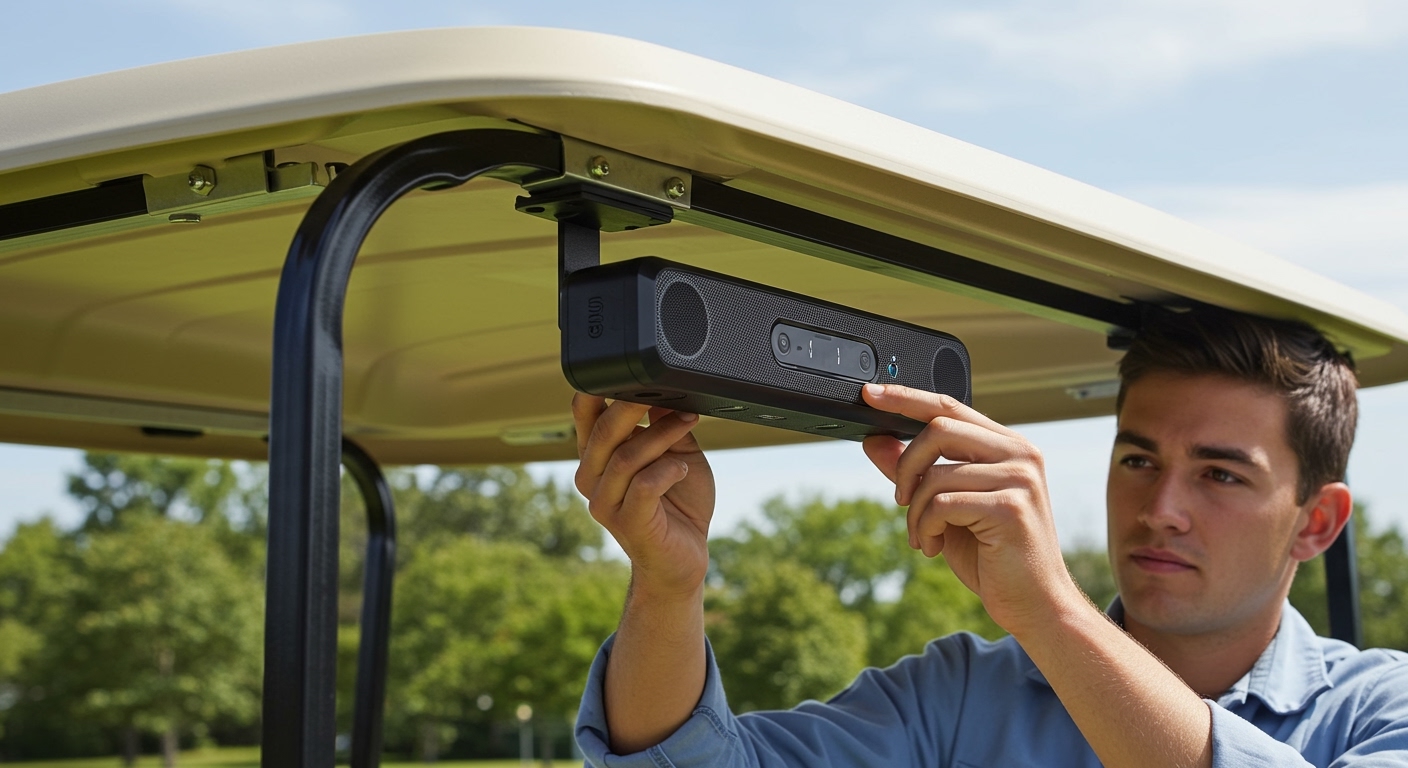
Bluetooth soundbars are the most popular “all-in-one” solution. They typically include the amplifier, speakers, and Bluetooth receiver in a single housing. You simply mount them to the rear roof supports or the front dash.
Pod speakers or flush-mount speakers require more work. You will need to cut holes in the body or dash. However, these provide a much better “surround sound” feel and don’t block your rearview mirror.
| Feature | Bluetooth Soundbar | Component/Pod Speakers |
|---|---|---|
| Ease of Install | Very High (Bolt-on) | Moderate (Requires cutting) |
| Audio Quality | Good (Focused direction) | Excellent (Stereo separation) |
| Space Usage | Mounts to roof/struts | Mounts in-dash or under-seat |
| Durability | High (Self-contained) | High (If marine-rated) |
Essential Tools and Materials
Having the right tools is the difference between a 1-hour job and an all-day headache. I recommend gathering these before you strip a single wire.
Required Tools
- Cordless Drill with various bits.
- Hole Saw (if installing flush-mount speakers).
- Wire Strippers and Crimping Tool.
- Multimeter (to test battery voltage).
- Socket Wrench Set.
- Fish Tape (to pull wires through the frame).
Required Materials
- Marine-Grade Bluetooth Speakers or Soundbar.
- Voltage Reducer (12V Output).
- Inline Fuse Holder (15A or 20A).
- 16-AWG Primary Wire.
- Zip Ties (UV resistant).
- Heat Shrink Tubing.
Step 1: Planning Your Power Source
This is where most DIYers make a mistake. Golf carts do not operate like cars. A standard gas car has a 12V battery. Electric golf carts use a “battery pack” consisting of multiple 6V, 8V, or 12V batteries wired in a series.
Determining Your Voltage
Check the labels on your batteries. If you have six 8V batteries, your total pack is 48 Volts. If you connect a 12V Bluetooth speaker directly to a 48V pack, the unit will explode or catch fire instantly.
The Role of the Voltage Reducer
We strongly recommend installing a 36V/48V to 12V DC-DC Converter. This device “taps” into the entire battery pack and outputs a steady 12V stream. This ensures your batteries drain evenly. If you pull 12V from just two batteries in a series, you will cause an imbalance, shortening the lifespan of your expensive battery pack.
Step 2: Preparing the Mounting Location
When learning how to install bluetooth speakers in golf cart frames, placement is everything. You want the sound to reach your ears, not the ground.
Dash Mounting
If you have a Yamaha, EZGO, or Club Car, the dash usually has empty “cubbies.” You can buy pre-cut dash kits that fit 6.5-inch speakers perfectly.
- Pro Tip: Use a painter’s tape mask over the plastic before cutting to prevent the drill or saw from chipping the finish.
Roof Mounting
Mounting to the roof struts is common for soundbars like those from Bazooka or Ecoxgear.
- Safety Check: Ensure the mounting brackets are tightened to the metal struts, not just the plastic roof canopy. The vibration from driving will eventually rattle a plastic-only mount loose.
Step 3: Running the Wiring
Wiring is the “nervous system” of your audio setup. It needs to be hidden and protected.
- Route the wires: Follow the existing wiring loom of the golf cart. Most carts have a channel running under the floor mat or through the frame rails.
- Avoid Moving Parts: Keep wires away from the steering column, brake linkage, and suspension.
- Use Zip Ties: Every 12 inches, secure the wire to the frame. This prevents the wires from snagging on brush or debris while you are off-roading or on the trail.
Step 4: Connecting to the Battery Pack
Now it’s time to get powered up. Follow this sequence carefully to avoid sparks.
- Turn the Key to OFF: Put the cart in TOW mode if it’s an electric model.
- Install the Voltage Reducer: Mount the reducer in a ventilated area (it gets hot). Connect the input wires to the Main Positive and Main Negative of the entire battery pack.
- Add an Inline Fuse: On the 12V output wire (positive), install an inline fuse holder. This protects your speakers from a power surge.
- Connect the Speaker: Connect the speaker’s red wire to the fused 12V output and the black wire to the 12V negative output.
Step 5: Mounting and Finishing
With the wiring tested, finish the physical installation.
- Seal the Holes: If you cut into the dash, use a bead of silicone sealant around the speaker rim. This prevents water from leaking into the electrical components behind the dash.
- Secure the Unit: Double-check all bolts. I recommend using Blue Loctite on mounting screws to prevent them from vibrating out over time.
- Tidy Up: Use a split-loom tubing to cover exposed wires. This gives the install a “factory” look and provides an extra layer of protection against the elements.
Step 6: Pairing and Tuning
The final step in how to install bluetooth speakers in golf cart systems is the software side.
- Turn on the cart and switch to RUN mode.
- Power on your Bluetooth speaker.
- Open the Bluetooth settings on your phone and look for the device name (e.g., “Boss Audio” or “Wet Sounds”).
- Tuning: Adjust the Equalizer (EQ) on your phone. Because golf carts are open-air vehicles, you typically need to boost the Mid-range and Treble to cut through wind and motor noise.
Troubleshooting Common Installation Issues
Even the best pros run into snags. Here are the top three issues I see:
Issue 1: “Engine” Whine or Buzzing
This is usually caused by a Ground Loop. Ensure your speaker ground is connected to the voltage reducer, not the cart’s metal frame. Modern golf carts use an “ungrounded” system to prevent frame corrosion.
Issue 2: Bluetooth Keeps Disconnecting
Check your power source. If the voltage drops too low when you accelerate the cart, the Bluetooth chip may reset. This is a sign that your voltage reducer is undersized or your batteries are weak.
Issue 3: No Sound After Rain
Even if speakers are “Marine Grade,” the wiring connections behind them might not be. Check for green corrosion on the terminals. Clean them with contact cleaner and apply dielectric grease.
FAQ: Frequently Asked Questions
Can I install a car stereo in a golf cart?
Yes, but it is not recommended unless the unit is Marine Rated. Standard car stereos have open vents that allow moisture and dust to enter, which will destroy the internal circuitry within a few months of outdoor use.
Do I need a separate battery for my golf cart speakers?
While you can use a dedicated 12V deep-cycle battery, it adds significant weight and requires a separate charging routine. Using a voltage reducer on your existing battery pack is the more efficient and professional solution.
How many watts do I need for a golf cart?
Because golf carts are open to the environment, sound dissipates quickly. I recommend a system with at least 40-50 Watts RMS per channel. If you are using a soundbar, look for one rated at 200 Watts peak or higher to ensure you can hear it clearly while driving at full speed.
Will a Bluetooth speaker drain my golf cart battery?
Modern LED-lit Bluetooth speakers and amplifiers pull very little current compared to the electric motor. You can typically play music for 10-15 hours without significantly impacting your driving range. However, always turn the system off when the cart is stored for long periods.









