

Mastering Your Audio: How to Install Bowers and Wilkins Ceiling Speakers
To how to install bowers and wilkins ceiling speakers effectively, you must map your ceiling joists, cut a precise aperture using the provided template, and secure the unit using the proprietary QuickDogs™ fastening system. This professional-grade installation ensures the Bowers & Wilkins (B&W) drivers remain decoupled from the drywall, preventing unwanted vibrations and maximizing the signature Carbon Dome or Continuum cone performance.
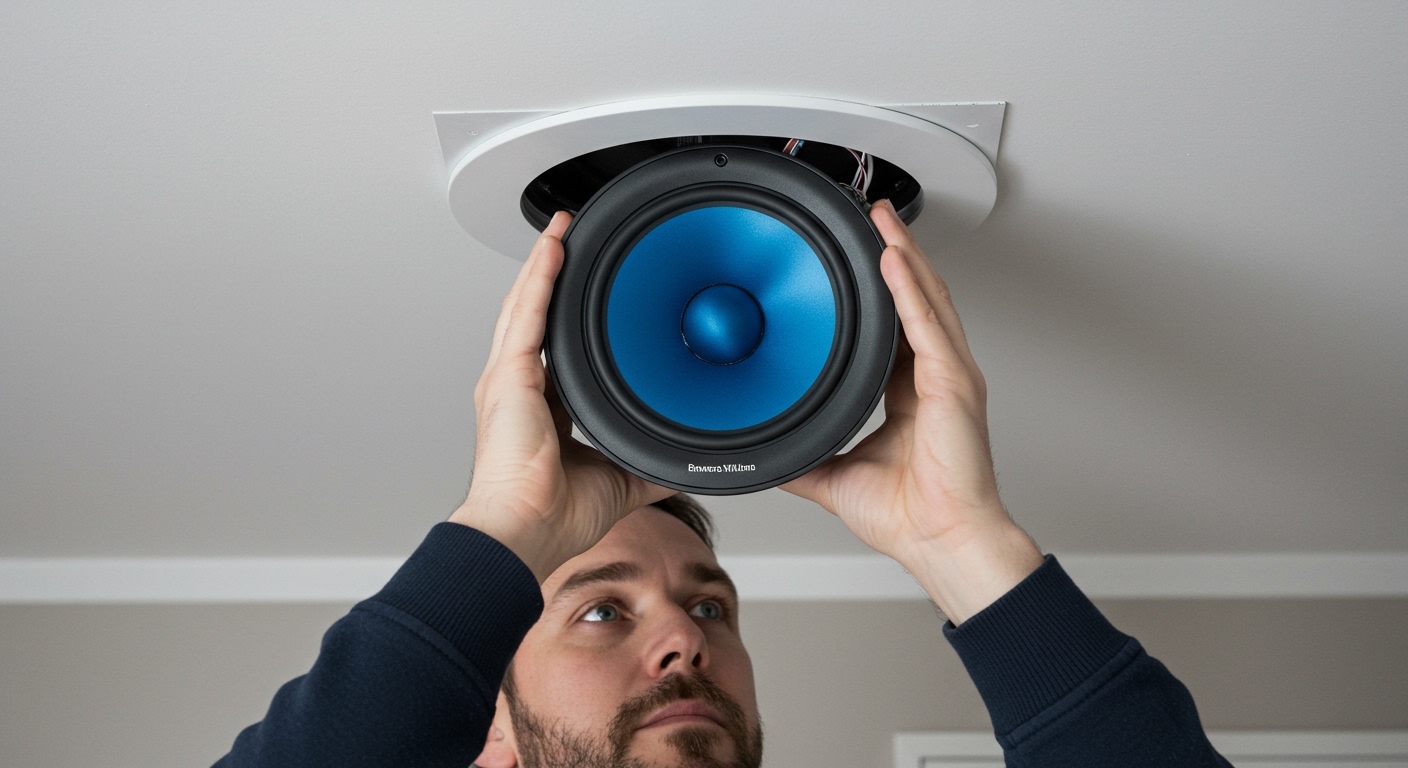
In my years of high-end home theater integration, I have found that while B&W speakers are designed for ease of use, the difference between a “good” install and a “breathtaking” one lies in the precision of the placement and the quality of the CL3-rated wiring used. This guide walks you through every technical nuance to ensure your CCM Series speakers perform exactly as the engineers in Worthing, England, intended.
TL;DR: Key Takeaways for B&W Installation
- Precision Cutting: Always use the cardboard template provided; B&W tolerances are tight.
- QuickDogs™ System: These spring-loaded clamps make installation tool-less once the hole is cut.
- Wiring Matters: Use at least 16-gauge (16/2) oxygen-free copper wire for runs under 50 feet.
- Back Boxes: For optimal bass response and fire safety, always use an integrated B&W Back Box if the ceiling cavity is shared or open.
- Tweeter Aiming: Most B&W CCM models feature a pivoting tweeter; aim these toward the primary listening position (the “Sweet Spot”).
Essential Tools and Materials for the Job
Before you climb the ladder, you need a specific kit to ensure you don’t damage your premium Bowers & Wilkins hardware or your ceiling. We have tested various drywall saws, and a fine-tooth blade is always better for preventing “blow-out” on the edges of your cut.
| Tool Category | Recommended Item | Purpose |
|---|---|---|
| Measurement | Laser Level & Tape Measure | Ensures perfectly aligned, symmetrical speaker rows. |
| Cutting | Manual Drywall Saw or RotoZip | Creating the circular aperture for the speaker frame. |
| Detection | Deep-Scan Stud Finder | Locating joists, HVAC ducts, and electrical wires. |
| Connectivity | 14/2 or 16/2 CL3 Wire | High-fidelity signal transfer and fire-code compliance. |
| Finishing | Magnetic Grille Tool | Removing and attaching the ultra-fine B&W grilles. |
Choosing the Right Speaker Wire
For how to install bowers and wilkins ceiling speakers with zero signal loss, we recommend 14-gauge wire for runs exceeding 50 feet. This reduces impedance and ensures the high-current demands of the B&W crossovers are met without overheating or thinning the sound.
Step 1: Strategic Placement and Acoustic Mapping
The most common mistake I see in DIY installs is placing speakers too close to a wall. This creates “boundary gain,” which makes the bass muddy and destroys the legendary B&W clarity.
The 30-Degree Rule
For a stereo pair, aim to place the speakers at a 30-degree angle from the listener’s head. If you are installing a 7.1.4 Dolby Atmos system, the overhead speakers should be aligned with the front left and right speakers to maintain a cohesive soundstage.
Avoiding Obstructions
Use your stud finder to map out the “bays” between your ceiling joists. Bowers & Wilkins CCM663 and CCM683 models require a specific depth (usually around 4-5 inches); ensure there are no plumbing stacks or electrical junctions blocking the insertion depth.
Step 2: Marking and Cutting the Aperture
Once you’ve confirmed the location is clear of joists, tape the B&W cutting template to the ceiling. I always recommend using a small “pilot hole” first.
The Pilot Hole Technique
Insert a stiff piece of wire (like a coat hanger) into a small 1/8-inch hole and spin it around. If the wire hits an obstruction, you can easily patch a tiny hole, whereas a full 8-inch hole is a much larger headache to repair.
Executing the Cut
Follow the outer line of the template with your drywall saw. Hold the saw at a 90-degree angle to the ceiling to ensure the QuickDogs™ have a flat surface to grip onto. If the cut is slanted, the speaker flange may not sit flush, causing an audible air leak.
Step 3: Wiring and Back Box Integration
With the hole open, reach inside and pull your CL3 speaker wire through. If you are installing in a new construction environment, you should have already used B&W Pre-Mount Kits.
Integrating the Back Box
If your model supports it (like the CCM7.5 S2), install the B&W Back Box now. These boxes serve two purposes:
- Acoustic Isolation: They prevent sound from traveling to the room above.
- Consistent Performance: They provide a fixed volume of air, ensuring the woofer behaves predictably.
Stripping and Terminating
Strip approximately 1/2 inch of the jacket off the wire. B&W speakers typically use high-quality gold-plated spring terminals. Ensure no stray wire strands are touching the opposite terminal, as this could short out your Rotel or Classé amplifier.
Step 4: Mounting with the QuickDogs™ System
One of the reasons I love how to install bowers and wilkins ceiling speakers is the QuickDogs™ mechanism. This is a tool-less, spring-loaded system that makes the final mounting a breeze.
Engaging the Clamps
- Align the speaker frame with the hole.
- Push the speaker up into the cavity.
- Push down on the QuickDogs™ tabs located on the side of the frame.
- The clamps will swing out and snap tight against the top of the drywall.
Ensuring a Flush Fit
If the speaker feels loose, you can use a Phillips screwdriver to manually tighten the QuickDogs™. Do not over-tighten, as you could crack the drywall or warp the speaker’s plastic baffle.
Step 5: Tweeter Aiming and Final Calibration
Before you put the grilles on, you need to “voice” the room. Most B&W CCM Series speakers allow the tweeter to be angled.
Directing the High Frequencies
High-frequency sounds are highly directional. Point the Nautilus™-inspired tweeter directly toward where your ears will be when seated. This dramatically improves the “phantom center” effect and stereo imaging.
EQ Adjustments
Check the baffle for a High-Frequency (HF) Switch. If your room has a lot of glass and hardwood (a “bright” room), set this to -2dB. If the room is heavily carpeted and has thick curtains (a “dull” room), set it to +2dB or Neutral.
Comparison of Popular B&W Ceiling Models
| Model | Driver Material | Best For | Mounting Depth |
|---|---|---|---|
| CCM362 | Polypropylene | Kitchen/Bath (Moisture Resistant) | 3.2 inches |
| CCM663 | Blue Aramid Fiber | High-end Multi-room Audio | 5.2 inches |
| CCM682 | Large 8″ Woofer | Dedicated Home Theater Fronts | 5.2 inches |
| CCM7.5 S2 | Carbon Dome/Continuum | Audiophile Critical Listening | 5.0 inches |
Frequently Asked Questions (FAQ)
Can I paint the Bowers & Wilkins speaker grilles?
Yes, B&W grilles are designed to be painted. However, you must remove the scrim cloth from the back before painting and use a thinned spray paint (never a brush or roller) to avoid clogging the perforations, which would muffle the sound.
Do I need an enclosure for B&W ceiling speakers?
While not strictly required for all models, an enclosure (back box) is highly recommended for the CCM6 and CCM7 series. It improves bass response and ensures fire code compliance in many jurisdictions.
What amplifier works best with B&W ceiling speakers?
Bowers & Wilkins speakers are known for their transparency but can be demanding. We recommend high-current amplifiers like those from Rotel, Marantz, or Sonos Amp (for multi-room setups) to ensure the drivers are properly controlled.
How do I remove the speakers if I move?
The QuickDogs™ system is reversible. Simply use a screwdriver to turn the adjustment screws counter-clockwise. The dogs will swing back into their “home” position, allowing the speaker to slide out of the ceiling.
**
**
**
**









