

To install recessed speakers, you must first map your ceiling or wall layout, cut precise openings using a provided template, and run UL-rated (CL2 or CL3) speaker wire from your amplifier to the mounting locations. Once the wiring is in place, you connect the leads to the speaker terminals, insert the unit into the cutout, and tighten the “dog-leg” mounting brackets to secure the frame against the drywall. This process provides a seamless, high-fidelity audio experience while eliminating floor-standing clutter.
🚀 Key Takeaways: Recessed Speaker Installation
- Planning is Paramount: Always use a stud finder and a voltage detector before cutting into any surface.
- Wire Selection: Use 14-gauge or 16-gauge CL3-rated wire for in-wall runs to ensure fire safety and signal integrity.
- Tool List: You will need a drywall saw, wire strippers, level, and a drill/driver.
- Acoustics: Position speakers at least 2 feet away from corners to prevent “boomy” bass buildup.
- Safety First: If you are unsure about the electrical wiring behind your walls, consult a licensed electrician.
Planning Your Recessed Speaker Layout
The success of your project depends on where you place the units. In my years of installing home theater systems, I’ve seen many DIYers place speakers too close to walls, which creates harsh reflections.
Ideally, you want your recessed speakers to be spaced evenly to create a balanced soundstage. For a standard 12×12 room, placing speakers 6 to 10 feet apart is generally the sweet spot.
If you are installing a 5.1 or 7.1 surround sound system, the “tweeters” (the small middle part of the speaker) should be aimed toward the primary seating area. Many high-end models, like those from Sonos or Polk Audio, feature pivoting tweeters that allow you to direct sound after the installation is complete.
Essential Tools for How to Install Recessed Speakers
Before you make the first cut, gather these tools. Having the right equipment prevents the common “oops” moments that lead to messy drywall repairs.
| Tool Name | Purpose | Expert Pro-Tip |
|---|---|---|
| Stud Finder | Locates wooden joists or studs. | Use one with Deep Scan and AC Wire Detection. |
| Drywall Saw | Cuts the speaker opening. | A manual saw offers more control than a power tool. |
| Fish Tape | Pulls wire through hollow walls. | Use a fiberglass glow rod for ceiling runs. |
| Wire Strippers | Removes insulation from copper wire. | Ensure they can handle 14AWG to 16AWG wire. |
| Level | Ensures the speaker is straight. | Critical for in-wall speakers (less so for rounds). |
| CL3 Speaker Wire | Transmits audio signal safely. | Always buy 15% more length than you think you need. |
Step-by-Step Guide: How to Install Recessed Speakers
Following a logical sequence ensures you don’t end up with a hole in your ceiling that you can’t actually use.
Step 1: Survey the Cavity
Start by using your stud finder to locate the gaps between your ceiling joists or wall studs. Most modern homes have studs spaced 16 inches on center.
I recommend using a “pilot hole” method. Drill a small hole in the center of where you want the speaker and insert a bent coat hanger. Spin it around to ensure there are no hidden obstructions like PVC pipes, electrical conduits, or HVAC ducts.
Step 2: Trace the Template
Almost every brand, including Klipsch and Bose, provides a cardboard or plastic template in the box. Tape this template to the wall using painter’s tape.
Use a pencil to trace the inner circle or rectangle. Double-check your measurements with a level if you are installing rectangular in-wall speakers. Even a slight tilt will be highly visible once the grille is on.
Step 3: Cut the Opening
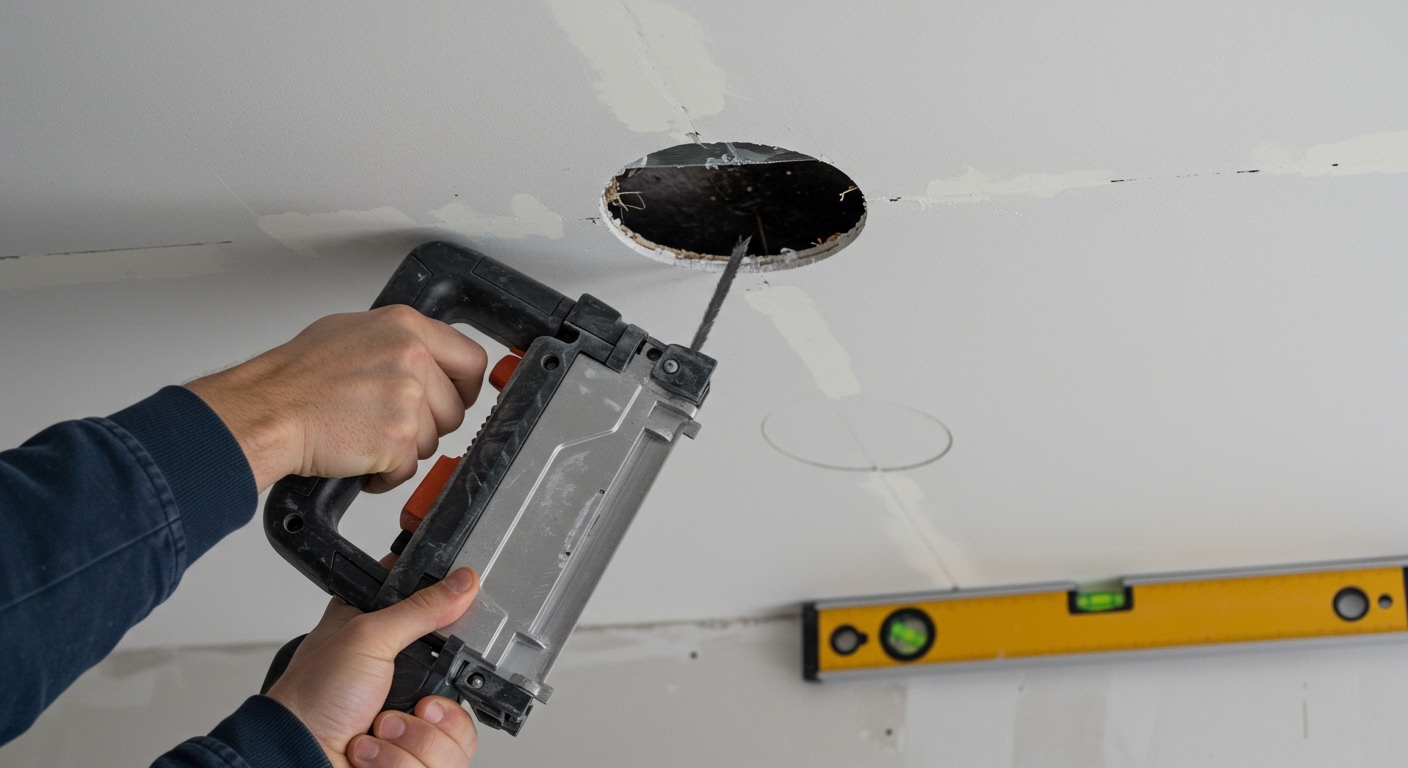
Using your drywall saw, poke a hole into the drywall at a 45-degree angle on the line you traced. Slow, steady strokes are better than forceful ones.
Expert Insight: Hold a shop-vac nozzle right below the saw while you cut. This captures 90% of the white gypsum dust, saving you hours of cleanup on your furniture and carpets.
Step 4: Run the Speaker Wire
This is often the most challenging part of how to install recessed speakers. You need to run the wire from your AV receiver or amplifier to the hole you just cut.
If you have attic access, this is easy. If not, you may need to use fishing rods to navigate through the wall headers. Ensure you are using CL3-rated wire; this is a building code requirement for wires hidden inside walls because the jacket is designed to not emit toxic fumes in a fire.
Step 5: Connect the Wiring
Strip about 1/2 inch of insulation from the ends of the speaker wire. Most recessed speakers use gold-plated spring-loaded terminals or push-posts.
- Press the terminal down.
- Insert the copper wire (Red to Positive, Black to Negative).
- Release the terminal to lock the wire in place.
- Give it a gentle tug to ensure a solid connection.
Step 6: Mount the Speaker
Insert the speaker into the hole. Most models use a “dog-leg” (or dog-ear) mounting system. As you tighten the screws on the front of the speaker frame, plastic wings on the back swing out and sandwich the drywall.
Warning: Do not over-tighten with a power drill. Drywall is fragile; over-tightening can crack the gypsum or strip the plastic threads of the speaker. I always finish the last few turns with a manual screwdriver.
Step 7: Painting and Grille Attachment
If you want the speakers to be truly “invisible,” you can paint the metal grilles. Use thin spray paint rather than a brush. Thick house paint can clog the tiny perforations in the grille, significantly muffling the high-frequency sound.
Choosing the Right Wire: Gauge and Rating
Don’t bottleneck your high-end speakers with cheap, thin wire. In my testing, the distance of the run dictates the thickness (gauge) you need.
- Runs under 50 feet: 16-gauge wire is sufficient.
- Runs 50–150 feet: Upgrade to 14-gauge wire.
- Runs over 150 feet: Use 12-gauge wire to prevent signal loss.
Oxygen-Free Copper (OFC) is the gold standard. Avoid “Copper Clad Aluminum” (CCA) as it has higher resistance and is more prone to breaking during the “fishing” process through walls.
Enhancing Sound Quality: Back Boxes and Insulation
One “pro secret” I always share is the use of acoustic back boxes or insulation batting.
When a speaker is mounted in a hollow ceiling, the sound waves from the back of the speaker can bounce around the attic, creating a muddy sound.
- Fiberglass Insulation: Stuffing a small amount of R-13 insulation behind the speaker can dampen these reflections.
- Vapor Barriers: If installing in a ceiling with an unconditioned attic above, use a vapor boot to prevent moisture from the home from entering the attic through the speaker hole.
Troubleshooting Common Installation Issues
Even for pros, things can go wrong. Here is how we handle the most common hurdles:
The Speaker Won’t Sit Flush
This usually happens because the dog-legs are hitting a stud. You may need to shave a small sliver of the stud away (if it’s non-structural) or slightly shift the hole. Always check for studs before cutting.
No Sound After Installation
Check your connections at both ends. The most common culprit is a “stray strand” of copper wire touching the opposite terminal, causing a short circuit. Most modern Denon or Yamaha receivers will go into “Protect Mode” if this happens.
Vibration or Rattling
If the drywall vibrates at high volumes, you may need to add a foam gasket between the speaker frame and the wall. Most premium brands like Sonance include these in the box.
Frequently Asked Questions
Can I install recessed speakers in an existing home?
Yes, this is called “retrofitting.” As long as you have hollow walls or access to a crawlspace/attic, you can run the wires and mount the speakers without removing the entire wall.
Do I need a special box behind the speaker?
Not usually. Most recessed speakers are “open-back” and designed to use the wall cavity as an enclosure. However, if you live in a multi-unit building, you may need a Fire-Rated Back Box to meet local building codes.
Is 16-gauge wire enough for in-ceiling speakers?
For most residential rooms where the wire run is under 50 feet, 16-gauge CL3 wire is perfect. If you are building a high-end dedicated theater with long runs, I recommend 14-gauge.
Can I use recessed speakers for a TV setup?
Absolutely. In-wall speakers are excellent for the Left, Center, and Right (LCR) channels of a TV setup, while in-ceiling speakers are ideal for “Atmos” height channels or background music.
Should I buy round or rectangular speakers?
This is mostly aesthetic. Round speakers are traditional for ceilings because they blend in with recessed lighting. Rectangular speakers are usually preferred for in-wall applications as they mimic the look of traditional bookshelf speakers.









