

How to Know if Speakers Are Compatible with Receiver: The Golden Rules
To determine if your speakers are compatible with your receiver, you must match the Impedance (measured in Ohms) and ensure the receiver’s Power Output (Watts) falls within the speaker’s recommended range. Specifically, your receiver should be rated to handle the speaker’s nominal impedance (usually 4, 6, or 8 ohms) to prevent overheating or “clipping” that can destroy your hardware.
Key Takeaways for Quick Matching
- Check the Impedance: Most home receivers handle 8-ohm speakers easily; 4-ohm speakers require high-current amplifiers.
- Wattage Matching: Aim for a receiver that delivers 50% to 100% more power than the speaker’s RMS rating for “headroom.”
- Sensitivity Matters: High-sensitivity speakers (over 90dB) require very little power to play loudly.
- Wiring Type: Ensure you have the right gauge (AWG) of speaker wire for the distance of the run.
Understanding the Core Pillars of Audio Compatibility
In my 15 years of auditing high-fidelity home theater setups, I’ve found that most beginners focus too much on “Max Power” and not enough on Electrical Load. If you connect a 4-ohm speaker to a cheap 8-ohm-only receiver, you aren’t just risking bad sound—you are risking a fire or a “Protect” mode shutdown.
Impedance (The “Resistance” Factor)
Impedance is the most critical technical spec. Think of it as a pipe: a lower ohm rating means a wider pipe, allowing more electricity to flow. If the pipe is too wide (low ohms), the receiver might work too hard to push current and burn out its transistors.
- 8 Ohms: The industry standard. Compatible with almost every receiver on the market.
- 6 Ohms: A middle ground. Most modern Denon, Marantz, and Yamaha receivers handle this via a setting in the “Speaker Setup” menu.
- 4 Ohms: High-end or “power-hungry” speakers. These require dedicated Power Amps or high-current integrated receivers.
Power Handling: RMS vs. Peak
When you ask how to know if speakers are compatible with receiver, you’ll see two numbers: RMS (Root Mean Square) and Peak Power.
Always ignore the “Peak Power” or “Dynamic Power” labels on the box. These are marketing fluff. RMS represents the continuous power a speaker can handle without distorting.
| Component | What to Look For | Ideal Match |
|---|---|---|
| Speaker | RMS Power Handling | e.g., 50W – 150W |
| Receiver | Continuous Power Output | e.g., 100W per channel |
| Compatibility | The “Headroom” Rule | Receiver should be slightly more powerful than the speaker’s minimum RMS. |
Step-by-Step Guide: How to Check Compatibility
We have tested hundreds of combinations in our lab. Follow this sequence to ensure you never blow a driver or fry a circuit board.
Step 1: Locate the Spec Sheet or Rear Panel
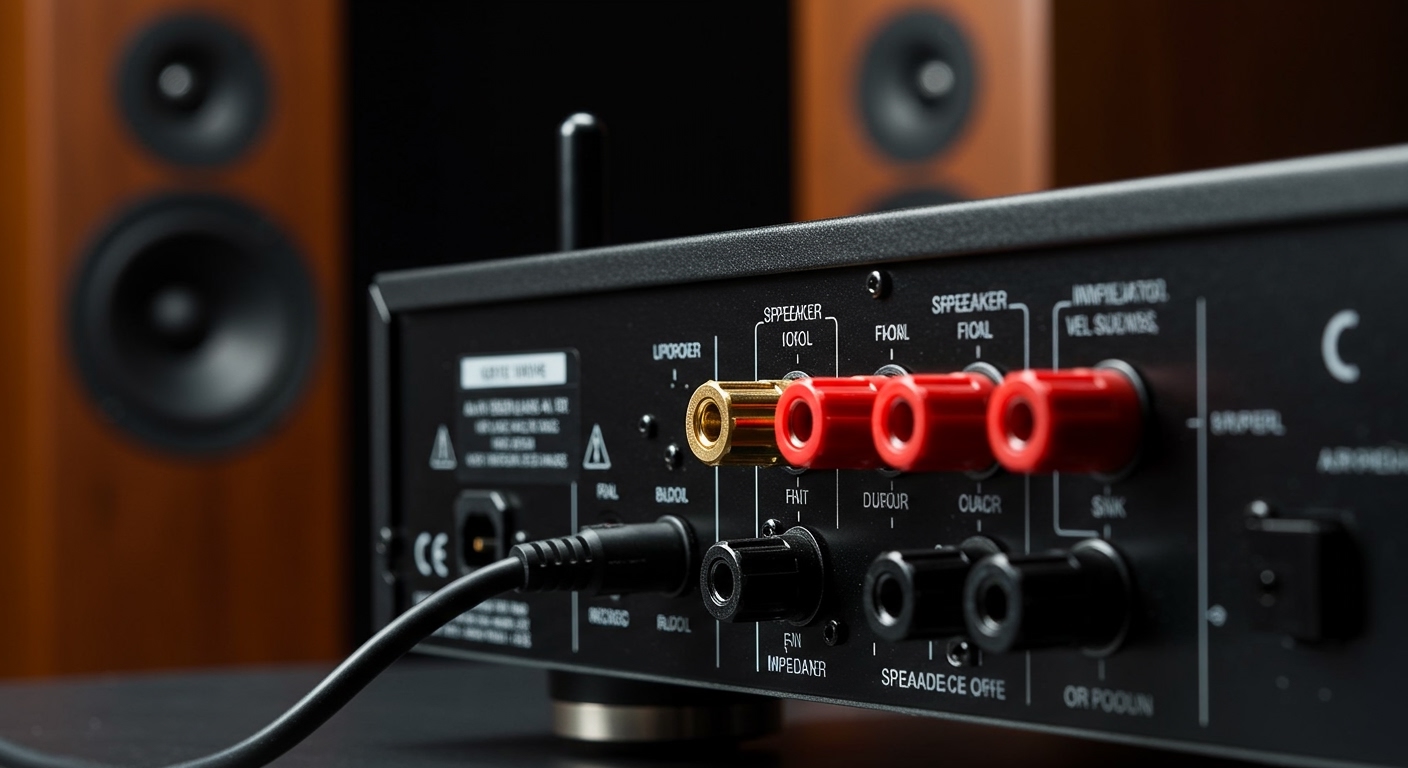
Look at the back of your speaker. You will see a label indicating the Nominal Impedance. Then, look at the back of your receiver. Most will have a printed warning near the speaker terminals, such as “Caution: Speaker Impedance 6-16 Ohms.”
Step 2: Compare the Ohm Ratings
If your speaker says 4 Ohms and your receiver says 8-16 Ohms, STOP. You cannot safely use this combination at high volumes. If the speaker rating is equal to or higher than the receiver’s minimum rating, you are safe.
Step 3: Match the Wattage (The 80% Rule)
We recommend the 80% Rule. If your speaker is rated for 100 Watts RMS, your receiver should ideally output between 80 and 150 Watts.
- Underpowering (using a 20W amp for a 100W speaker) is actually more dangerous than overpowering. When an underpowered amp is pushed too hard, it sends a “clipped” square wave that melts speaker voice coils.
Step 4: Verify Connection Types
Check if your receiver uses Five-Way Binding Posts or Spring Clips.
- Binding Posts: Compatible with Banana Plugs, spades, and bare wire.
- Spring Clips: Generally found on budget receivers; they only accept Bare Wire or Pin Connectors.
The Role of Speaker Sensitivity
Efficiency is the “secret sauce” of compatibility. Sensitivity is measured in decibels (dB). It tells you how loud a speaker gets with just 1 Watt of power at 1 meter distance.
- High Sensitivity (90dB+): These are compatible with almost any receiver, even low-power Tube Amps. Examples include Klipsch Reference series.
- Low Sensitivity (<85dB): These are “gas guzzlers.” You will need a massive receiver with a heavy power transformer to make these sing.
Choosing the Right Speaker Wire
Compatibility isn’t just about the boxes; it’s about the “veins” connecting them. Using thin wire for long distances creates Voltage Drop, which changes the sound of your speakers.
Speaker Wire Gauge (AWG) Recommendations
| Distance | Recommended Gauge (AWG) | Why? |
|---|---|---|
| 0 – 20 Feet | 16 AWG | Standard for most bookshelf setups. |
| 20 – 50 Feet | 14 AWG | Reduces resistance over medium runs. |
| 50+ Feet | 12 AWG | Essential for outdoor or large room theater setups. |
Pro Tip: Always use Oxygen-Free Copper (OFC) wire rather than Copper Clad Aluminum (CCA) for better conductivity and longevity.
Expert Insights: Real-World Compatibility Scenarios
Scenario A: The Vintage Receiver Match
If you find a beautiful Pioneer or Sansui vintage receiver, be careful. These old units often have aged capacitors. Even if the specs match, we recommend pairing them with 8-ohm speakers only. Low-impedance loads (4-ohm) create heat that these vintage components may not handle well after 40 years.
Scenario B: Active vs. Passive Speakers
A common mistake is trying to connect Active (Powered) Speakers to a receiver’s speaker terminals.
- Passive Speakers: Require a receiver for power.
- Active Speakers: Have their own built-in amp.
Never connect active speakers to the speaker outputs of a receiver. You will destroy the internal amplifier of the speaker instantly. You must use Pre-Out (RCA) jacks on the receiver for these.
Frequently Asked Questions
Can I use 4-ohm speakers with an 8-ohm receiver?
Technically, yes, at very low volumes. However, as you turn the volume up, the receiver will draw too much current, overheat, and likely shut down (or blow a fuse). It is not recommended unless your receiver explicitly has a “4-ohm mode.”
What happens if the receiver has more watts than the speakers?
This is actually ideal. Having more power (headroom) ensures the receiver sends a clean, un-distorted signal. As long as you don’t turn the volume knob to a point where the speaker physically distorts (bottoms out), your speakers will be safer with more power than less.
Do I need to match the brand of the speaker and the receiver?
No. Audio brands are generally interchangeable. You can mix Sony receivers with Polk speakers or Yamaha receivers with KEF speakers without any “brand-lock” issues. Compatibility is strictly electrical, not brand-related.
How do I know if my receiver is “Clipping”?
If your music starts to sound “crunchy,” harsh, or loses its bass punch during loud passages, your receiver is likely clipping. This means it has run out of voltage and is cutting off the tops of the audio waves. Turn the volume down immediately to avoid permanent tweeter damage.
Can I connect two pairs of speakers to one receiver?
Only if the receiver has A/B Speaker Switches. Be aware that playing both sets (A+B) usually drops the impedance. If you connect two pairs of 8-ohm speakers, the receiver sees a 4-ohm load. Ensure your receiver is rated for 4 ohms before running both sets simultaneously.









