

Understanding How to Refurbish Speakers: The Complete Restoration Guide
Learning how to refurbish speakers involves a systematic process of inspecting the internal electronics, replacing degraded foam surrounds, and refinishing the exterior cabinets to restore both acoustic performance and aesthetic appeal. By focusing on crossover recapping, woofer re-foaming, and cabinet sealing, you can return a pair of vintage “thrift store finds” to their original factory specifications or even improve upon them.
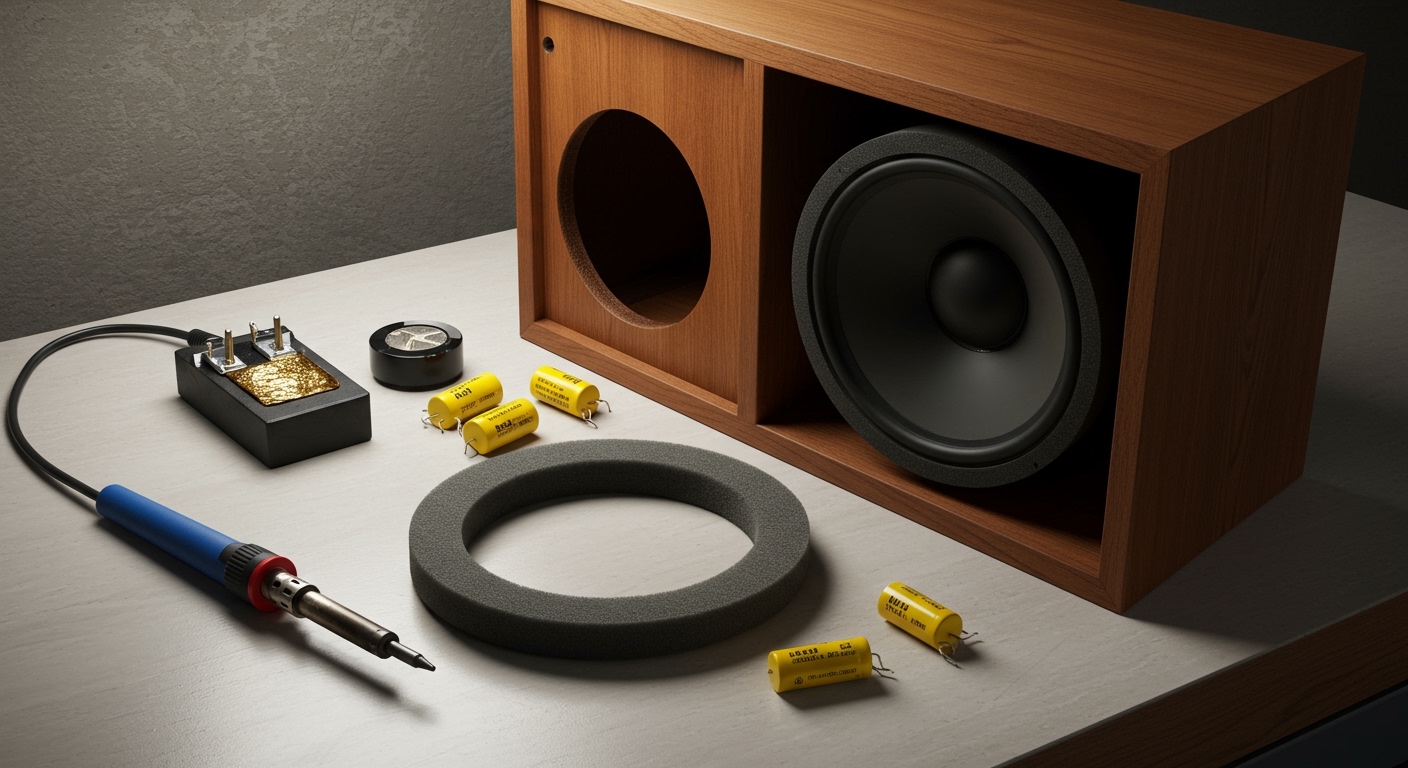
🚀 Key Takeaways: Speaker Restoration at a Glance
- Visual Inspection: Always check for “foam rot” on the woofer and bulging capacitors on the crossover board.
- Safety First: Use a multimeter to check voice coil continuity before spending money on cosmetic repairs.
- The “Golden Rule” of Parts: Replace electrolytic capacitors with film capacitors for a significant lift in high-frequency clarity.
- Seal the Air: For acoustic suspension speakers (sealed boxes), ensuring an airtight cabinet is more important than the brand of wire you use.
- Value Retention: Stick to period-correct finishes like tung oil or polyurethane to maintain the resale value of vintage brands like JBL, Advent, or Klipsch.
Why You Should Refurbish Instead of Replace
In my years of restoring high-fidelity audio equipment, I have found that vintage speakers from the 1970s and 80s often possess superior build quality compared to modern entry-level units. Heavy MDF or real wood veneer cabinets provide a resonance-free base that modern plastic speakers simply cannot match.
Refurbishing allows you to customize the sound profile to your specific room. Whether you are dealing with “scratchy” tweeters or “muddy” bass, a targeted refurbishment fixes the root cause of the degradation.
Comparing Restoration Costs vs. New Purchases
| Component/Action | Refurbishment Cost (DIY) | Equivalent New Quality | Value Gain |
|---|---|---|---|
| Woofer Re-foam | $25 – $40 | $200+ | High |
| Crossover Recap | $30 – $100 | $500+ | Extreme |
| Cabinet Refinishing | $20 – $50 | $300+ | Aesthetic |
| Grill Cloth Replace | $15 – $30 | N/A | Aesthetic |
Step 1: Initial Diagnosis and Testing
Before you learn how to refurbish speakers, you must determine if the “bones” of the speaker are still good. I always start by measuring the DC Resistance at the speaker terminals using a Digital Multimeter.
- Check Continuity: If the meter reads “OL” (Open Loop), the voice coil is likely burnt out, and the driver may need a professional “re-cone” or replacement.
- The Battery Test: Gently touch a 9V battery to the speaker terminals. A “pop” sound and forward/backward movement of the cone indicate the motor structure is functional.
- The Finger Test: Press gently on the foam surround. If it crumbles like a dry cracker, you have “foam rot”—the most common issue in vintage audio.
Step 2: Essential Tools for Speaker Refurbishment
To execute a professional-grade restoration, you need more than just a screwdriver. We recommend assembling a dedicated “audio bench” kit.
- Soldering Station: A 40W to 60W iron with adjustable temperature control.
- Desoldering Pump (Solder Sucker): Essential for removing old capacitors from the crossover board.
- Wood Glue and Clamps: For repairing separated cabinet seams.
- Isopropyl Alcohol (90%+): For cleaning old adhesive off speaker baskets.
- Utility Knife and Specialized Shims: Used for centering the voice coil during re-foaming.
Step 3: How to Refurbish Speakers – The Woofer Re-foam
The surround is the flexible ring that connects the cone to the metal basket. Over 15–20 years, the polyurethane foam breaks down due to humidity and UV exposure.
Removing the Old Surround
I start by using a flat-head screwdriver or a utility knife to scrape the “sticky mess” of the old foam off the frame. Be extremely careful not to puncture the paper cone. I’ve found that using a bit of Goof Off or acetone helps soften the stubborn factory glue.
Centering the Voice Coil
This is the most critical part of how to refurbish speakers. If the cone isn’t perfectly centered, the voice coil will rub against the magnet, causing distortion.
- The Shim Method: Remove the center dust cap and insert plastic shims between the voice coil and the magnet.
- The Tone Generator Method: Use a 30Hz sine wave app on your phone. The vibration will naturally center the cone as the glue dries.
Applying the New Foam
Apply a thin bead of specialized speaker glue (usually a white, water-based adhesive) to the inner edge of the new foam and the outer edge of the cone. Let it become “tacky” for 3 minutes before pressing them together.
Step 4: Restoring the Crossover (The Brain of the Speaker)
If your speakers sound “muffled,” the crossover capacitors are likely the culprit. Electrolytic capacitors contain a liquid that dries out over decades, shifting their capacitance value.
Identifying the Components
Open the cabinet and locate the circuit board. You will see:
- Capacitors: Usually cylindrical. These are what we replace.
- Inductors: Coils of copper wire. These rarely fail and usually don’t need replacing.
- Resistors: Rectangular blocks. Replace these only if they look charred or test out of spec.
The Capacitor Upgrade
When I teach people how to refurbish speakers, I suggest upgrading to Polypropylene Film Capacitors (like those from Dayton Audio or Solon). They offer lower ESR (Equivalent Series Resistance) and provide a much more detailed “soundstage.”
Pro Tip: Ensure your new capacitors have the same uF (microfarad) rating as the originals. The Voltage (V) rating can be higher than the original, but never lower.
Step 5: Cabinet Structural and Aesthetic Repair
A speaker cabinet is more than just a box; it is a pressure vessel. Any air leaks will kill your bass response.
Sealing the Enclosure
I use silicone caulk or wood glue to seal every internal joint. If the speaker has a “ported” design, ensure the plastic tube is firmly glued to the baffle. If it is a “sealed” design, use gasket tape (weather stripping) behind the drivers when you reinstall them to ensure an airtight fit.
Refinishing the Veneer
- Sanding: Start with 150-grit sandpaper and move to 220-grit. Be careful; vintage veneer is often very thin.
- Staining: Use a pre-stain conditioner if working with pine or soft woods to prevent blotching.
- Finishing: I prefer Howard Restor-A-Finish for light scratches. For a total overhaul, three coats of Wipe-on Poly provide a durable, modern sheen.
Step 6: Internal Damping and Wiring
Many budget speakers from the past used cheap “fiberglass pink” insulation. I often replace this with Acosta-Stuf polyfill or No-Res damping sheets. This absorbs internal standing waves, resulting in “tighter” bass and a cleaner midrange.
For internal wiring, you don’t need expensive “boutique” cables. Replacing thin 22-gauge wire with 16-gauge oxygen-free copper (OFC) is a cost-effective way to ensure maximum signal transfer from the crossover to the drivers.
Step 7: Final Assembly and Breaking In
Once the glue is cured and the finish is dry, it’s time to reassemble.
- Polarity Check: Ensure the red (+) and black (-) wires are connected correctly. If one speaker is “out of phase,” the bass will disappear when you stand between them.
- The Break-in Period: New foam surrounds and capacitors need time to settle. I recommend playing music at moderate volumes for about 20 to 40 hours before doing any critical listening.
Frequently Asked Questions (FAQ)
Is it worth refurbishing cheap speakers?
Generally, no. If the cabinet is made of thin particle board or the drivers have tiny magnets, the “ceiling” for improvement is low. Focus your efforts on how to refurbish speakers from reputable brands like Acoustic Research, Dynaco, Bowers & Wilkins, or Boston Acoustics.
What glue is best for speaker repair?
For re-foaming, use a solvent-based nitrile glue or a specialized white PVA glue designed specifically for speakers. Never use “Super Glue” (Cyanoacrylate) as it dries too brittle and can crack the cone or foam.
Can I change the crossover design to “improve” the sound?
Unless you are an electrical engineer with measuring microphones, I recommend sticking to the original circuit values. Designers spent hundreds of hours “voicing” the speaker; changing capacitor values will alter the crossover frequency and likely create “holes” in the sound.
How do I fix a dented tweeter dust cap?
If the tweeter has a silk dome, you can often use a vacuum cleaner with a small attachment to gently “suck” the dent out. For metal domes, you can sometimes use a piece of S Scotch tape to pull the dent forward, though creases may remain.
Where can I find replacement parts?
Sites like Parts Express, Madisound, and Simply Speakers are the gold standard for finding specific re-foam kits, capacitors, and replacement diaphragms.
**
**
**
**









