

To learn how to rig speakers safely, you must follow a protocol of calculating Working Load Limits (WLL), using only load-rated hardware, and ensuring all overhead suspension points are certified by a professional rigger. This process involves securing fly bars to the speaker cabinet, connecting shackles and wire rope to motor hoists, and performing a final safety inspection to guarantee a 5:1 or 10:1 safety design factor.
Key Takeaways for Safe Speaker Rigging
- Prioritize Safety: Never use “hardware store” grade equipment; only use Grade 80 or higher forged steel.
- Calculate Loads: Always account for the weight of the speakers, cables, and the fly frame combined.
- Redundancy is Vital: Use secondary safety cables for every flown element.
- Professional Oversight: If you are not a certified rigger, always have your calculations and points checked by a qualified professional.
- Software Integration: Utilize manufacturer software (like L-Acoustics Soundvision or d&b ArrayCalc) to predict splay angles and center of gravity.
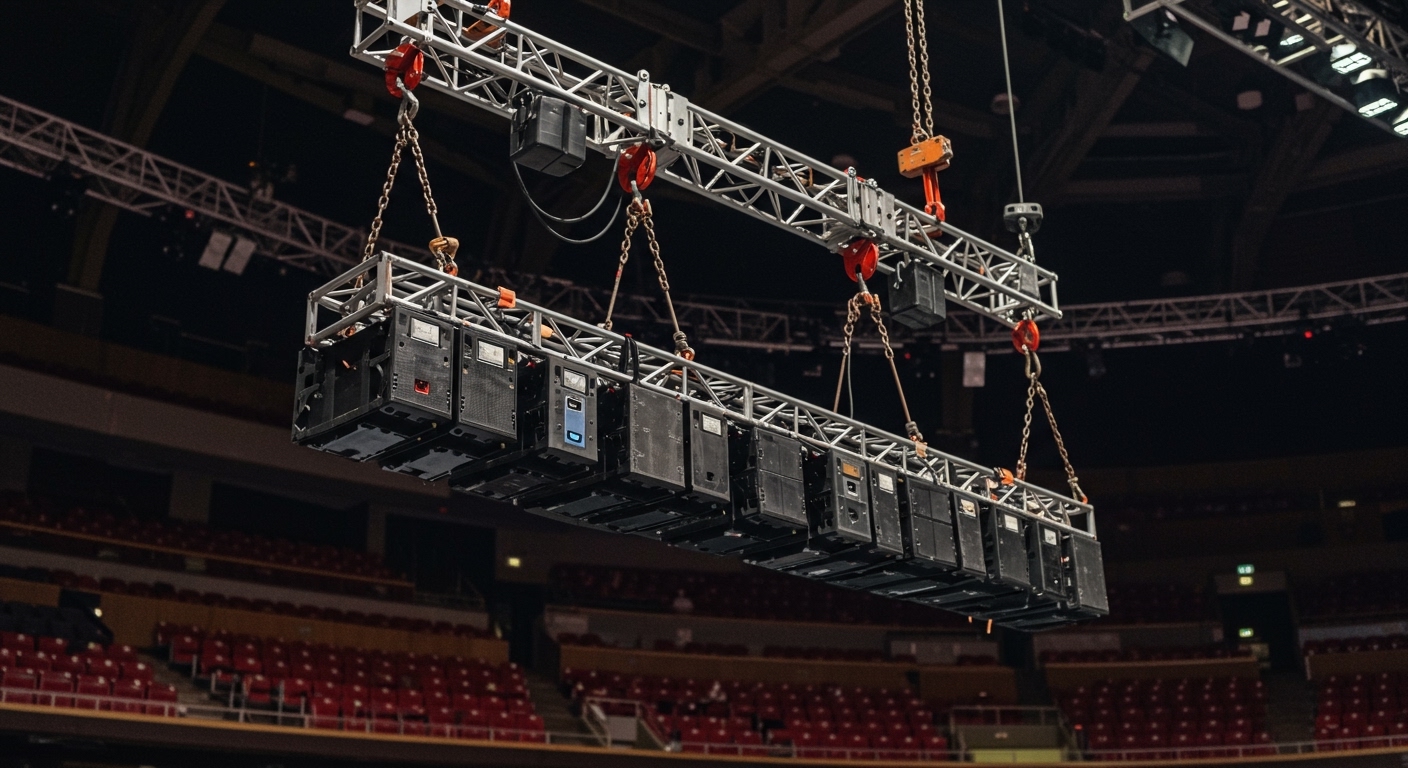
Understanding the Fundamentals of Speaker Rigging
Before you lift a single cabinet, you must understand the physics of overhead suspension. Rigging is not just about hanging boxes; it is about managing dynamic loads and ensuring that no single component in the “rigging chain” becomes a point of failure.
In my years of touring as a systems engineer, I’ve seen that the most common mistake is ignoring the Vector Forces created by bridle angles. When you rig speakers at an angle, the tension on the cables increases significantly.
The 5:1 vs. 10:1 Safety Factor
In the professional audio industry, we adhere to strict safety ratios. A Safety Factor is the ratio between the breaking strength of a piece of gear and the weight it is intended to hold.
- 5:1 Ratio: Generally used for static loads in temporary installations.
- 10:1 Ratio: The gold standard for “life safety” or when speakers are suspended directly over audiences.
Critical Rigging Hardware Comparison
| Component | Material Requirement | Primary Use | Key Identification |
|---|---|---|---|
| Shackles | Forged Steel (e.g., Crosby) | Connecting fly bars to motors | Must have WLL stamped on body |
| Wire Rope | Improved Plow Steel (IWRC) | Creating suspension leads | 7×19 construction is standard |
| Chain Hoists | Electric or Manual (e.g., CM Lodestar) | Lifting the entire array | Must be “Rigging Grade” |
| Fly Bars | Manufacturer Specific | The interface between box and motor | Usually powder-coated steel |
| Spansets | Polyester Slings | Choking around beams or trusses | Color-coded for weight capacity |
Essential Gear: What You Need to Rig Speakers Safely
To learn how to rig speakers, you must first assemble a professional rigging kit. Never substitute professional-grade audio rigging hardware with generic bolts or chains from a local hardware store.
- Forged Shoulder Eye Bolts: These are used for point-source cabinets. Ensure they are shouldered to handle angular loads; non-shouldered bolts can snap when pulled sideways.
- Rated Shackles: Look for Screw Pin Anchor Shackles. I personally recommend Crosby G-209 shackles because they are industry-tested and heat-treated.
- STAC Chain: This is “Special Theatrical Alloy Chain” used for fine-tuning the height or “trim” of a rig.
- Load Cells: For massive line arrays, we use digital load cells (like those from Broadweigh) to monitor the weight on each motor in real-time.
How to Rig Speakers: A Step-by-Step Guide
Following a consistent workflow reduces the chance of human error. Here is the professional process we use for suspending a line array or a heavy point-source system.
Step 1: Pre-Flight Inspection
Before the speakers leave the ground, inspect every rigging pin, hinge, and fly point. Look for cracks in the metal, rust, or “egging” (where a hole has stretched into an oval shape). If any component looks compromised, “red tag” it immediately and take it out of service.
Step 2: Calculate the Center of Gravity
When learning how to rig speakers, you’ll realize that balance is everything. Use the manufacturer’s rigging software to determine the Center of Gravity (CoG). This will tell you which hole on the fly bar to use for the motor hook to ensure the array hangs at the correct “trim” angle.
Step 3: Attaching the Fly Bar
Place the fly bar (or bumper) on top of the first speaker cabinet. Insert the locking pins and ensure they are fully seated. Double-check the “Quick Release Pins” (QRPs) to make sure the ball-lock mechanism is engaged.
Step 4: Connecting to the Motor
Lower the chain hoist hook to the fly bar. Attach a shackle through the motor hook and the designated hole on the fly bar.
- Pro Tip: Always orient the shackle so the “pin” is on the bottom (the load side) to prevent the pin from unscrewing due to vibration.
Step 5: Lifting and Splaying
Slowly lift the first cabinet until the second cabinet can be rolled underneath. Connect the rigging hardware between the boxes. As the array rises, adjust the splay angles (the angle between cabinets) according to your acoustic model. This determines the vertical coverage of the sound.
Step 6: Deploying Safety Redundancies
Once the array is at the desired height (the “Trim Height”), attach a safety cable from the fly bar to a secondary structural point. This ensures that if the primary motor or chain fails, the speakers will not fall to the ground.
Advanced Techniques: Dealing with Bridles and Angles
Often, the structural beam is not directly above where the speakers need to hang. In this case, we use a Bridle.
A bridle consists of two cables meeting at a single point. You must be extremely careful here. As the angle between the two cables (the horizontal angle) increases, the tension on those cables multiplies.
- At 45 degrees: Tension is roughly 0.7x the load on each leg.
- At 120 degrees: Tension equals 100% of the load on each leg.
- At 160 degrees: Tension is nearly 3x the load. Never exceed a 120-degree bridle angle.
The Importance of Acoustic Aiming and Splay Angles
Rigging isn’t just about safety; it’s about audio performance. When you rig speakers, the “Splay Angle” dictates how the high-frequency drivers interact.
We use software like AFMG EASE Focus to simulate the room. In my experience, even a 1-degree error in the top box angle can result in the sound “overshooting” the balcony or creating massive “hot spots” in the front row.
Common Rigging Configurations
- Single Point Hang: Easiest to deploy, but difficult to aim horizontally.
- Two-Point Hang: Uses two motors (Front and Rear). This allows you to adjust the “tilt” or “inclination” of the array remotely.
- Dead Hang: A permanent installation where the speaker is fixed to a beam without a motor.
Regulatory Standards: OSHA and ESTA
In the United States, the Entertainment Services and Technology Association (ESTA) sets the standards for rigging through the Technical Standards Program (TSP). Specifically, ANSI E1.8 covers the requirements for “loudspeaker enclosures intended for overhead suspension.”
Following these standards isn’t optional; it’s a legal requirement under OSHA’s General Duty Clause. If you are rigging speakers in a public space, you are liable for the safety of everyone underneath that rig.
Common Mistakes to Avoid When Rigging Speakers
- Using Carabiners Instead of Shackles: Most carabiners are designed for climbing or light loads and are not rated for the multi-directional forces of speaker rigging.
- Over-tightening Screw Pins: Tighten the shackle pin until it bottoms out, then “back it off” a quarter turn. This prevents the pin from seizing due to load-induced friction.
- Mixing Grades of Chain: Never mix Grade 30 (proof coil) with Grade 80 (alloy steel).
- Ignoring Wind Loads: If rigging speakers outdoors, the array acts like a giant sail. You must calculate the Wind Load and use “guy wires” to prevent the rig from swinging.
Frequently Asked Questions
Can I rig speakers using standard eye bolts from a hardware store?
No. Standard eye bolts are often made of brittle “pot metal” or cast iron and are not load-rated. You must use forged, shouldered eye bolts with a certified Working Load Limit (WLL) stamped on the hardware.
What is a “safety lead,” and do I really need one?
A safety lead is a secondary steel cable that bypasses the primary lifting mechanism (the motor). It is essential because it provides redundancy. If the motor’s internal brake fails or a chain snaps, the safety lead catches the load.
How often should rigging gear be inspected?
Rigging gear should undergo a visual inspection before every use and a thorough annual inspection by a competent person. Any equipment that has been involved in a “shock load” (a sudden drop) must be destroyed and replaced immediately.
What is the difference between “Flown” and “Ground Stacked” speakers?
“Flown” speakers are suspended in the air using rigging hardware. “Ground Stacked” speakers are piled on top of each other on the stage or floor. While ground stacking is easier, “flying” the speakers provides much better sound coverage and prevents the front row from being deafened.
Do I need a license to rig speakers?
While some jurisdictions do not require a specific “speaker rigging license,” most professional venues require you to be an ETCP Certified Rigger. Even without a license, you are legally responsible for any accidents caused by improper rigging techniques.









