

How to Wire Component Speakers Without Crossover: The Active Method
To wire component speakers without a passive crossover, you must use an “Active Setup” where an amplifier or Digital Signal Processor (DSP) filters the frequencies before they reach the speakers. You connect each individual tweeter and woofer directly to its own dedicated amplifier channel, ensuring the amp’s High-Pass Filter (HPF) and Low-Pass Filter (LPF) are correctly set to prevent blowing the drivers.
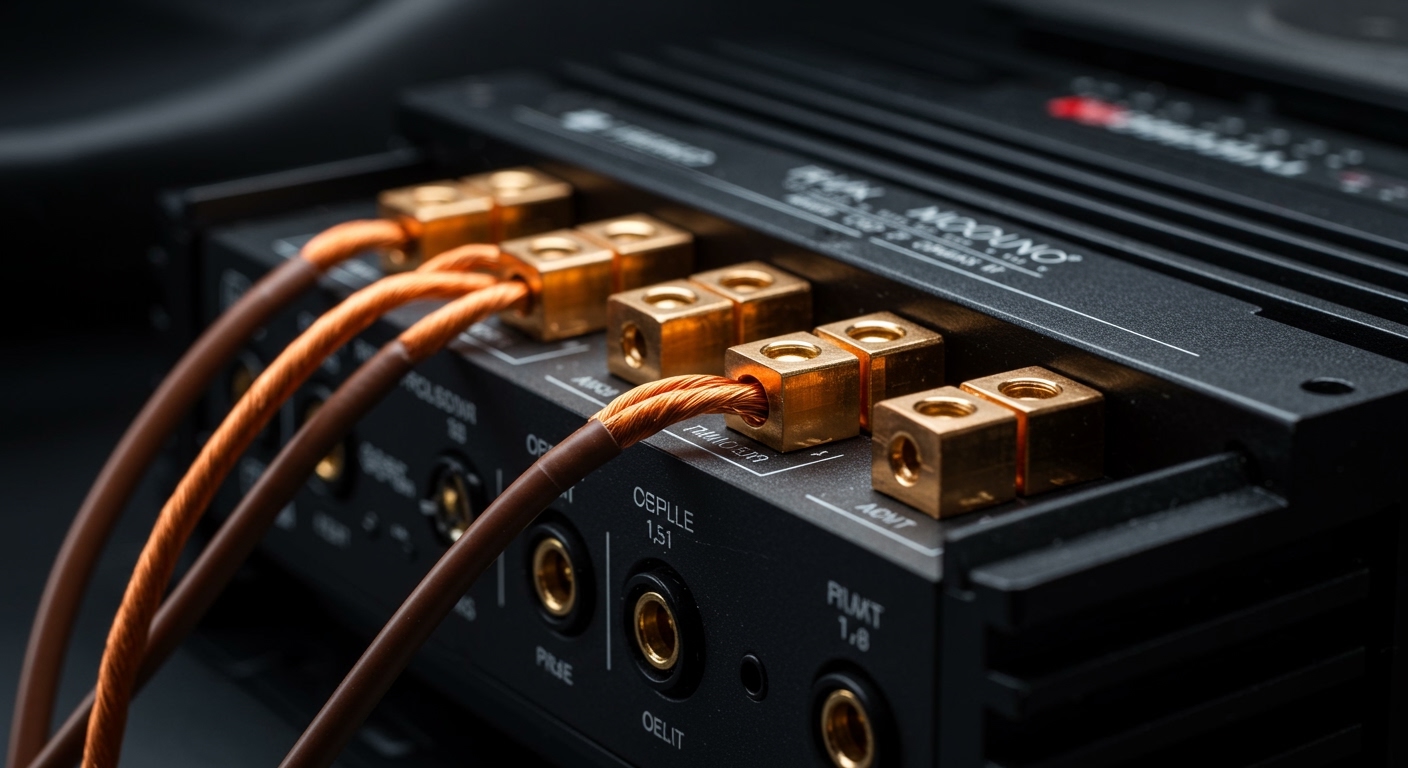
In my experience building high-end SQ (Sound Quality) car audio systems, bypassing the factory passive crossover is the single best way to achieve “imaging” and “staging.” By following this guide, you will learn how to safely transition to an active configuration while protecting your hardware.
Key Takeaways for Active Wiring
- Dedicated Channels: Each speaker (2 tweeters, 2 woofers) needs its own amp channel (4 channels total for a front set).
- Bi-Amping: This method is often called bi-amping, allowing for precise control over the volume and timing of each driver.
- Wire Quality: Use 100% Oxygen-Free Copper (OFC) wire to maintain signal integrity over long runs.
Why You Would Wire Component Speakers Without a Passive Crossover
Standard component sets come with a “black box” known as a passive crossover. While convenient, these boxes consume power through heat and offer zero flexibility in tuning.
When I first switched to an active setup in my own demo vehicle, the clarity improvement was immediate. By wiring directly to the amp, you eliminate the phase shifts and insertion loss caused by passive components like capacitors and inductors.
Active vs. Passive Crossover Comparison
| Feature | Passive Crossover (Standard) | Active Setup (No Crossover Box) |
|---|---|---|
| Power Efficiency | Lower (Power lost as heat) | Higher (Direct connection) |
| Tuning Flexibility | Fixed Crossover Points | Fully Adjustable via Amp/DSP |
| Channel Requirement | 2 Channels for 4 Speakers | 4+ Channels (1 per speaker) |
| Risk Factor | Low | High (Requires manual setup) |
| Sound Quality | Good | Superior / Audiophile Grade |
The Critical Hardware Requirements
Before you learn how to wire component speakers without crossover, you must ensure your gear is capable of protecting your speakers. You cannot simply twist wires together and hope for the best.
A 4-Channel Amplifier with Wide-Range Filters
To run a 2-way component set (tweeter + woofer), you need at least a 4-channel amplifier. Channels 1 and 2 will power the tweeters, while Channels 3 and 4 power the woofers. Ensure the amp has a Crossover Switch that can reach the high frequencies tweeters require (usually 2.5kHz to 5kHz).
Digital Signal Processor (DSP)
A DSP is the “brain” of a modern active system. It allows you to set precise crossover slopes (e.g., 24dB/octave Linkwitz-Riley) and time alignment. Brands like AudioControl, Helix, and MiniDSP are industry standards for this configuration.
High-Quality Speaker Wire
I recommend 16-gauge OFC wire for the woofers and 18-gauge OFC wire for the tweeters. Avoid CCA (Copper Clad Aluminum) as it has higher resistance and is prone to corrosion in automotive environments.
Step-by-Step Guide: How to Wire Component Speakers Without Crossover
Follow these steps precisely. An error in an active setup can result in a “popped” tweeter in less than a second if full-range frequencies are sent to it.
Step 1: Disconnect the Battery
Always disconnect the negative battery terminal before working on your car’s electrical system. This prevents accidental shorts that could fry your Head Unit or Amplifier.
Step 2: Plan Your Wiring Routes
In a standard setup, one wire goes from the amp to the crossover, then splits. In an active setup, you must run four separate pairs of wires from the amplifier location to the speaker locations.
- Run 1 & 2: From Amp Channels 1/2 to the Left and Right Tweeters.
- Run 3 & 4: From Amp Channels 3/4 to the Left and Right Woofers.
Step 3: Secure the Speaker Connections
Use crimped female spade connectors or solder the wires directly to the speaker terminals.
- Tweeters: Usually have smaller terminals. Be extremely careful with the polarity (Positive to Positive, Negative to Negative).
- Woofers: Ensure the wire is secured so it doesn’t rattle against the window track inside the door.
Step 4: Configure the Amplifier/DSP Filters (CRITICAL)
Do not skip this step. Before turning the system on, set your crossovers.
- Tweeter Channels (1 & 2): Set the switch to HPF (High Pass Filter). Turn the dial to approximately 3,500Hz (3.5kHz). This prevents bass from reaching the tweeter.
- Woofer Channels (3 & 4): Set the switch to Bandpass (if available) or LPF (Low Pass Filter). Set the upper limit to 3,500Hz to match the tweeters.
Step 5: Level Matching and Gain Setting
Since tweeters are much more efficient than woofers, they will naturally be louder. You will need to turn the Gain/Sensitivity on the tweeter channels down significantly compared to the woofer channels to achieve a balanced sound.
Advanced Expert Tips for Active Tuning
Having tuned hundreds of active systems, I’ve found that the “standard” settings are just a starting point. To truly master how to wire component speakers without crossover, keep these professional insights in mind:
The Importance of Phase
In many car interiors, mounting the tweeter on the dash and the woofer in the door creates a distance gap. Sometimes, reversing the polarity (wiring Positive to Negative) on just the tweeters can actually improve the soundstage by putting the speakers “in phase” at your ears.
Protecting Tweeters with a “Safety Cap”
If you are worried about your amp failing or a setting getting bumped, you can wire a non-polarized capacitor (inline) with the tweeter’s positive wire. A 20 microfarad (uF) capacitor acts as a 1st-order filter that blocks frequencies below 2,000Hz, serving as a “fail-safe” for your active setup.
Use a Digital Multimeter
Before playing music, use a Digital Multimeter to check the DC Resistance (Re) at the amp end of the speaker wires. A 4-ohm speaker should read somewhere between 3.2 and 3.8 ohms. If you see 0 ohms, you have a short circuit that will damage your amp.
Common Mistakes to Avoid
- Mixing Up Channels: Accidentally plugging the woofer wire into the tweeter channel (with no filter) will likely result in a dead tweeter the moment you turn the volume up.
- Incorrect Wire Gauge: Using wire that is too thin for high-powered woofers can lead to voltage drop and clipping.
- Ignoring the Slope: Using a shallow 6dB/octave slope on a tweeter can let too much low-end energy through. I always recommend at least a 12dB or 24dB/octave slope for active setups.
Frequently Asked Questions
Can I wire component speakers without a crossover directly to a head unit?
No. Most factory or aftermarket head units do not have the sophisticated internal crossovers required to protect tweeters. You must use an external amplifier or a DSP with active filtering capabilities.
What frequency should I set for my woofers and tweeters?
A safe starting point for most 6.5-inch component sets is a High-Pass Filter (HPF) at 3.5kHz for the tweeters and a Low-Pass Filter (LPF) at 3.5kHz for the woofers. You should also set an HPF at 80Hz for the woofers to protect them from sub-bass frequencies.
Do I need a crossover if I have a DSP?
If you have a DSP, you do not need the physical passive crossover boxes that came with your speakers. The DSP handles all the frequency splitting digitally, which is much more precise and allows for time alignment.
Is an active setup worth the extra work?
Yes, absolutely. Wiring component speakers without a crossover allows you to “level match” the drivers. If your tweeters are too “bright” or “harsh,” you can simply turn down the gain for those specific channels without affecting the mid-bass performance.
Can I damage my speakers by wiring them this way?
Yes, there is a higher risk. If your amplifier’s crossover is accidentally switched to “Full” or “Flat,” the tweeters will receive low-frequency signals they aren’t designed to handle, which can cause the voice coil to overheat and fail instantly.









