

Is Amharic Hard to Learn for English Speakers?
Amharic is considered a “Category IV” or “Hard” language for English speakers, requiring approximately 1,100 class hours to reach professional proficiency. While it is more difficult than Romance languages like Spanish due to its unique Fidel script and complex verb morphology, it is often seen as more approachable than “Super-Hard” languages like Mandarin or Arabic because of its phonetic consistency.
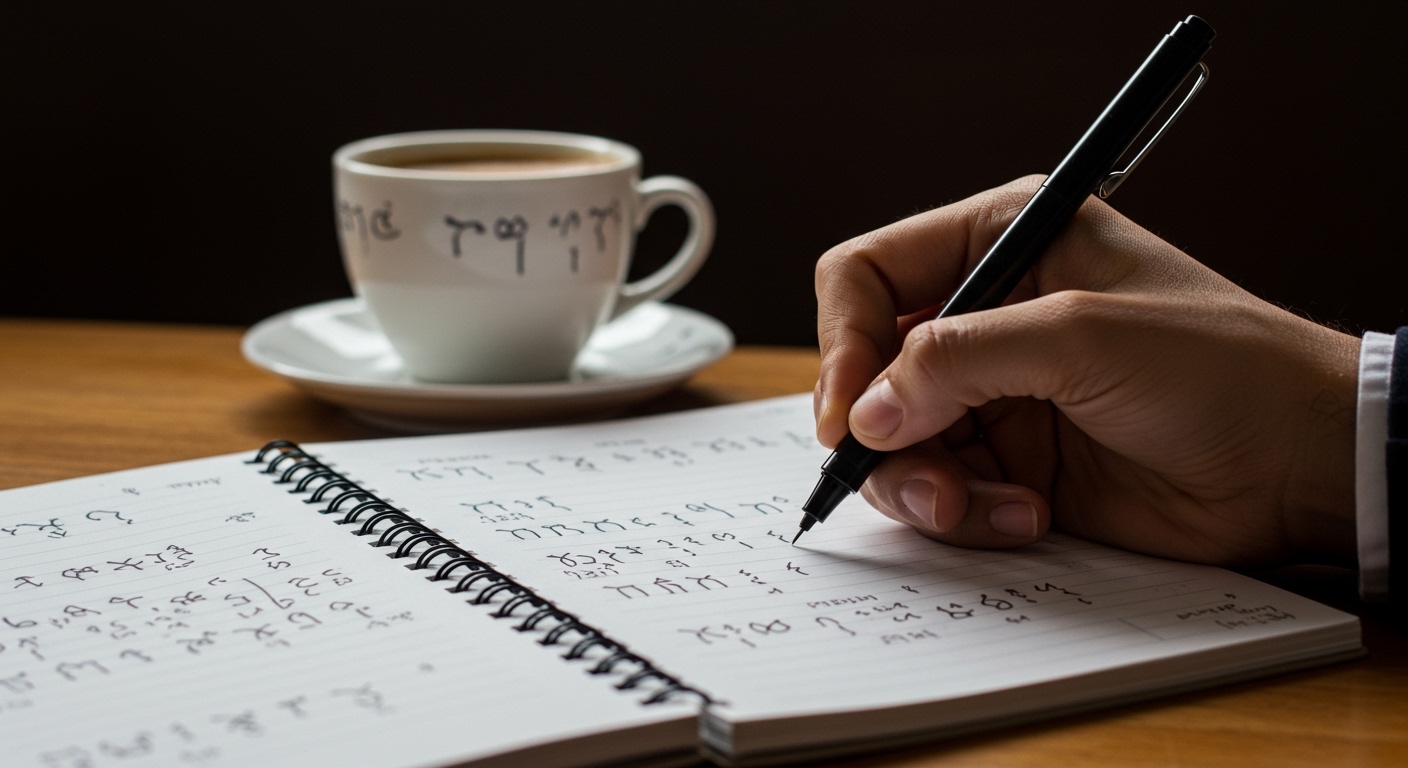
During my first three months living in Addis Ababa, I realized that the “hardness” of Amharic isn’t about the vocabulary; it’s about retraining your brain to handle Subject-Object-Verb (SOV) sentence structures and mastering ejective consonants that don’t exist in English. If you can move past the initial hurdle of the Ge’ez script, the logic of the language begins to click.
Key Takeaways for Learning Amharic
- Difficulty Rating: Hard (FSI Category IV). Expect 44 weeks of dedicated study for fluency.
- The Script: You must learn the Fidel (Abugida); do not rely on Latin transliteration for long.
- Pronunciation: Focus on ejective sounds (p’, t’, k’) early to avoid being misunderstood.
- Grammar: Prepare for a Subject-Object-Verb order where the verb always comes last.
- Best Resource: Combine FSI Amharic Basic Course with modern apps like LanguageCrush or Italki tutors.
Is Amharic Hard to Learn for English Speakers? A Reality Check
When asking is amharic hard to learn for english speakers, the answer depends heavily on your previous linguistic experience. If you have studied Hebrew or Arabic, you will recognize the Semitic root system, which makes vocabulary acquisition much faster. However, for a monolingual English speaker, Amharic presents three distinct “shocks” to the system.
The Three Major Challenges
- The Ge’ez Script (Fidel): Unlike the 26 letters of the English alphabet, the Amharic Fidel consists of 33 core characters, each having 7 variations based on the vowel attached. This creates a grid of over 231 characters to memorize.
- Agglutination: Amharic is a “synthetic” language. This means a single word can represent an entire English sentence by adding prefixes and suffixes to a core root.
- Phonetics: Amharic uses glottalized/ejective consonants. These are sounds produced by a sudden release of air and a closing of the glottis. To an untrained English ear, “K” and “K’” sound identical, but they change the meaning of a word entirely.
Difficulty Comparison Table
| Feature | English | Amharic | Difficulty Level |
|---|---|---|---|
| Sentence Order | Subject-Verb-Object | Subject-Object-Verb | Moderate |
| Writing System | Latin Alphabet (26) | Fidel Abugida (231+) | High |
| Verb Roots | Linear | Tri-consonantal Roots | High |
| Tones | Non-tonal | Non-tonal (Pitch accent) | Low |
| Genders | Neutral/Natural | Masculine/Feminine | Moderate |
How to Learn Amharic: A Step-by-Step Guide
To conquer the difficulty of Amharic, you need a structured roadmap. Following a random assortment of YouTube videos will lead to burnout. Here is the proven 5-step framework we recommend for English speakers.
Step 1: Master the Fidel (The Writing System)
Do not use “Engle-Amharic” (transliteration). Transliteration is inconsistent and masks the true sounds of the language.
- Focus on the “House” method: Learn the 33 base characters (the 1st orders) first.
- Understand the Vowel Orders: Each character has seven “orders” (e.g., Ha, Hu, Hi, Ha, He, Hi, Ho).
- Actionable Tip: Use flashcard apps like Anki or Quizlet to drill 10 characters a day. Within three weeks, you will be able to read street signs in Ethiopia.
Step 2: Conquer the “Semitic Root” Logic
Amharic words are built from three-consonant roots. For example, the root S-B-R relates to “breaking.”
- Se-be-re: He broke.
- Yi-se-br-al: He will break.
- Me-s-be-r: To break.
- Siy-be-r: When it breaks.
By learning one root, you effectively unlock 10–20 related words. This is the “secret weapon” for English speakers to rapidly expand their vocabulary.
Step 3: Train Your Vocal Chords for Ejectives
The “hard” part of is amharic hard to learn for english speakers is often just physical. You must learn to produce explosive sounds.
- The Five Ejectives: ጥ (T’), ጵ (P’), ጭ (CH’), ቅ (K’), and ፅ (TS’).
- Practice Hack: Place your hand in front of your mouth. For a standard “K,” you feel a breath of air. For the ejective “K’,” there should be no breath of air—only a sharp, clicking sound.
Step 4: Adopt the SOV Sentence Structure
In English, we say “The boy (S) ate (V) the bread (O).”
In Amharic, you must say “The boy (S) the bread (O) ate (V).” (Liju dabbo bel’a).
- Mental Shift: Start placing your verbs at the end of every thought.
- Expert Insight: I found that speaking like “Yoda” from Star Wars actually helped me internalize Amharic syntax much faster during my initial studies.
The Best Resources for Learning Amharic
Because Amharic is a “niche” language, you won’t find it on Duolingo or Babbel. You must use specialized tools.
- FSI Amharic Basic Course: This is a “Gold Standard” public domain resource. It is dense and dry, but it provides the best grammatical foundation available for free.
- LanguageCrush (formerly Amharic.com): Excellent for audio-visual learners who need to hear the Fidel spoken by natives.
- Italki / Preply: You must speak with a native. Amharic is a social language. You can find tutors in Addis Ababa or Dire Dawa for $10–$15 per hour.
- Colloquial Amharic by David Appleyard: The best modern textbook for English speakers who want a classroom-style experience at home.
Common Pitfalls for English Learners
Avoid these mistakes to ensure you don’t give up in the first month:
- Ignoring Gemination: Amharic uses “double consonants” (stressed sounds). The word “Alu” means “they said,” but “Allu” means “they are present.” If you don’t stress the “L,” you will be misunderstood.
- Formal vs. Informal: Amharic is deeply rooted in Ethiopian Orthodox culture and social hierarchy. There are different pronouns for “You” depending on whether you are talking to a man, a woman, an elder, or a priest.
- Translation Overload: Don’t try to translate “The” or “A.” Amharic uses suffixes to indicate definiteness. “Bet” (house) becomes “Bet-u” (The house).
Why Amharic is Worth the Effort
Despite the difficulty, learning Amharic is incredibly rewarding. Ethiopia is the only African nation never to be colonized, and its language is a gateway to:
- Ancient History: Access to Ge’ez manuscripts and 4th-century history.
- Diplomacy: Addis Ababa is the headquarters of the African Union.
- Culture: Understanding the lyrics of Tilahun Gessesse or the poetry of Tsegaye Gabre-Medhin.
- Cuisine: Ordering Injera and Doro Wat in a local “megeb bet” using the correct social etiquette.
Frequently Asked Questions (FAQ)
Is Amharic harder than Arabic?
For most English speakers, Amharic is slightly easier than Arabic. While both are Semitic, Amharic does not have the complex “diglossia” (huge difference between spoken and written) that Arabic has, and the Fidel script is read from left to right, just like English.
Can I learn Amharic in 3 months?
You can learn to read the Fidel and handle basic “survival” conversations (ordering food, greetings, taxis) in 3 months. However, reaching a level where you can discuss politics or literature typically takes 18 to 24 months of consistent study.
What is the best way to practice Amharic speaking?
The best way is through shadowing. Listen to Amharic news (like EBC) or podcasts and repeat exactly what they say, mimicking the pitch and the “explosiveness” of the consonants. Joining a local Ethiopian church or community center is also a fantastic way to find conversation partners.
Why isn’t Amharic on Duolingo?
Duolingo typically prioritizes languages with Latin or easy-to-digitize scripts and massive global demand. While Amharic has 30-50 million speakers, the technical complexity of the Abugida script and lower commercial demand compared to Asian or European languages has kept it off the platform.
Does Amharic use tones like Chinese?
No, Amharic is not a tonal language. Meaning does not change based on the “pitch” of a vowel. However, it does use pitch accent and gemination (stressing consonants), which can feel similar to beginners.
**
**
**
**









