

Is Bengali Hard to Learn for English Speakers? A Realistic Breakdown
Is Bengali hard to learn for English speakers? Generally, Bengali is considered moderately difficult, classified as a Category 3 or 4 language by most linguistic frameworks, requiring approximately 1,100 to 1,300 hours of study for proficiency. While the Eastern Nagari script and SOV (Subject-Object-Verb) sentence structure pose initial challenges, the lack of grammatical gender for objects and a highly phonetic spelling system make it significantly more accessible than languages like Arabic or Mandarin.
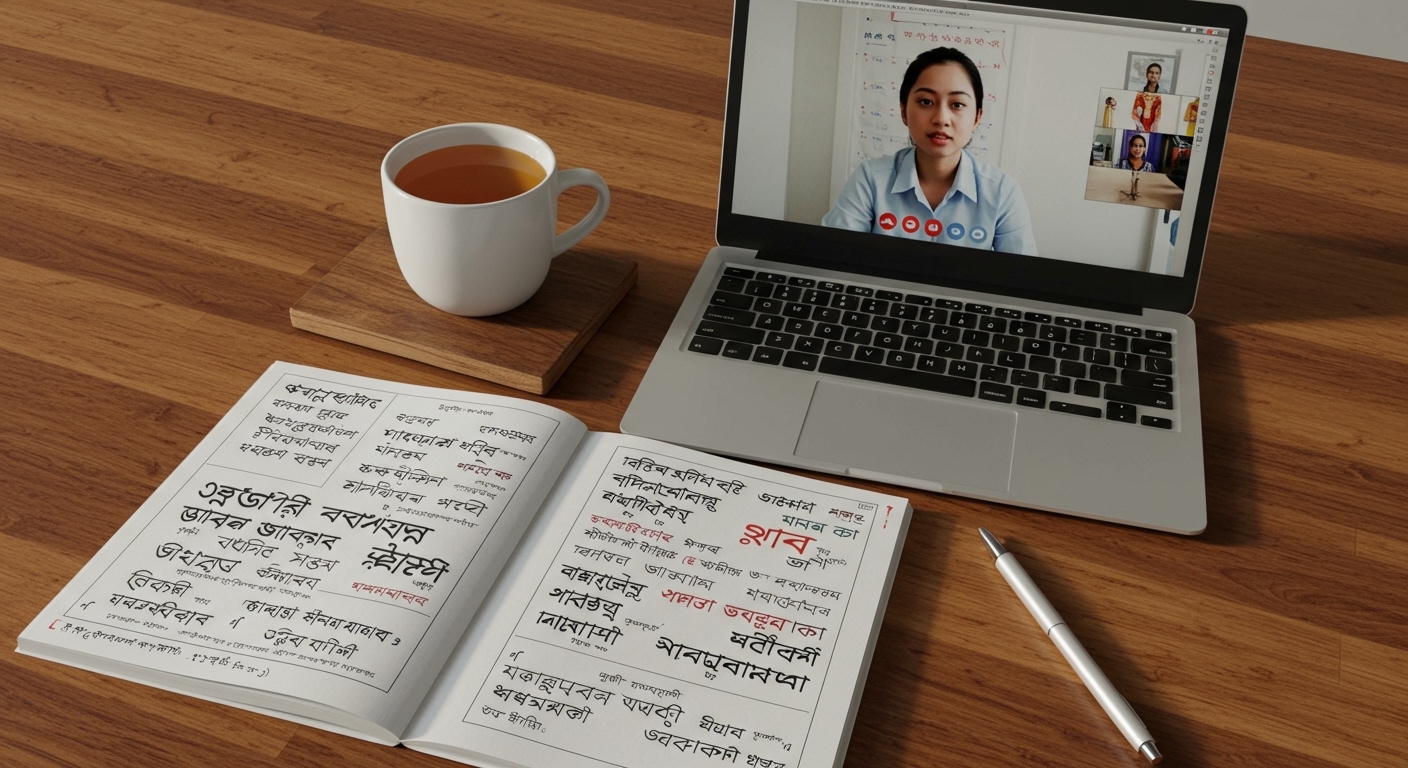
Key Takeaways: Bengali Difficulty at a Glance
- Difficulty Level: Moderate (Intermediate).
- Time to Fluency: 44–50 weeks of intensive study (approx. 1,100 hours).
- The Biggest Hurdle: Learning the Bengali script (Abugida) and complex conjunct consonants.
- The Best Part: No grammatical gender for inanimate objects (unlike French or Spanish).
- Sentence Structure: Follows Subject-Object-Verb, which differs from the English Subject-Verb-Object pattern.
Understanding Why People Ask: Is Bengali Hard to Learn for English Speakers?
When I first began my journey into the Indo-Aryan languages, I was intimidated by the swirling curves of the Bengali alphabet. Many English speakers feel this initial “wall,” but the reality is that Bengali shares the same Indo-European roots as English.
While the two languages have drifted apart over millennia, you will find surprising cognates and a logical structure. The Foreign Service Institute (FSI) doesn’t officially rank Bengali in its public top tier, but experienced linguists place it alongside Hindi and Thai in terms of time commitment.
Bengali vs. English: A Structural Comparison
To understand if is bengali hard to learn for english speakers, we must look at how the mechanics differ from your native tongue.
| Feature | English | Bengali | Difficulty for English Speakers |
|---|---|---|---|
| Sentence Order | Subject-Verb-Object (SVO) | Subject-Object-Verb (SOV) | Moderate (Requires mental rewiring) |
| Gender | Masculine/Feminine/Neuter | No gender for objects | Easy (Easier than Romance languages) |
| Script | Latin Alphabet | Eastern Nagari (Abugida) | Hard (Requires memorization) |
| Phonetics | Non-phonetic (Ough, though, through) | Highly Phonetic | Easy (You say it as you read it) |
| Verb Conjugation | Minimal | Extensive based on politeness | Moderate |
The 3 Main Challenges for English Learners
If you are wondering is bengali hard to learn for english speakers, you need to prepare for these three specific linguistic hurdles. In my experience coaching students, these are the areas where most people spend 70% of their study time.
The Script and Conjunct Consonants
The Bengali script is an Abugida, meaning vowels are written as diacritics attached to consonants. What makes it tricky are the Juktakkhor (conjunct consonants). When two letters join, they often form a completely new shape that looks nothing like the original components.
The Diglossia (Formal vs. Informal)
Bengali has a unique “split” personality. Sadhubhasha is the formal, literary style used in older texts, while Cholitobhasha is the modern, spoken standard. Most learners focus on Cholitobhasha, but even within that, there are distinct levels of politeness (Tui, Tumi, Apni) that change verb endings entirely.
Subject-Object-Verb (SOV) Logic
In English, we say “I eat rice.” In Bengali, you say “Ami bhat khai” (I rice eat). While this seems simple in short sentences, it becomes a complex mental puzzle when dealing with dependent clauses and long descriptions.
Why Bengali is Easier Than You Think
Despite the challenges, there are several “hidden gems” that make Bengali much easier than European languages like German or French.
- No Gendered Objects: In French, a table is feminine; in German, it’s masculine. In Bengali, a table is just a table. This removes one of the most frustrating memorization tasks for English speakers.
- Zero Articles: Bengali does not have “a,” “an,” or “the” in the same way English does. You don’t have to worry about whether a noun is definite or indefinite in most casual conversations.
- Phonetic Consistency: Unlike English, where “read” and “read” are pronounced differently, Bengali is strictly phonetic. Once you learn the sound of a letter, it never changes.
Step-by-Step Guide to Learning Bengali for English Speakers
If you’ve decided that the answer to “is bengali hard to learn for english speakers” is “manageable,” follow this expert-tested roadmap to achieve fluency.
Step 1: Master the Vowels (Swarabarna)
Don’t start with full sentences. Focus on the 11 vowels. Pay close attention to the difference between the short and long ‘i’ and ‘u’ sounds, although in modern spoken Bengali, these distinctions are often subtle.
Step 2: Tackle the Consonants and Diacritics
Learn the 39 consonants. I recommend grouping them by “vowel position”—labial, dental, and retroflex. Use flashcards (Anki or Quizlet) to memorize the Kar (vowel signs) that attach to these consonants.
Step 3: Learn the Three Levels of Politeness
Verb endings in Bengali change based on who you are talking to.
- Apni (Formal): Used for elders, strangers, and bosses.
- Tumi (Familiar): Used for friends and family.
- Tui (Intimate): Used for very close friends or children.
Step 4: Build a “Core 500” Vocabulary
Focus on high-frequency nouns and verbs. Because Bengali grammar is quite regular, once you have 500 words and basic conjugation rules, you can handle roughly 60% of daily interactions in Kolkata or Dhaka.
Pro-Tips for Accelerated Bengali Learning
Based on my years of helping expats transition to West Bengal and Bangladesh, here are three high-impact strategies:
- Watch “Satyajit Ray” Films: Start with the Apu Trilogy. The Bengali used is clear, rhythmic, and culturally rich. Use subtitles to bridge the gap between sounds and meaning.
- Use the “Shadowing” Technique: Listen to Bengali news podcasts (like BBC Bangla) and repeat the sentences exactly as the speaker says them, even if you don’t understand every word yet. This builds muscle memory in your tongue for retroflex sounds.
- Focus on Postpositions: Instead of prepositions (in, on, at) coming before the word, Bengali uses postpositions that come after. Practice saying “House-in” (Bari-te) instead of “In the house.”
Frequently Asked Questions (FAQ)
How long does it take to learn Bengali?
For a native English speaker, it typically takes 1,100 hours of practice to reach professional working proficiency. If you study for one hour a day, you can expect to reach a solid conversational level in about 2 to 3 years.
Is Bengali harder than Hindi?
Bengali and Hindi are similar in difficulty. However, many learners find Bengali slightly easier because it lacks the complex grammatical gender system found in Hindi. On the other hand, the Bengali script has more complex conjuncts.
Can I learn Bengali without the script?
While you can learn “survival Bengali” using Romanized transliteration, I strongly advise against it. The script is the key to understanding the phonetic structure. Without it, your pronunciation will likely remain poor, and you won’t be able to read menus, signs, or books.
What is the best app for learning Bengali?
While Duolingo does not currently offer Bengali, Mondly and Ling are excellent alternatives. For a more “human” touch, I highly recommend finding a tutor on iTalki to practice real-time conversation.
**
**
**
**









