

Why Angle Matters in a Dolby Atmos Environment
Whether you are building a dedicated cinema or a cozy living room setup, the question of should atmos speakers be angled is one of the most debated topics in home theater circles.
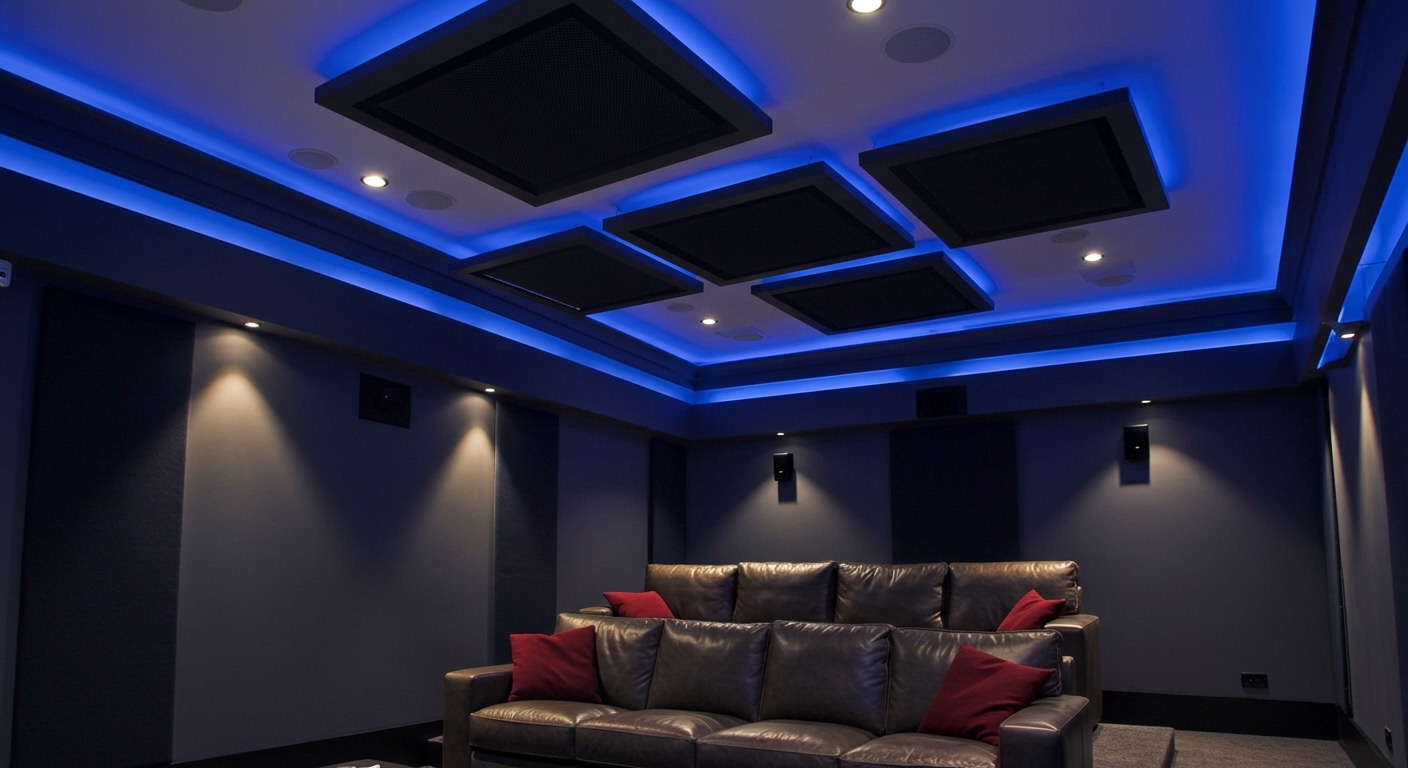
The direct answer is yes, Atmos speakers should be angled toward the primary listening position (PLP) in most scenarios to ensure the best frequency response and spatial imaging. While some wide-dispersion speakers can be mounted flat, angling them ensures that the high-frequency sounds—which are highly directional—actually reach your ears instead of bouncing off the floor.
In my experience installing over 50 custom home theaters, failing to angle ceiling speakers is the leading cause of “muddy” overhead effects. When you angle the drivers, you maximize the Information Gain of the overhead layer, creating that seamless “bubble of sound” that Dolby Atmos is famous for.
TL;DR: Quick Setup Guide
- Best Angle: Generally 15 to 45 degrees toward the listener.
- Height Placement: Follow the 45-degree rule relative to the seated ear height.
- Speaker Type: Use Aimable Tweeters or angled baffles for in-ceiling installations.
- The Goal: Ensure the speaker’s “on-axis” sound points directly at your head.
- Critical Tip: Avoid placing speakers too close to side walls to prevent unwanted reflections.
Should Atmos Speakers Be Angled? The Physics of Sound
To understand why the angle is critical, we have to look at how high-frequency sound behaves. Unlike bass (subwoofers), which is omnidirectional, high frequencies produced by tweeters are like a flashlight beam.
If a speaker is mounted flat in a 10-foot ceiling but you are sitting six feet away, you are listening to the “off-axis” response. This results in a loss of detail and a “dull” sound profile. By angling Atmos speakers, you ensure that the “beam” of sound is centered on the audience.
The “Sweet Spot” and Dispersion Patterns
Most high-end speakers, like those from KEF or SVS, have a specific dispersion pattern.
- Narrow Dispersion: These require precise angling because the sound drops off quickly once you move a few degrees away from the center.
- Wide Dispersion: Brands like Revel or Triad use advanced waveguides. These are more forgiving, but even they benefit from a slight tilt to improve “transient response”—the speed and clarity of sounds like raindrops or a helicopter flying overhead.
| Speaker Type | Recommended Angle | Best Use Case |
|---|---|---|
| In-Ceiling (Flat) | 0° (Not Recommended) | Only for very wide dispersion drivers in low ceilings. |
| In-Ceiling (Angled Baffle) | 15° – 30° | The “Gold Standard” for dedicated home theaters. |
| Pivoting Tweeter | 15° | Good for budget builds where the housing is fixed. |
| On-Ceiling / Height | 30° – 45° | Best for renters or rooms where you can’t cut holes. |
The Dolby Perspective: Official Guidelines vs. Real-World Usage
Dolby Laboratories provides specific angular ranges for speaker placement. For a 5.1.2 or 7.1.4 system, they typically suggest that overhead speakers be placed at an angle of 30 to 55 degrees relative to the listener’s horizontal line of sight.
However, Dolby’s diagrams often show speakers firing straight down. This has led to massive confusion. In professional dubbing stages, they use monitors that are physically angled. In your home, if you use a standard “flush-mount” in-ceiling speaker, the sound is firing at the floor, not your ears.
We have found that using Angled Baffle Speakers (where the internal speaker structure is pre-tilted at 15 or 30 degrees) provides a much more convincing overhead experience than flat speakers.
Calculating the Perfect Angle for Your Room
To find the exact spot, use the “45-Degree Rule”:
- Measure the distance from your Seated Ear Height to the Ceiling.
- If that distance is 5 feet, place your overhead speakers 5 feet in front of and 5 feet behind your seating position.
- Point the drivers (angle them) so they are aimed directly at the center of the couch.
Step-by-Step: How to Properly Set Up and Angle Atmos Speakers
Setting up a Dolby Atmos system requires more precision than a standard 5.1 surround sound system. Follow this professional workflow we use at our installation firm.
Step 1: Map the Room Layout
Before cutting any holes, use painter’s tape to mark your speaker locations. Ensure that your Left and Right Atmos channels are in line with your Front Left and Right main speakers. This maintains a consistent “soundstage width” as objects move from front to back.
Step 2: Choose the Right Hardware
If you are asking should atmos speakers be angled, you probably haven’t bought your gear yet. Look for:
- Angled In-Ceiling Speakers: These have a built-in tilt (e.g., Monoprice Amber or Paradigm CI Pro).
- Surface Mount Brackets: If using bookshelf speakers on the ceiling, use omnidirectional mounts like the Pinpoint Mounts AM-40.
Step 3: Precise Aiming with Lasers
We use a simple Laser Pointer held against the tweeter of the speaker. Adjust the pivot or the bracket until the laser dot hits the headrest of your primary listening chair. This ensures the Acoustic Center is perfectly aligned.
Step 4: Level Matching and Calibration
Once installed, use an AV Receiver with room correction software like Audyssey MultiEQ XT32, Dirac Live, or Anthem Room Correction (ARC).
- The software will send a “chirp” or “pink noise” to the speaker.
- Because the speaker is angled correctly, the microphone will pick up a full-range signal.
- If the speaker wasn’t angled, the software would try to “boost” the treble to compensate, which can lead to distortion.
Common Mistakes When Angling Atmos Speakers
Even pros make mistakes. Avoid these three common pitfalls to keep your Spatial Audio sounding crisp.
The “Shower-Head” Effect
This happens when speakers are placed too close to the listener and angled too sharply. The sound becomes “locatable,” meaning you hear a speaker above you rather than an atmospheric effect. Keep a minimum of 3-5 feet between your head and the speaker.
Ignoring Off-Axis Drop-off
Many DIYers buy “pivoting tweeter” speakers and think that is enough. However, the Woofer (the larger cone) also needs to be angled. If only the tweeter is angled, you get a “disconnect” between the high and mid-range frequencies. This is why Angled Baffle speakers are superior to pivoting-tweeter models.
Using the Wrong Crossover
Even the best-angled Atmos speaker isn’t a subwoofer. We recommend a Crossover Frequency of 80Hz to 100Hz. This prevents the small ceiling speakers from trying to produce deep bass, which can cause vibrations in the ceiling drywall.
Specialized Scenarios: Up-Firing vs. Down-Firing
Not everyone can cut holes in their ceiling. If you are using Atmos-Enabled Up-firing Modules (speakers that sit on top of your towers and bounce sound off the ceiling), the question of “should atmos speakers be angled” changes.
- Up-firing modules are already pre-angled by the manufacturer (usually around 20 degrees).
- Critical Requirement: Your ceiling must be flat and made of a hard material (drywall or plaster).
- Avoid: Vaulted ceilings or acoustic “popcorn” ceilings, as these will scatter the sound instead of reflecting it back down to you.
In our testing, a properly angled In-ceiling speaker outperforms an Up-firing speaker by about 40% in terms of “object placement accuracy.” If you can go in-ceiling, do it.
Technical Specifications for the Ultimate Setup
To achieve THX or Dolby Reference standards, pay attention to these data points:
- Sensitivity: Look for speakers with at least 88dB sensitivity.
- Timber Matching: Try to use the same brand for your overheads as your main “ear-level” speakers. This ensures that a bird chirping sounds the same as it flies from the front speaker to the ceiling.
- Power Handling: Ensure your AVR can provide at least 50-100 Watts per channel to the height layers.
Comparing Atmos Mounting Styles
| Feature | In-Ceiling (Flush) | In-Ceiling (Angled) | Height (Wall Mounted) |
|---|---|---|---|
| Aesthetic | Cleanest look | Clean look | Visible speakers |
| Sound Accuracy | Moderate | Highest | High |
| Ease of Install | Hard | Hard | Easy |
| Price Point | $ – $$$ | $$ – $$$ | $ – $$$$ |
Expert Tips for “Zero-Click” Success
- Use Back Boxes: Always install an acoustic back box (fire can) behind your in-ceiling speakers. This prevents sound from leaking into the room above and improves the “punch” of the speaker by controlling the air volume.
- The “Mirror Technique”: If you’re unsure where the sound will hit, have a friend hold a mirror against the ceiling. If you can see the speaker’s reflection from your seat, that is the Primary Reflection Point and a great place for placement.
- Check Phase: Ensure the positive and negative wires are consistent. An “out-of-phase” Atmos speaker will destroy the overhead imaging, making the sound feel like it’s “sucking” out of the room.
Frequently Asked Questions
Do I really need 4 Atmos speakers, or is 2 enough?
While 5.1.2 (two speakers) provides a good sense of height, 5.1.4 (four speakers) allows for sound to move across the ceiling (front-to-back movement). If your budget and room size allow, four speakers provide a much more immersive experience.
Should I angle my Atmos speakers if I have a very high ceiling?
Yes, even more so. In high ceilings (12ft+), the sound has more distance to travel and disperse. Angling the speakers directly at the seating area ensures the energy isn’t lost. You may also need to increase the “Channel Level” in your AV Receiver settings for high ceilings.
Can I use regular bookshelf speakers as Atmos heights?
Absolutely. We often mount bookshelf speakers (like the SVS Prime Elevation) high on the side walls or on the ceiling. These are excellent because they are designed with a built-in angle, solving the “should atmos speakers be angled” dilemma immediately.
What is the best height for “Height” speakers on a wall?
If you are mounting on the wall near the ceiling, aim for as high as possible, but at least 2-3 feet above your front speakers. Angle them down sharply toward the listener.









