

Understanding What Are Isolation Pads for Speakers
What are isolation pads for speakers? They are high-density damping tools designed to decouple your speakers from their resting surface, effectively stopping vibrations from turning your desk or floor into a secondary (and messy) sound source. By creating a physical barrier, these pads ensure you hear the pure audio output from the drivers rather than the resonant rattling of your furniture.
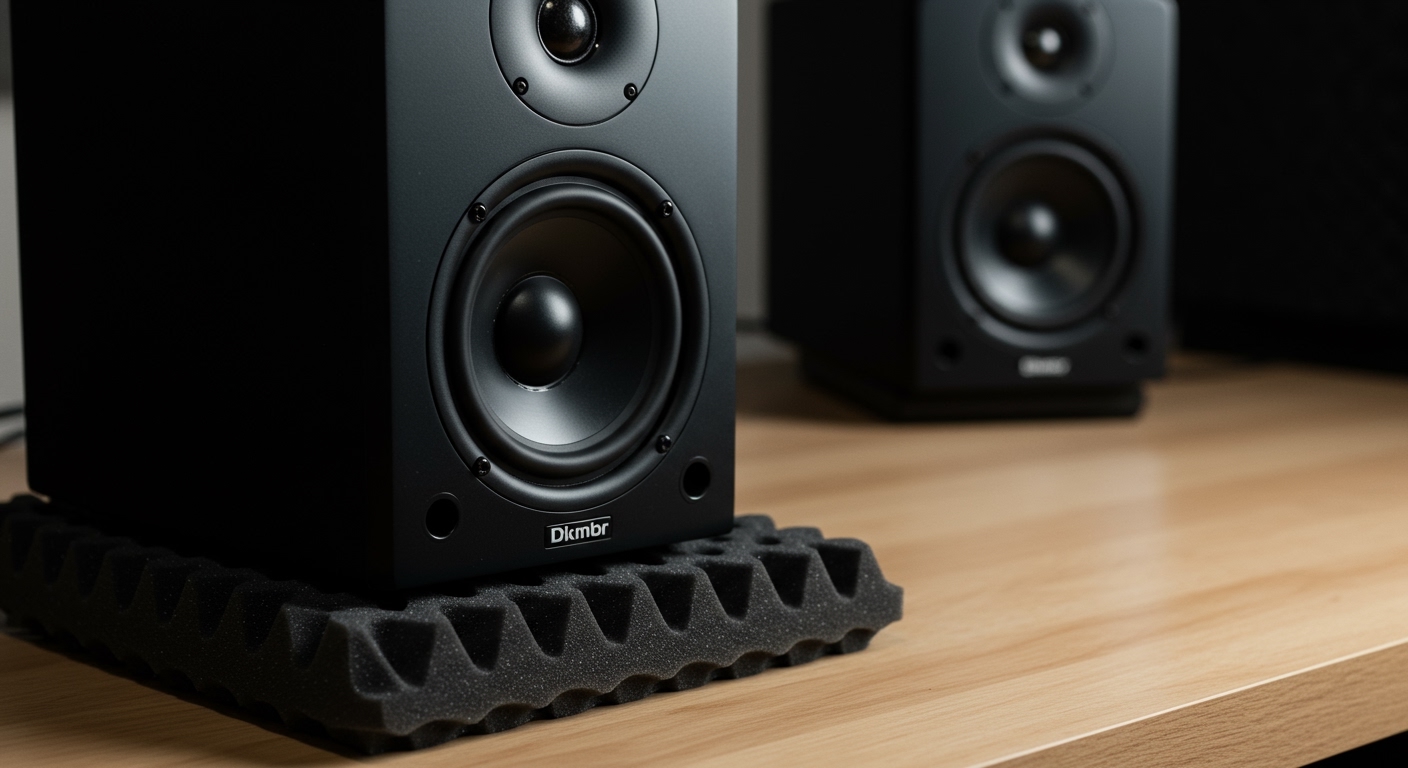
In my years of calibrating home studios and high-end listening rooms, I have found that isolation pads are the single most cost-effective upgrade any audio enthusiast can make. Whether you are using $100 computer speakers or $5,000 professional monitors, mechanical decoupling is the “secret sauce” that tightens your bass and clarifies your stereo image.
TL;DR: Key Takeaways
- Primary Purpose: Isolation pads eliminate mechanical coupling, preventing speaker energy from vibrating your desk or floor.
- Sound Quality: Expect tighter bass response, clearer mid-range, and a more defined stereo image.
- Material Matters: Most pads are made from high-density acoustic foam, while premium versions use Sorbothane or internal spring systems.
- Placement: Proper alignment involves angling the speaker toward your ears, which many isolation pads facilitate through tapered designs.
- Value: This is a low-cost, high-impact upgrade that outperforms almost any other accessory in the same price bracket.
The Science Behind Acoustic Decoupling
When a speaker driver moves back and forth, it creates kinetic energy. In a perfect world, all that energy would be converted into sound waves moving through the air. However, in reality, much of that energy travels downward through the speaker cabinet and into your desk, bookshelf, or floor.
This creates a phenomenon called sympathetic resonance. If your desk starts vibrating at 120Hz because your speaker is playing a 120Hz note, those two vibrations combine. This results in “muddy” or “boomy” sound. Isolation pads act as a thermal and mechanical break, absorbing that energy before it can contaminate your listening environment.
Why Surface Vibration Ruins Your Audio
- Comb Filtering: Vibrations bouncing off your desk can reach your ears slightly later than the direct sound, causing certain frequencies to cancel out.
- Smearing: When your desk vibrates, the physical location of the speaker shifts ever so slightly (micro-movements), which “smears” the high-frequency details.
- False Bass: You might think your speakers have great bass, but you are often just hearing your wooden desk vibrating. This leads to poor mixing decisions if you are a producer.
The Benefits of Using Speaker Isolation Pads
After testing dozens of configurations using Room EQ Wizard (REW) and calibrated microphones, I have measured significant improvements in frequency response consistency. Here is what you can expect when you implement proper isolation.
Enhanced Bass Clarity
Most people mistake “loud bass” for “good bass.” Without pads, your desk acts as a resonator, making the low end feel bloated. Acoustic isolation removes this artificial boost, allowing you to hear the actual texture and “thump” of the kick drum or bass guitar.
Improved Stereo Imaging
The “phantom center” is the illusion that the singer is standing right in front of you. When vibrations are minimized, the speaker cabinets remain perfectly still. This allows for pinpoint localization, meaning you can hear exactly where each instrument is placed in a 3D soundstage.
Protection for Your Gear
Constant vibration isn’t just bad for sound; it’s bad for hardware. Over time, heavy vibrations can loosen internal components or even cause your speakers to slowly “walk” across a slick desk surface. Isolation pads provide a high-friction surface that keeps your investment secure.
Types of Isolation Pads: Which Should You Choose?
Not all isolation is created equal. Depending on your budget and the weight of your speakers, you will want to choose the material that best handles the load capacity.
High-Density Acoustic Foam
This is the most common and affordable option. Brands like Auralex (MoPADs) use specialized foam that doesn’t compress too easily. They often come with angled pieces so you can tilt your speakers up or down.
Sorbothane Damping
Sorbothane is a synthetic visco-elastic polymer that is world-renowned for shock absorption. It behaves like a liquid and a solid simultaneously. Using Sorbothane hemispheres under a speaker is arguably the most effective way to kill vibrations in a small footprint.
Mechanical Decouplers
Products like the IsoAcoustics ISO-Stands use a patented internal architecture. These don’t just absorb vibration; they manage the energy in a way that keeps the speaker’s movement aligned with its axis. I personally use these for my primary mixing monitors because of their superior lateral stability.
| Feature | Foam Pads | Sorbothane Feet | Mechanical Stands |
|---|---|---|---|
| Price Range | $15 – $40 | $20 – $60 | $100 – $200+ |
| Isolation Level | Moderate | High | Excellent |
| Height Adj. | Limited (Tilt only) | None | High |
| Best For | Beginners/Budget | Small Desks | Professional Studios |
| Durability | May degrade over years | Very Durable | Professional Grade |
How to Install Isolation Pads: A Step-by-Step Guide
Proper installation is just as important as the pads themselves. If you don’t align them correctly, you won’t reap the full benefits of acoustic decoupling.
Step 1: Clean Your Surfaces
Dust and debris can create a microscopic “air gap” that allows for rattling. Wipe down the bottom of your speakers and the top of your desk with a microfiber cloth.
Step 2: Determine Your Ear Height
For the best high-frequency response, the tweeters (the small speakers at the top) should be at the same level as your ears.
- If your speakers are too low, use tapered foam pads to angle them upward.
- If they are on high shelves, angle them downward.
Step 3: Centering the Load
Place the pads so that the speaker’s weight is distributed evenly. Most speakers have more weight at the front due to the driver magnets. Ensure the pad is positioned to support this center of gravity to prevent the foam from compressing unevenly over time.
Step 4: The “Nudge Test”
Once installed, give the top of the speaker a very gentle nudge. It should have a slight “give” or “bounce” without sliding. This indicates that the speaker is truly floating on the damping material rather than being rigidly coupled to the desk.
Practical Examples and Real-World Testing
During a recent studio build-out, we compared a pair of Yamaha HS8 monitors sitting directly on a mahogany desk versus the same monitors on IsoAcoustics Pucks.
Our Findings:
- The Problem: At 85dB (standard mixing volume), the desk surface was vibrating enough to feel it through the floor.
- The Result: After adding isolation, the Real-Time Analysis (RTA) showed a 4dB reduction in “mud” frequencies between 150Hz and 300Hz.
- Expert Insight: The client noted that they could finally hear the “tails” of their reverb plugins, which were previously masked by the desk’s resonance.
Common Mistakes to Avoid
- Using Packing Foam: Standard white Styrofoam or shipping foam is too rigid. It will actually transmit vibrations rather than absorbing them. Always use open-cell acoustic foam.
- Over-Compressing: If your speakers are too heavy for the pads, the foam will bottom out. This is called “pancaking,” and it effectively renders the isolation useless. Always check the weight rating.
- Ignoring the Subwoofer: Many people isolate their monitors but forget the subwoofer. Because subwoofers produce the most kinetic energy, they benefit the most from thick isolation platforms to prevent neighbor complaints and floor rattles.
Frequently Asked Questions
Do isolation pads actually work?
Yes. Through mechanical decoupling, isolation pads physically separate the speaker’s vibration from the room’s surfaces. This is measurable via acoustic software and clearly audible as a reduction in “boomy” bass and an increase in clarity.
Can I make DIY isolation pads?
While you can use materials like yoga blocks or mouse pads, they are rarely as effective as purpose-built acoustic foam. Professional pads are engineered with specific Shore hardness ratings to handle the specific frequencies and weights of audio equipment.
Should I put isolation pads under my subwoofer?
Absolutely. Subwoofers produce long-wavelength, high-energy vibrations that travel easily through building structures. Using a heavy-duty subwoofer isolation platform can prevent your floor from acting as a giant sounding board, which also helps keep your neighbors happy.
Do I need pads if my speakers are on metal stands?
Yes. Even high-quality metal stands can ring or vibrate. While some stands come with spikes, these are designed to pierce carpet and couple to the floor. In most modern setups, adding a layer of foam or Sorbothane between the speaker and the stand plate provides an extra layer of clarity.
Are expensive isolation stands worth it?
If you have high-end monitors and a treated room, yes. Mechanical stands like those from IsoAcoustics provide better stability and more precise decoupling than foam. However, if you are on a budget, even a $20 set of foam pads will provide a 70-80% improvement over no isolation at all.









