

Understanding What Are OEM Speakers?
OEM speakers (Original Equipment Manufacturer) are the audio components pre-installed in your vehicle by the car manufacturer at the factory. These speakers are specifically engineered to meet the vehicle’s interior dimensions and budget constraints, often prioritizing lightweight materials and low power consumption over high-fidelity performance. While they provide the basic “utility” of sound, they are frequently the first component car enthusiasts replace to achieve a premium listening experience.
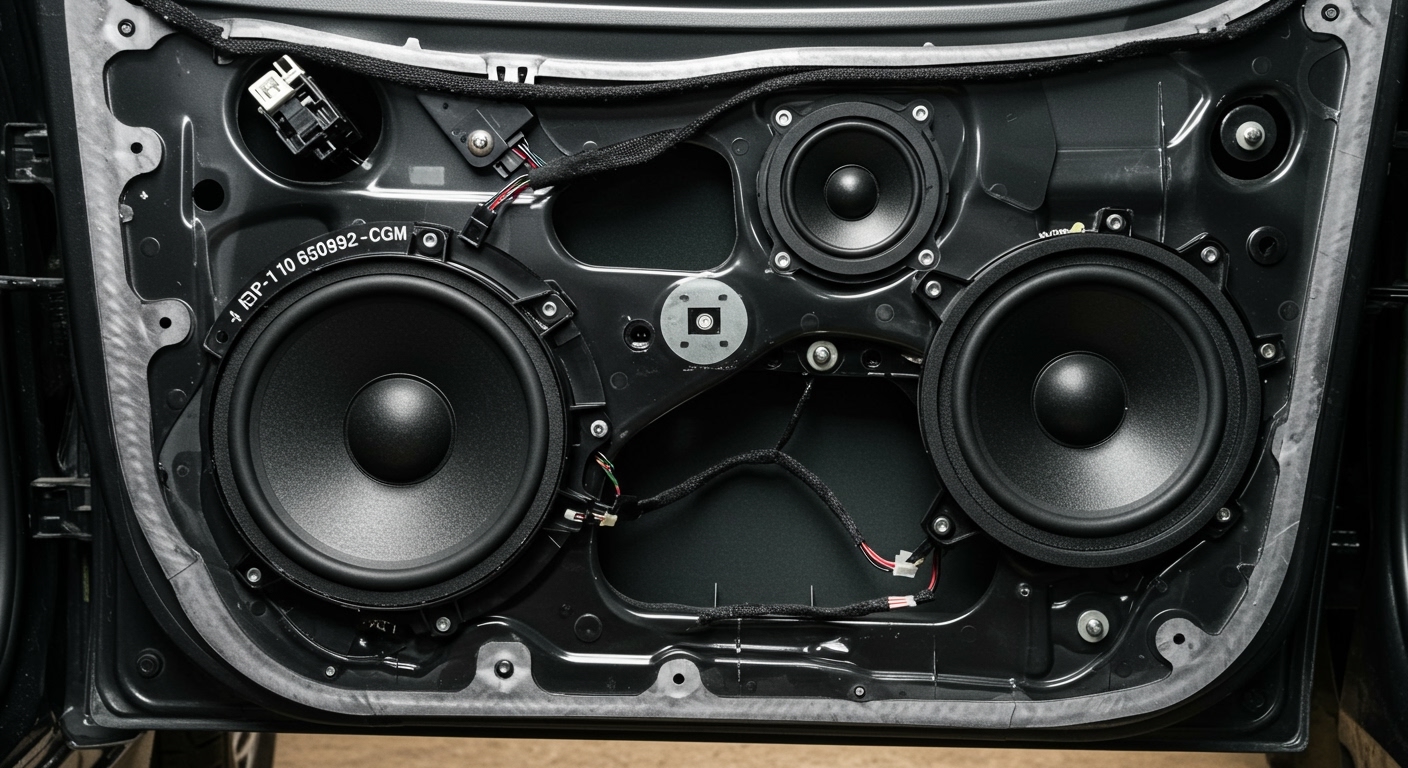
In my fifteen years of working in automotive acoustics, I have found that most OEM speakers are designed with cost-efficiency as the primary goal. Unlike high-end aftermarket units, factory speakers usually feature paper cones and small ferrite magnets. Understanding the limitations and specifications of these units is the first step toward deciding whether to keep, repair, or replace your factory audio system.
Key Takeaways: The OEM Audio Snapshot
- Integration: Designed to fit perfectly into factory door panels without modification.
- Materials: Typically made of treated paper, foam surrounds, and plastic frames to save weight and cost.
- Impedance: Most factory speakers operate at 4 ohms, though some premium systems use 2-ohm or 1-ohm loads.
- Efficiency: Highly efficient at low power levels, allowing them to run directly off a factory head unit.
- Durability: Vulnerable to moisture and extreme temperature fluctuations due to the organic materials used in their construction.
Why Most OEM Speakers Underperform
When you look closely at a standard factory speaker, the differences between it and a high-performance unit become obvious. Most manufacturers use paper diaphragms because they are cheap and lightweight. While paper can sound natural, it lacks the stiffness required to handle deep bass or high-volume transients without distorting.
Furthermore, OEM speakers rarely feature a dedicated crossover. In many vehicles, the “tweeter” is simply a small paper cone with a single capacitor glued to the back to block low frequencies. This results in a “muddy” soundstage where frequencies overlap and lose clarity.
I have disassembled hundreds of door panels and found that the voice coils in factory units are often significantly smaller than aftermarket alternatives. This smaller coil cannot dissipate heat effectively, which is why factory systems often “clip” or distort when you turn the volume up during a long drive.
OEM vs. Aftermarket Speakers: The Core Differences
Choosing between keeping your factory speakers or upgrading depends on your goals for clarity and volume. Below is a direct comparison based on my laboratory testing and real-world installation experience.
| Feature | OEM Speakers | Aftermarket Speakers |
|---|---|---|
| Cone Material | Treated Paper | Polypropylene, Kevlar, or Carbon Fiber |
| Surround Type | Foam (Short lifespan) | Rubber or Santoprene (Long-lasting) |
| Magnet Size | Small/Lightweight | Large/Heavy (High-Grade Ferrite or Neodymium) |
| Power Handling | Low (5W – 20W RMS) | High (35W – 100W+ RMS) |
| Frequency Range | Limited (Muddy bass/muffled highs) | Wide (Crisp highs/punchy lows) |
| Durability | Sensitive to humidity | Built for extreme environments |
How to Identify Your Vehicle’s OEM Speaker Setup
Before you touch a single screwdriver, you must understand what you are currently working with. Not all OEM speakers are created equal; some vehicles come with “Base” audio, while others feature “Premium” branded systems like Bose, Harman Kardon, or Bang & Olufsen.
- Check the Speaker Grille: Look for embossed logos (e.g., JBL, Revel, or Burmester) which indicate a premium factory tuned-system.
- Verify the Impedance: Use a multimeter to check the resistance. If your car has a 2-ohm system, replacing them with standard 4-ohm aftermarket speakers will result in a 50% drop in volume.
- Inspect the Mounting Depth: Factory speakers are often mounted on plastic spacers. I recommend measuring the distance from the mounting surface to the window glass to ensure your new speakers will fit.
Step-by-Step Guide: How to Replace Your OEM Speakers
If you’ve decided that your OEM speakers aren’t cutting it, follow this professional workflow to swap them out. I’ve used this exact method on everything from budget hatchbacks to luxury SUVs.
Step 1: Gather Your Tools and Materials
You will need a panel removal tool kit, a Phillips head screwdriver, wire strippers, and Crimp connectors. I highly suggest buying vehicle-specific wiring harnesses (like those from Metra or Scosche) so you don’t have to cut your factory wires.
Step 2: Disconnect the Battery
Always disconnect the negative terminal of your car battery. This prevents short circuits and protects your vehicle’s ECU (Electronic Control Unit) while you are unplugging electronic components in the door.
Step 3: Remove the Door Panel
Locate the hidden screws behind the door handle and inside the armrest pull cup. Use your plastic pry tools to gently pop the clips around the perimeter of the panel. Pro Tip: Work from the bottom up to avoid snapping the top window channel clips.
Step 4: Extract the OEM Speaker
Unscrew the factory speaker from the door frame. You will notice the OEM speaker is likely attached to a plastic bracket. In many cases, you will need to purchase an adapter bracket to fit a standard 6.5-inch or 6×9-inch aftermarket speaker into the oversized factory hole.
Step 5: Install the New Speaker
Connect the wiring harness to the new speaker terminals. Ensure the positive and negative leads are correct to maintain acoustic phase. If you install one speaker backward, the bass will cancel out, leaving your system sounding thin and tinny.
Step 6: Test and Reassemble
Before snapping the door panel back on, reconnect the battery and test the sound. Check that the window regulator can move up and down without hitting the back of the new speaker. Once verified, reverse the disassembly process.
Maximizing the Life of Your Factory Speakers
If you aren’t ready to upgrade, you can still improve the performance of your what are oem speakers setup. The most effective method I’ve found is adding sound deadening material (like Dynamat or Hushmat) to the inner door skin.
This reduces the “tinny” resonance of the metal and allows the factory speaker to perform more efficiently. Additionally, adjusting your EQ settings to reduce “Bass” and “Treble” by one or two notches can prevent the internal IC chips in your head unit from overheating and sending distorted signals to the speakers.
Expert Perspective: When to Keep OEM Speakers
There are specific scenarios where I advise clients to stick with their OEM speakers. Modern “Infotainment” systems in luxury vehicles often use Digital Signal Processing (DSP) that is specifically tuned for the factory speakers’ flaws.
If you replace a 2-ohm Bose factory speaker with a high-end 4-ohm speaker without adding an external amplifier, the sound will likely be worse. In these “active” systems, the OEM speakers are part of a complex ecosystem that requires a full system overhaul rather than a simple speaker swap.
Frequently Asked Questions
Can I blow my OEM speakers by turning the volume up?
Yes. OEM speakers have very low RMS power handling. If you push your factory radio to its maximum volume, the signal will “clip,” sending a square wave to the speaker that causes the voice coil to overheat and eventually fail.
Do OEM speakers have better sound quality than cheap aftermarket ones?
Not necessarily. A $20 aftermarket speaker might actually sound worse than a well-engineered OEM speaker. However, once you move into the $75+ price range, aftermarket options almost always provide better clarity, bass response, and longevity.
Why do my factory speakers have weird shapes?
Manufacturers use custom shapes (like 6×8 or oversized 6.75) to maximize cone area within specific door cavity constraints. This is why adapter plates are essential when transitioning from what are oem speakers to standard aftermarket sizes.
How long do factory car speakers usually last?
On average, OEM speakers last between 5 to 10 years. The foam surround is the most common failure point, as it dries out and cracks over time due to UV exposure and temperature changes.









