

Understanding What Are the Best Speakers for Music Production for Your Studio
To determine what are the best speakers for music production, you must look for active nearfield studio monitors that provide a flat frequency response, such as the Yamaha HS8, Adam Audio T7V, or Genelec 8030C. Unlike consumer speakers that “color” sound to make it pleasant, the best monitors provide an honest, clinical representation of your audio so your mixes translate to every device.
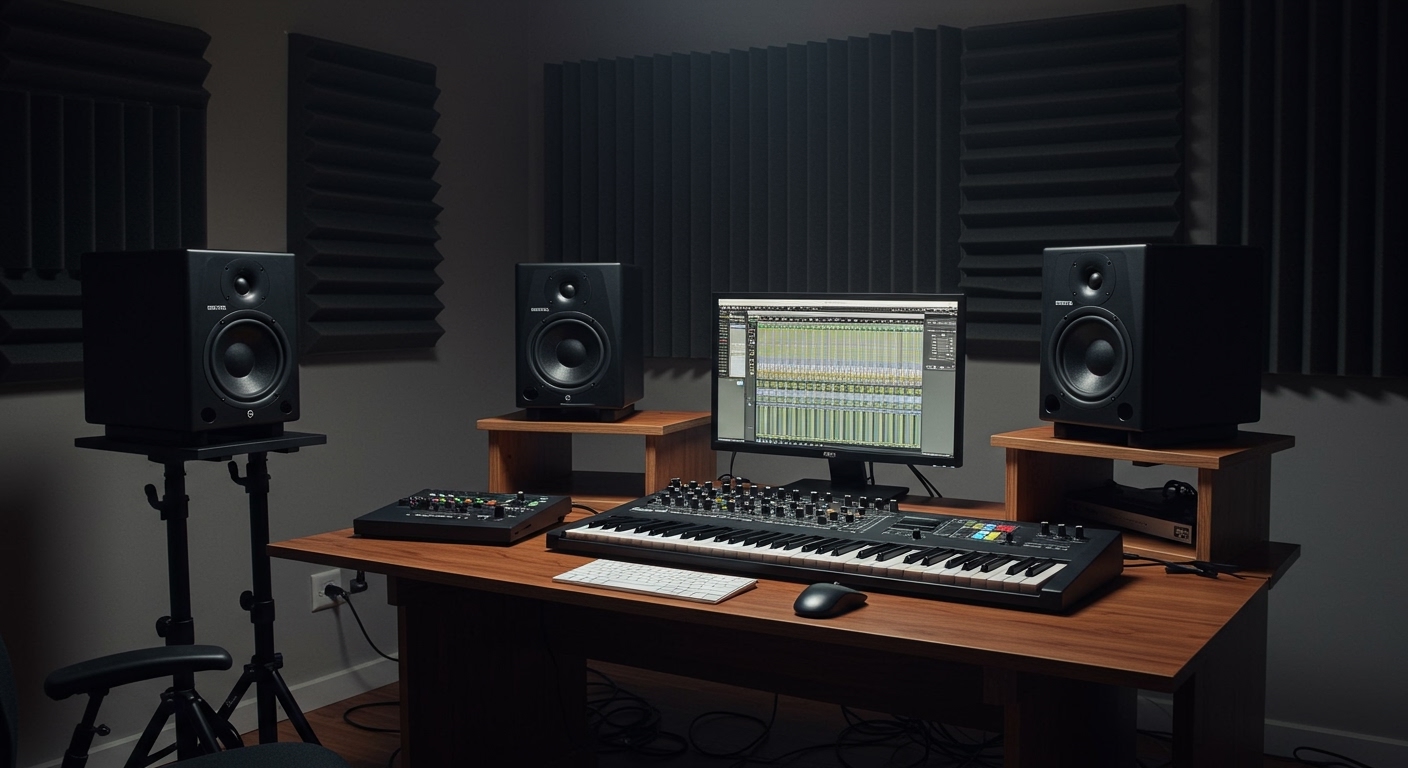
As someone who has spent over a decade in treated professional rooms and messy bedroom studios, I’ve learned that the “best” speaker is the one that fits your specific acoustic environment and budget. Choosing incorrectly often leads to “muddy” low ends and “shrill” highs that sound great in your room but fall apart in a car or on a smartphone.
Quick Takeaways: Choosing Your Studio Monitors
- Accuracy Over Aesthetics: Look for a “flat” response curve; you want the truth, not boosted bass.
- Driver Size Matters: Use 5-inch drivers for small rooms and 7 to 8-inch drivers for larger, treated spaces.
- Active vs. Passive: Most modern producers should choose Active (Powered) monitors to avoid needing external amplifiers.
- Placement is Key: Your monitors should form an equilateral triangle with your head, with tweeters at ear level.
- Room Treatment: Even $5,000 speakers will sound poor in a room with parallel bare walls and heavy echoes.
Step 1: Analyze Your Acoustic Environment
Before buying gear, you must evaluate where the speakers will live. In my experience, a common mistake is putting 8-inch monitors in a tiny 10×10 bedroom. Large speakers move a lot of air; in a small room without bass traps, that air creates “standing waves” that make your low-end impossible to judge.
Matching Room Size to Woofer Size
- Small Rooms (Bedroom/Nook): Stick to 4-inch or 5-inch woofers. These provide enough detail without overwhelming the space with uncontrollable low frequencies.
- Medium Rooms (Standard Spare Room): 6-inch to 7-inch woofers are the “sweet spot” for most home producers, balancing bass extension with clarity.
- Large/Pro Studios: 8-inch woofers or larger, often paired with a subwoofer, are necessary to feel the sub-harmonics in genres like EDM or Hip-Hop.
The Importance of Porting
Check if the speaker is front-ported or rear-ported. If you must place your speakers close to a wall, choose front-ported models (like the KRK Rokit series). Rear-ported speakers (like the Yamaha HS series) need at least 12–24 inches of space from the wall to prevent “bass buildup.”
Step 2: Identifying Key Technical Specifications
When researching what are the best speakers for music production, you will encounter technical jargon. Here is a breakdown of what actually matters for your workflow.
Frequency Response
This tells you the range of notes the speaker can play. Look for a range that starts as low as 40Hz and goes up to 20kHz. A wider range allows you to hear the “air” in vocals and the “thump” in a kick drum.
Total Harmonic Distortion (THD)
THD measures how much the speaker changes the signal. Lower is better. Professional-grade monitors typically have a THD of less than 0.5% at standard listening volumes.
Amplification (Class D vs. AB)
- Class AB: Often preferred by purists for a “smoother” sound but they run hot and are heavier.
- Class D: Modern, lightweight, and efficient. Most high-end monitors like Genelec and Barefoot now use advanced Class D amps.
Top Recommendations: Comparison Table
| Model | Driver Size | Best For | Price Point | Key Feature |
|---|---|---|---|---|
| Yamaha HS5 | 5″ | Small Rooms / Vocals | Budget | Ultra-flat “honest” mids |
| KRK Rokit 5 G4 | 5″ | Electronic Music | Budget | Built-in DSP Room Tuning |
| Adam Audio T7V | 7″ | All-around Production | Mid-Range | U-ART Accelerated Ribbon Tweeter |
| Neumann KH 120 II | 5.25″ | Professional Mixing | High-End | Incredible Phase Linearity |
| Genelec 8030C | 5″ | Precision Monitoring | High-End | Minimum Diffraction Enclosure |
Step 3: Top Picks for Every Budget
The Industry Standard: Yamaha HS Series
The Yamaha HS8 and HS5 are the descendants of the legendary NS-10s. I have found that if a mix sounds good on a pair of Yamahas, it will sound good anywhere. They are notoriously “unflattering,” which is exactly what you want when mixing.
The Detailed Highs: Adam Audio T-Series
If you work with dense arrangements or intricate high-end percussion, the Adam Audio T7V is an incredible choice. The U-ART ribbon tweeter provides a wider “sweet spot,” meaning you don’t have to sit perfectly still to hear an accurate image.
The Modern Classic: KRK Rokit G4
The KRK Rokit 5 G4 is ubiquitous for a reason. These speakers include a graphic EQ on the back via an LCD screen, helping you compensate for poor room acoustics. While older KRKs were criticized for being too “bass-heavy,” the G4 line is significantly more balanced.
Step 4: Proper Studio Monitor Placement for Accurate Mixing
Even the best speakers for music production will fail if placed incorrectly. Follow these steps to create an accurate listening environment.
The 38% Rule
If possible, place your listening position (your chair) at 38% of the room’s length from the front wall. This is mathematically the point where room modes (standing waves) are least likely to distort your perception of bass.
The Equilateral Triangle
The distance between the two speakers should be exactly the same as the distance from each speaker to your head.
- Step A: Measure 4 feet between the monitors.
- Step B: Position your chair so your ears are 4 feet from each monitor.
- Step C: Angle (toe-in) the speakers toward your ears.
Ear Level Tweeters
High frequencies are highly directional. Ensure the tweeters (the small top speakers) are at the exact same height as your ears. Use speaker stands or desktop isolation pads (like ISO-Acoustics) to achieve this and decouple the speakers from your desk to stop vibrations.
Step 5: Essential Accessories and Calibration
Buying the speakers is only 80% of the journey. To get professional results, consider these additions:
- Acoustic Treatment: Invest in broadband absorbers (not cheap egg-carton foam). Placing panels at the “first reflection points” on your side walls will drastically improve stereo imaging.
- Audio Interface: You need a high-quality DAC (Digital-to-Analog Converter). Models like the Focusrite Scarlett 2i2 or Universal Audio Volt provide clean signals to your monitors via balanced XLR or TRS cables.
- Calibration Software: I highly recommend Sonarworks SoundID Reference. It uses a measurement microphone to analyze your room and creates an EQ curve that “flattens” your speakers’ output, correcting for room flaws.
FAQ: Frequently Asked Questions
Can I just use high-end headphones for music production?
While headphones like the Sennheiser HD600 are great for checking details, they cannot accurately replicate how sound waves interact in a physical space (crossfeed). Mixing solely on headphones often leads to errors in stereo width and reverb levels.
Do I need a subwoofer for my home studio?
Only if your room is large and well-treated. In a small, untreated room, a subwoofer usually causes more problems than it solves by creating massive “bass peaks” and “nulls.” Most 8-inch monitors provide plenty of low-end for home use.
What is the difference between balanced and unbalanced cables?
For studio monitors, always use balanced cables (XLR or 1/4″ TRS). Balanced cables use a third conductor to cancel out electrical interference and hum, which is vital when your speakers are near computers and monitors.
How much should I spend on my first pair of monitors?
Expect to spend between $300 and $500 for a solid entry-level pair like the JBL LSR305P or Yamaha HS5. Spending less often results in speakers that are no better than high-end computer speakers.
**
**
**
**









