

Why Cicero’s Rhetoric Matters: Solving the “Quiet Voice” Problem
Have you ever had a brilliant idea but failed to convince your team to act on it? This common frustration occurs because most people focus on what they say rather than how they say it. To solve this, we look to the master of persuasion, Marcus Tullius Cicero.
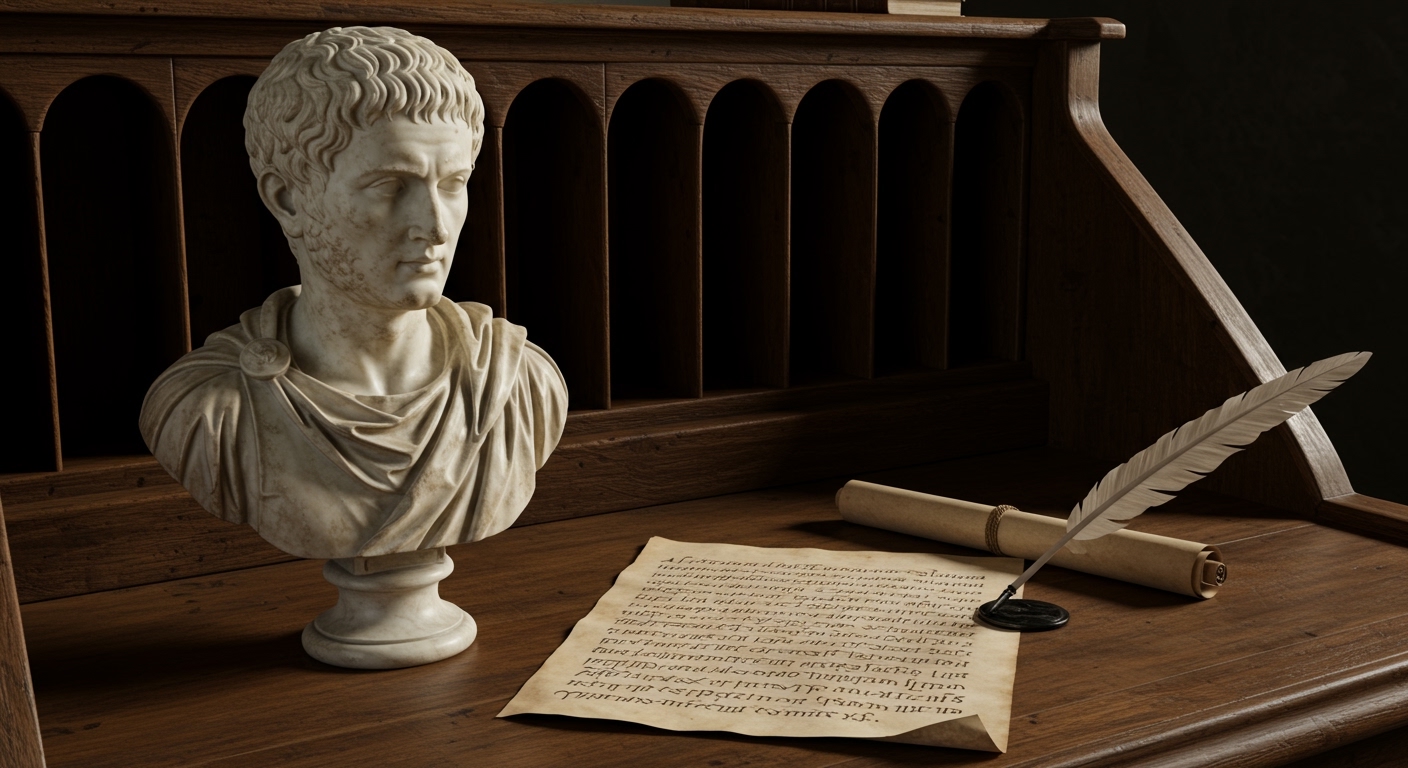
What did cicero believe speakers should use rhetoric for? Cicero believed speakers should use rhetoric to combine eloquence with wisdom to serve the public good and preserve the stability of the state. He viewed rhetoric not as a trick for deception, but as a vital tool for civic duty, justice, and the promotion of virtuous action within a Republic.
TL;DR: Key Takeaways from Ciceronian Rhetoric
- The Goal: Rhetoric must bridge the gap between abstract philosophy and practical political action.
- The Requirements: A great speaker must possess broad knowledge in law, history, and philosophy (the “Ideal Orator”).
- The Three Aims: To inform (docere), to delight (delectare), and to move (movere).
- The Foundation: Persuasion is built on the Five Canons: Invention, Arrangement, Style, Memory, and Delivery.
Understanding What Cicero Believed Speakers Should Use Rhetoric For
In my years analyzing classical communication, I’ve found that modern speakers often mistake rhetoric for “spin.” However, for Cicero, rhetoric was the highest form of human achievement. He lived during the turbulent end of the Roman Republic, where words were literally a matter of life and death.
What did cicero believe speakers should use rhetoric for? Primarily, he believed it was the engine of democracy. He argued that “wisdom without eloquence does too little for states, but eloquence without wisdom generally does great harm.”
The Marriage of Wisdom and Eloquence
Cicero’s most famous work, De Oratore, emphasizes that a speaker should not just be a “word-smith.” Instead, the speaker must be a statesman-philosopher. He believed rhetoric should be used for:
- Protecting the Innocent: Using legal arguments to ensure justice in the courts.
- Guiding the State: Persuading the Senate toward policies that benefit the people.
- Preserving Order: Calming social unrest through powerful, reasoned appeals.
- Advancing Truth: Making complex philosophical truths accessible and persuasive to the average citizen.
The Three Duties of an Orator: The “Officia Oratoris”
Cicero outlined three specific duties that every speaker must fulfill to be successful. If you miss even one of these, your message will likely fail.
Docere (To Teach or Inform)
This is the intellectual foundation of your speech. You must provide the facts, the data, and the logical progression of your argument. Without docere, your audience remains confused.
Delectare (To Delight)
People do not listen to boring speakers. Cicero believed you must use wit, charm, and elegant language to keep the audience’s attention. This builds rapport and makes the audience more receptive to your difficult points.
Movere (To Move or Persuade)
This is the ultimate goal. You don’t just want people to agree; you want them to act. This involves tapping into the audience’s emotions—anger, pity, or hope—to drive them toward a specific decision.
| Duty | Purpose | Modern Business Equivalent |
|---|---|---|
| Docere | Inform with facts | The data-heavy PowerPoint slides |
| Delectare | Engage through style | Storytelling and high-quality visuals |
| Movere | Drive to action | The “Call to Action” or closing pitch |
The Step-by-Step Guide: Applying the Five Canons of Rhetoric
To achieve what Cicero believed speakers should use rhetoric for, you must follow a systematic process. These are known as the Five Canons. I have used this framework to structure everything from 10-minute keynote speeches to complex corporate manifestos.
Step 1: Inventio (Invention)
This is the process of finding what to say. It isn’t about “making things up” but rather “discovering” the most persuasive arguments available.
- Define the “Stasis”: Determine where the conflict lies. Is it a question of fact (Did it happen?), definition (What do we call it?), or quality (Is it good or bad?).
- Identify Proofs: Use Ethos (your credibility), Logos (logical reasoning), and Pathos (emotional connection).
Step 2: Dispositio (Arrangement)
Structure is the key to clarity. Cicero typically followed a specific six-part structure for his orations:
- Exordium: The introduction. Hook the audience and establish your authority.
- Narratio: State the facts of the case clearly and briefly.
- Partitio: Outline exactly what points you will cover.
- Confirmatio: Present your main proofs and evidence.
- Refutatio: Anticipate and disprove the opponent’s arguments.
- Peroratio: The powerful conclusion. Summarize and issue a final emotional appeal.
Step 3: Elocutio (Style)
This is where you choose your words. Cicero categorized style into three levels:
- The Plain Style: Used for teaching and clarity. Simple language, no fluff.
- The Middle Style: Used for pleasing the audience. More metaphors and rhythm.
- The Grand Style: Used for moving the audience. High-energy, intense metaphors, and powerful cadence.
Step 4: Memoria (Memory)
In the Roman era, reading from a scroll was seen as a sign of weakness. Cicero used the “Method of Loci” (the Memory Palace). He would mentally place parts of his speech in different rooms of a house he knew well. As he “walked” through the house in his mind, the arguments would come to him naturally.
Step 5: Pronuntiatio (Delivery)
This involves voice control and body language. Cicero was known for his “histrionics”—dramatic gestures and varied vocal tones.
- Expert Tip: In modern settings, don’t overact. However, do vary your pitch and pace to emphasize key points. A well-timed pause is often more powerful than a loud shout.
Advanced Ciceronian Techniques for Modern Persuasion
To truly master the craft, we must look deeper into the specific rhetorical devices Cicero used to sway the Roman masses.
The Power of the “Tricolon”
Cicero loved the “rule of three.” Whether it was “Veni, Vidi, Vici” (attributed to Caesar but a classic rhetorical form) or his own rhythmic triplets, groups of three create a sense of completeness and urgency.
- Example: “We must act with courage, we must act with speed, and we must act with honor.”
Praeteritio (The “I won’t mention it” trick)
This is a brilliant, albeit sneaky, tactic. You mention a subject by saying you aren’t going to mention it.
- Ciceronian Example: “I will not even speak of my opponent’s legendary greed, or his history of failed projects, for we are here to discuss the future.”
- Why it works: It allows you to plant a seed of doubt without appearing to be an “aggressive” attacker.
Anaphora (Repetition for Emphasis)
This involves repeating a word or phrase at the beginning of successive clauses. It builds a rhythm that is hypnotic and memorable. Think of Martin Luther King Jr.’s “I Have a Dream”—that is pure Ciceronian elocution.
Case Study: Cicero vs. Catiline
In 63 BC, a senator named Catiline conspired to overthrow the Roman government. Cicero, serving as Consul, used his rhetorical skill to stop him. He didn’t use an army; he used four speeches.
By applying Inventio to uncover the plot and Elocutio (specifically the Grand Style) to shame Catiline in front of the Senate, Cicero forced the conspirator to flee the city. This is the ultimate example of what Cicero believed speakers should use rhetoric for: defending the Republic when the law alone wasn’t enough.
Why Modern Speakers Struggle (And How to Fix It)
Most speakers today fail because they focus 90% of their time on Inventio (the content) and 0% on Elocutio (style) or Pronuntiatio (delivery).
The Fix:
- Reduce your slides: Stop hiding behind text. Focus on your presence.
- Practice your “Grand Style”: Identify one moment in your presentation where you stop being “polite” and start being passionate.
- Anticipate the Refutatio: Don’t ignore the “elephant in the room.” Address your audience’s doubts before they have a chance to voice them.
FAQ: Common Questions About Ciceronian Rhetoric
What is the “Ideal Orator” according to Cicero?
The Ideal Orator is someone who possesses a “universal knowledge” of all important arts and sciences. Cicero believed that a speaker cannot truly persuade if they do not understand the underlying philosophy, history, and law of their subject.
How does Cicero’s rhetoric differ from Aristotle’s?
While Aristotle focused on the scientific and logical classification of rhetoric, Cicero was more focused on the practical application and artistic performance. Aristotle wrote for the classroom; Cicero wrote for the courtroom and the Senate floor.
Can rhetoric be used for evil purposes?
Cicero acknowledged this danger. However, he argued that the solution was not to abandon rhetoric, but to ensure that virtuous men became the most skilled speakers. He believed that the truth, when presented with equal eloquence, would naturally defeat lies.
Why did Cicero emphasize “Memory” so much?
For Cicero, Memory allowed for eye contact and spontaneity. If you are reading, you cannot see how your audience is reacting. If you have the speech memorized (or at least the structure), you can adapt your “Delivery” in real-time to the mood of the room.
Final Thought:
Mastering what Cicero believed speakers should use rhetoric for transforms you from a mere messenger into a leader. By combining deep knowledge with beautiful expression, you don’t just share information—you change minds.









