

Understanding the A and B Speaker Switch
The A and B labels on a stereo receiver or amplifier refer to two distinct sets of speaker outputs that allow you to connect and control two separate pairs of speakers from one device. By using the front-panel toggle, you can play audio through pair A, pair B, or both simultaneously (A+B) to fill different rooms or compare speaker performance.
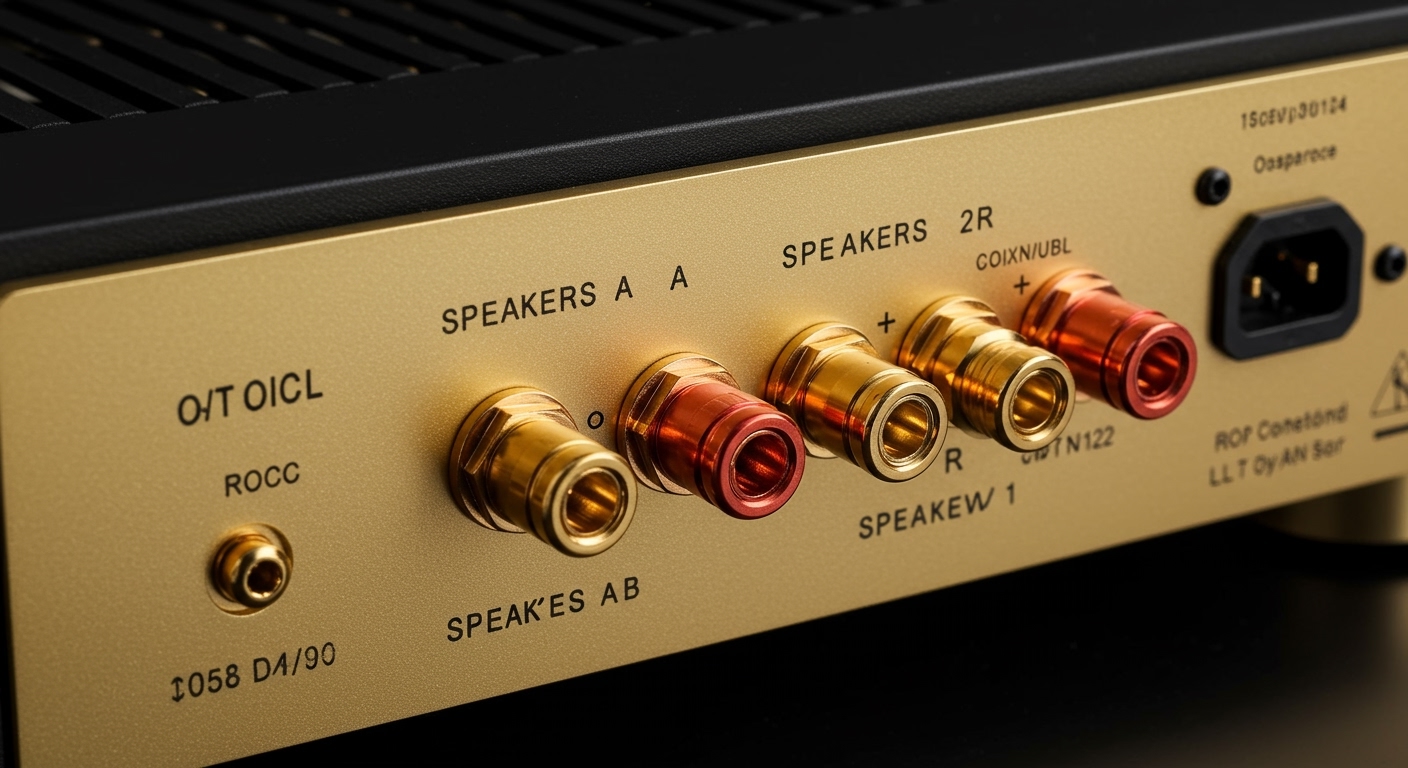
When I first started setting up home theater systems in the early 2000s, I often saw users confuse these labels with “left and right” channels. In reality, Speakers A and B are both stereo pairs, meaning each has its own Left and Right terminals. Understanding how to manage these outputs is essential for protecting your Amplifier’s Power Stage from overheating or “clipping.”
TL;DR: Key Takeaways
- Purpose: Allows one amplifier to drive two different sets of speakers (e.g., Living Room vs. Patio).
- Functionality: Use the A/B Switch to select which pair is active or play both (A+B).
- Impedance Risk: Playing A+B simultaneously drops the Electrical Resistance (Ohms), which can damage budget receivers.
- Wiring: Always ensure your speakers match the Impedance Rating (usually 4 to 8 Ohms) listed on the back of the receiver.
- Expert Tip: Only use the A+B setting if both speaker pairs are 8-Ohm rated to avoid triggering “Protection Mode.”
What Does A and B Mean on Speakers? The Core Functionality
In the world of High-Fidelity (Hi-Fi) Audio, the A and B designations are part of a Speaker Selector Circuit. Think of it as a routing station for your music. When you look at the back of your Integrated Amplifier, you will see four pairs of terminals: A (Left/Right) and B (Left/Right).
I’ve spent years testing Vintage Marantz and Modern Denon receivers, and the logic remains identical across decades. The A output is typically your “Primary” listening zone, such as your main bookshelf or tower speakers in the living room. The B output is your “Secondary” zone, often utilized for speakers in a kitchen, bedroom, or outdoor space.
Common Scenarios for A/B Usage:
- Multi-Room Audio: Playing the same music in two different areas of the house.
- Speaker Comparison (A/B Testing): Comparing two different brands of speakers to see which sounds better in your specific room.
- Application Mixing: Using high-quality Reference Monitors on A for critical listening and larger Floorstanding Speakers on B for parties.
How A and B Switching Works: Parallel vs. Series Wiring
It is crucial to understand how your receiver handles the electrical load when you press the A+B button. Most consumer-grade receivers use Parallel Wiring for the A and B outputs.
In a Parallel Connection, the amplifier sends full voltage to both sets of speakers. However, this significantly increases the current draw. If you connect two pairs of 8-Ohm speakers, the amplifier “sees” a total load of 4 Ohms. If you connect two pairs of 4-Ohm speakers, the load drops to 2 Ohms, which is low enough to fry the internal circuitry of most standard home receivers.
Speaker Impedance Comparison Table
| Speaker Setup | Individual Impedance | Resulting Load on Amp | Safety Status |
|---|---|---|---|
| Only A Active | 8 Ohms | 8 Ohms | Safe |
| Only B Active | 4 Ohms | 4 Ohms | Safe (if amp rated for 4Ω) |
| A + B (Both) | 8Ω + 8Ω | 4 Ohms | Safe for most amps |
| A + B (Both) | 8Ω + 4Ω | 2.6 Ohms | Dangerous / High Heat |
| A + B (Both) | 4Ω + 4Ω | 2 Ohms | EXTREME DANGER / Protection Mode |
Pro Tip: I always check the back of the receiver near the speaker terminals. It will often state: “A or B: 4-16 Ohms; A + B: 8-16 Ohms.” This is a warning that the receiver cannot handle the high current required for low-impedance loads when both sets are active.
Essential Speaker Terminology: Beyond A and B
To master your audio setup, you need to understand more than just the A/B switch. Here are the most critical terms I use daily when calibrating Stereo Systems.
Impedance (Ohms)
Impedance is the measure of electrical resistance. Think of it like a water pipe: a lower Ohm rating means a wider pipe that allows more current to flow. While this sounds good, too much flow (low impedance) can overwhelm your Amplifier’s Power Supply.
Sensitivity (dB)
Measured in Decibels (dB), this tells you how loud a speaker gets with one watt of power. If you are running an A/B setup with one pair of high-sensitivity speakers and one pair of low-sensitivity speakers, the B pair might sound much quieter even though the volume knob hasn’t moved.
Bi-Wiring vs. Bi-Amping
Do not confuse A/B switching with Bi-Wiring. Some high-end speakers have four terminals on the back (two red, two black).
- Bi-Wiring: Running two sets of wires from the Speaker A terminal to a single speaker to separate high and low frequencies.
- Bi-Amping: Using two separate amplifier channels to power one speaker.
Crossover Frequency
This is the “traffic cop” inside your speaker. It directs high frequencies to the Tweeter and low frequencies to the Woofer. When setting up an A/B system, I ensure that the crossover points of both pairs complement each other if they are playing in the same room.
Step-by-Step Guide: How to Properly Wire A and B Speakers
Wiring your system incorrectly can lead to a “short circuit” or “out-of-phase” audio, which makes the bass disappear. Follow my proven process for a clean installation.
Step 1: Check Your Amp’s Capability
Look at the manual or the rear chassis. Confirm the Minimum Impedance for A+B operation. If your speakers are 4-Ohm and your amp says “8-Ohm minimum for A+B,” do not attempt to play both at once.
Step 2: Prepare High-Quality Wire
I recommend using 14-gauge or 16-gauge Oxygen-Free Copper (OFC) wire. Avoid Copper Clad Aluminum (CCA) as it has higher resistance and can degrade sound quality over long distances (like running wires to Zone B in another room).
Step 3: Maintain Polarity
Polarity is the “positive to positive” and “negative to negative” connection.
- Strip 1/2 inch of insulation.
- Twist the copper strands tightly.
- Connect the Red (+) terminal on the amp to the Red (+) terminal on the speaker.
- Repeat for the Black (-) terminal.
- Critique: If your speakers sound “hollow” or the singer sounds like they are coming from the walls instead of the center, you likely have one speaker wired in reverse polarity.
Step 4: Test Zones Individually
Turn the volume to zero. Turn on the amp and select Speaker A. Slowly increase volume to ensure clear sound. Switch to Speaker B and repeat. Finally, test A+B while feeling the top of the receiver for excessive heat.
Troubleshooting Common A/B Speaker Issues
Even expert audiophiles run into snags. Here are the three most common problems I encounter during Field Installations.
Problem 1: The Receiver Keeps Shutting Off
This is usually Protection Mode. It happens when the total impedance is too low or a stray wire strand is touching the chassis.
- Solution: Check for “whiskers” (loose wire strands) at the terminals. If clean, ensure you aren’t running two pairs of low-impedance speakers simultaneously.
Problem 2: Volume Drops When A+B is Active
Since the amplifier is sharing its Power Reservoir between four speakers instead of two, a slight volume drop is normal in many Class AB Amplifiers.
- Solution: Use speakers with similar Sensitivity Ratings (e.g., both 90dB) so the volume remains consistent across both zones.
Problem 3: Sound is Muddy in One Zone
This often happens when the “B” speakers are placed in a room with poor acoustics or are connected with very thin, cheap wire.
- Solution: Upgrade the wire gauge for your longer “Zone B” runs to minimize Signal Degradation.
Advanced Knowledge: Using Speaker Selectors for More than Two Pairs
If A and B aren’t enough, you might consider an External Speaker Selector Box. These devices connect to your “Speaker A” terminals and allow you to distribute audio to 4, 6, or even 10 pairs of speakers.
Why use a selector box?
- Impedance Protection: High-quality selectors (like those from Niles or Russound) have internal resistors or transformers that keep the impedance at a safe level (usually 8 Ohms) regardless of how many speakers you turn on.
- Individual Volume Control: Some boxes allow you to adjust the volume for the “Kitchen” without affecting the “Patio.”
Frequently Asked Questions (FAQ)
Can I use A and B speakers at the same time?
Yes, most receivers allow you to play A+B simultaneously. However, you must ensure the combined Impedance does not drop below the amplifier’s safe operating limit. Most experts recommend using only 8-Ohm speakers if you plan to play both sets at once.
Does Speaker B sound worse than Speaker A?
In most modern receivers, the internal signal path for A and B is identical. There is no inherent “quality loss” on the B channel. However, if your “B” wire run is significantly longer (over 50 feet), you may experience High-Frequency Roll-off if you use thin wire.
What happens if I connect 4-ohm speakers to the B channel?
If you only play the B channel, it will likely work fine (provided the amp is 4-ohm stable). If you try to play 4-ohm speakers on B while 8-ohm speakers are playing on A, the load drops to 2.6 Ohms, which will likely trigger Thermal Shutdown on most home theater receivers.
Is A and B the same as “Zone 2”?
Not exactly. A and B usually play the same source at the same volume. A Zone 2 feature on modern AV Receivers allows you to play a different source (e.g., Radio in the kitchen while a Movie plays in the living room) with independent volume control.









