

Why English Pronunciation and Vocabulary Pose Such a Challenge
For many native Spanish speakers, the journey to English fluency feels like navigating a linguistic minefield. The most difficult English words for Spanish speakers typically involve minimal pair vowels (like ship vs. sheep), consonant clusters (like strength), and the notorious “TH” sounds.
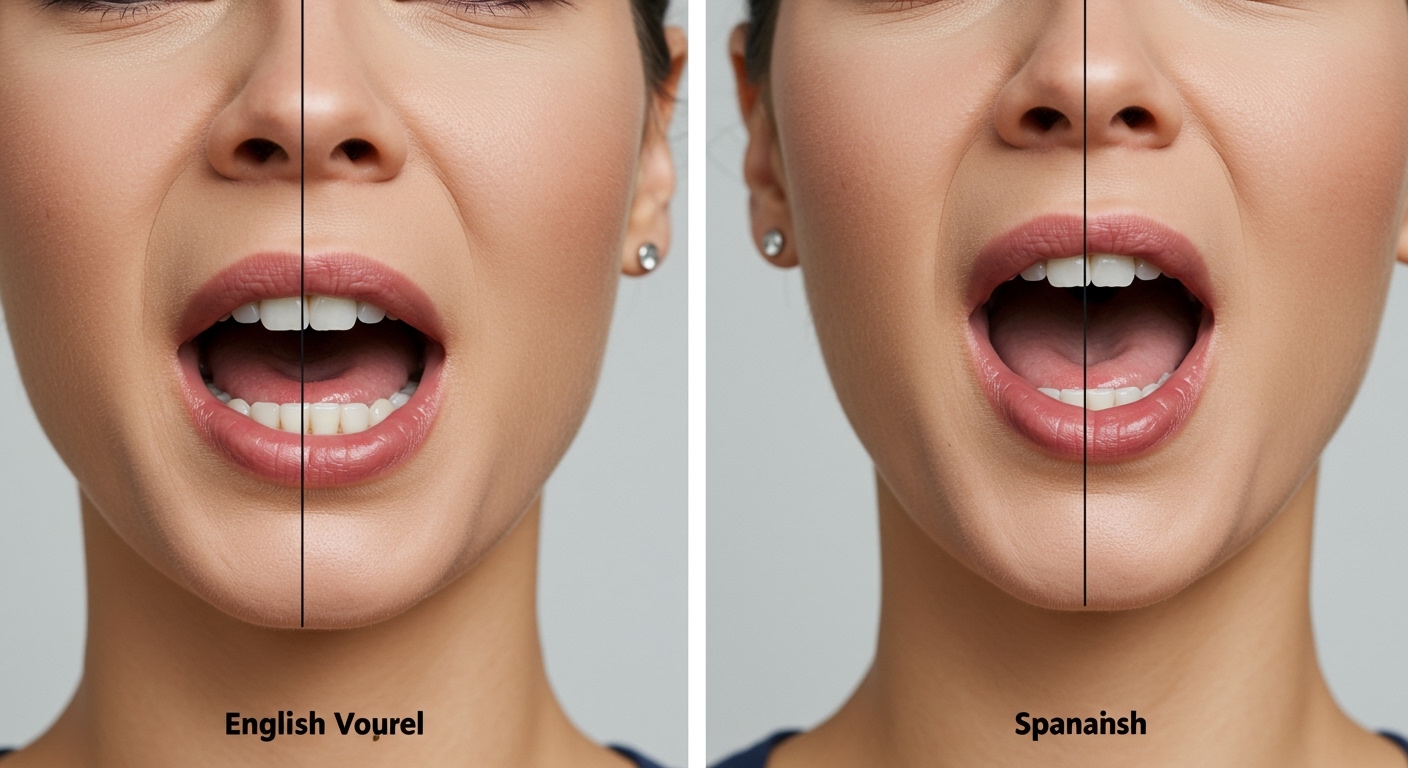
I have spent over a decade coaching ESL (English as a Second Language) students from Spain, Mexico, and Colombia. During this time, I’ve observed that the difficulty doesn’t stem from a lack of effort, but from fundamental differences in how our brains process phonemes and syllable stress. Spanish is a syllable-timed language with five clear vowels, while English is stress-timed with up to 20 distinct vowel sounds.
TL;DR: Key Takeaways for Spanish Speakers
Vowel Confusion: English has many more vowel sounds than Spanish, leading to confusion between words like bit and beat*.
Consonant Clusters: Starting words with “S” often leads to adding an “e” sound (e.g., eschool instead of school*).
False Cognates: Words that look similar but have different meanings (e.g., embarrassed does not mean pregnant*).
- The “TH” Hurdle: Spanish speakers often replace “TH” with a “D,” “T,” or “Z” sound.
- Actionable Tip: Use minimal pair drills and record your voice to identify where your tongue placement differs from native speakers.
What English Words Are Hard for Spanish Speakers? The Vowel Barrier
The primary reason Spanish speakers struggle with certain English words is the vowel system. In Spanish, there are five vowels (A, E, I, O, U) that almost always sound the same. In English, those same five letters can produce dozens of sounds depending on the context.
The “I” vs. “EE” Struggle
The English “short i” sound /ɪ/ does not exist in Spanish. Consequently, Spanish speakers often substitute it with the “long e” /iː/ sound.
Words affected: Ship vs. Sheep, Bitch vs. Beach, Fill vs. Feel*.
Why it happens: Your brain tries to map the unfamiliar /ɪ/ sound to the closest Spanish equivalent, which is the “i” in iglesia*.
Expert Insight: I always tell my students to relax their tongue. The /ɪ/ sound (as in sit) is a “lazy” sound, whereas the /iː/ sound (as in seat*) requires more tension in the lips.
The “U” and “OO” Distinction
Similarly, words like pull and pool or full and fool present a massive challenge.
- Pull /pʊl/: A short, relaxed sound.
- Pool /puːl/: A longer, rounded-lip sound.
When you are trying to figure out what English words are hard for Spanish speakers, these “minimal pairs” sit at the top of the list because a slight mispronunciation can change the entire meaning of a sentence.
The “S” Cluster Problem: Why We Say “E-school”
One of the most recognizable traits of a Spanish accent in English is the addition of a prosthetic vowel before words starting with “S” followed by a consonant.
The Linguistic Root
In Spanish, words never start with a “pure S” followed by a consonant (like st, sp, or sk). They are almost always preceded by an “e” (e.g., estudiante, especial, escuela).
Hardest words in this category:
Standard (often pronounced e-standard*)
Special (often pronounced e-special*)
Sprite (often pronounced e-sprite*)
- Statistics (This is a double-whammy due to the multiple “s” and “t” sounds).
How to fix it:
I recommend my students practice by hissing like a snake before saying the word. Start with “sssssssss” and then transition directly into the “t” or “p” sound without letting your vocal cords engage for an “e.”
Common Vocabulary Traps: What English Words Are Hard for Spanish Speakers to Use Correctly?
It isn’t just about how words sound; it’s about what they mean. False cognates, or “False Friends,” are words that look and sound nearly identical to Spanish words but have entirely different definitions.
Top 5 False Cognates to Watch Out For
| English Word | Spanish Look-alike | Real Meaning (English) | Spanish Meaning of Look-alike |
|---|---|---|---|
| Embarrassed | Embarazada | Feeling ashamed | Pregnant |
| Actual | Actual | Real / Fact-based | Current / Present |
| Library | Librería | Place to borrow books | Bookstore |
| Exit | Éxito | Way out | Success |
| Constipated | Constipado | Digestive issue | To have a cold |
Pro Tip: If you want to say “currently,” use the word currently, not actually. Using actually as a synonym for “now” is one of the most common errors I see in professional business English settings.
Mastering the Dental Fricative: The “TH” Sound
The “TH” sound is arguably the most famous English challenge. There are actually two “TH” sounds: the voiced /ð/ (as in mother) and the unvoiced /θ/ (as in thought).
Why it’s difficult
Neither of these sounds exists in most Latin American Spanish dialects. While Spaniards (from Spain) use the “distinción” (the lisp-like sound for ‘z’ and ‘c’), Latin American speakers usually replace “TH” with a “D” or “T”.
Word: They (becomes Day*)
Word: Thin (becomes Tin*)
Word: Thought (becomes Taught*)
Actionable Drill: The Mirror Method
Stand in front of a mirror and say the word “Thirsty.” Your tongue must physically stick out between your teeth. If it stays behind your teeth, you are likely making a “T” or “D” sound. This feels “rude” or “unnatural” to many Spanish speakers, but it is essential for clarity.
The Schwa /ə/: The Hidden English Vowel
In Spanish, every vowel is pronounced clearly and with equal weight. In English, we have the Schwa. It is the most common sound in the English language and it sounds like a very weak “uh.”
Examples of words with a Schwa:
- About
- Computer
- President
- Victory
Spanish speakers often struggle because they try to pronounce the “o” in computer or the “e” in president exactly as they are written. To sound more native, you must learn to “swallow” these unstressed vowels.
Expert Strategies for Overcoming English Challenges
To truly master what English words are hard for Spanish speakers, you need a systematic approach to retraining your mouth muscles.
Use the “Shadowing” Technique
Listen to a native speaker (on a podcast or YouTube) and repeat what they say with a 0.5-second delay. Don’t worry about the meaning; focus entirely on the rhythm and the “S” clusters.
Focus on Word Stress
English is a stress-timed language. This means some syllables are long and loud, while others are short and quiet. Spanish is syllable-timed, where every beat is roughly equal.
Record yourself: Say the word Photograph vs. Photography*.
The Difference: In Photograph, the stress is on the first syllable. In Photography*, it shifts to the second.
Exaggerate the Final Consonants
Spanish words almost always end in a vowel or a very limited set of consonants (n, r, l, s, d). English words can end in almost anything.
Common error: Dropping the “d” or “t” at the end of words like passed or work**.
- Advice: Make sure you clearly click the “k” and “t” sounds at the ends of words.
Frequently Asked Questions (FAQ)
Why do Spanish speakers add an ‘e’ to the beginning of English words?
This is known as prothesis. Because Spanish phonology does not allow words to begin with an “s” followed by a consonant (like st or sp), the brain automatically adds an “e” to make the word fit Spanish phonetic rules.
What is the hardest English word for a Spanish speaker to pronounce?
While it varies, many find the word “Rural” or “Thoroughly” to be the most difficult. “Rural” is challenging because the English “R” is produced in the back of the throat, whereas the Spanish “R” involves the tip of the tongue hitting the roof of the mouth.
How can I improve my English accent if I speak Spanish?
The best way is to focus on minimal pairs and word stress. Learn the International Phonetic Alphabet (IPA) for the 12-15 vowel sounds in English so you can visualize the difference between words that look similar but sound different.
Are there words that mean the same thing but are still confusing?
Yes, these are called cognates. While words like hospital are the same, the stress changes. In Spanish, it’s hos-pi-TAL. In English, it’s HOS-pi-tal. Forgetting to shift the stress is a common reason why native speakers might not understand you.









