

The Legacy and Decline of Advent Speakers
If you are wondering what happened to advent speakers, the original Advent Corporation effectively dissolved through a series of corporate acquisitions starting in the 1980s, eventually losing its high-fidelity focus. Today, the Advent brand name is owned by Voxx International, but the legendary “east coast sound” engineering of the 1970s has been replaced by entry-level consumer electronics and accessories.
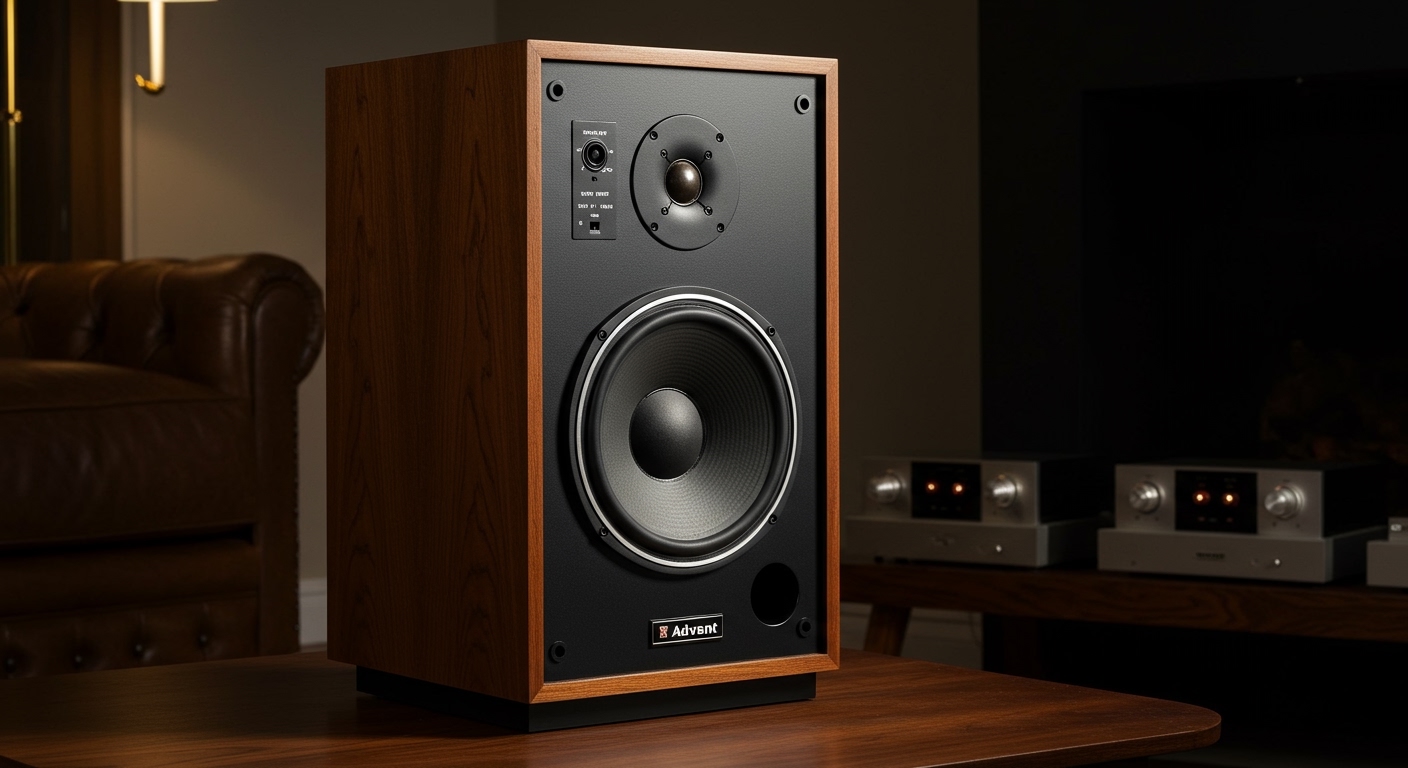
Finding a pair of vintage Large Advents at a thrift store or in a relative’s basement is a rite of passage for many audiophiles. During my years of restoring vintage audio equipment, I’ve found that few speakers offer the same “bang for your buck” as a well-maintained set of original Advents. They represent a specific era when high-fidelity sound became accessible to the middle class, a legacy that unfortunately didn’t survive the transition to modern mass-market manufacturing.
TL;DR: Key Takeaways
- Founder: Founded by Henry Kloss in 1967 after he left KLH.
- The Golden Era: The 1970s saw the release of the Large Advent and Smaller Advent, which revolutionized the home audio market.
- Corporate Shift: The brand was sold to Jensen in 1981, then Recoton, and finally Audiovox (now Voxx International).
- Current Status: The brand is essentially defunct in the high-end speaker market, focusing instead on budget accessories.
- Restoration Value: Original units are highly sought after by enthusiasts for their acoustic suspension design and warm sound profile.
Understanding What Happened to Advent Speakers
To understand what happened to advent speakers, we have to look at the timeline of American hi-fi history. The decline wasn’t an overnight failure but a slow dilution of the brand’s identity through three decades of corporate hand-offs.
The Rise of the Henry Kloss Era (1967–1981)
Henry Kloss was the visionary behind Advent. Having already co-founded Acoustic Research (AR) and KLH, Kloss wanted to create a speaker that could compete with the world’s best at a fraction of the price. The result was the Advent Loudspeaker (now known as the Large Advent).
During this period, Advent dominated the market. They used a unique acoustic suspension design that allowed for deep, tight bass from a relatively small cabinet. If you owned a hi-fi system in 1975, there was a high statistical probability you had Advent speakers connected to your receiver.
The Jensen and Recoton Years (1981–2003)
In 1981, Jensen Sound Laboratories acquired Advent. While Jensen initially tried to maintain quality with models like the Advent Heritage and Advent Graduate, the focus began shifting toward higher profit margins and “lifestyle” designs.
By the time Recoton purchased the brand in the 1990s, the engineering soul of the company had largely vanished. They moved production to cheaper facilities and began using lower-grade components. This era marked the definitive answer to what happened to advent speakers: they became a “badge-engineered” product rather than an engineered masterpiece.
The Audiovox (Voxx International) Acquisition
In 2003, Audiovox (now Voxx International) purchased the assets of Recoton. Under Voxx, the Advent name was relegated to budget-tier products like wireless outdoor speakers, clock radios, and cheap home theater in-a-box systems. For the true audiophile, the Advent story ended when the last New Advent Loudspeaker left the factory in the early 80s.
The Most Iconic Advent Models
If you are searching for that classic sound, you need to know which models actually carry the Henry Kloss DNA. Not all speakers with an Advent badge are created equal.
| Model Name | Production Years | Key Feature | Driver Design |
|---|---|---|---|
| The Large Advent | 1969–1977 | Masonite Ring Woofer | 10-inch woofer, Fried Egg Tweeter |
| The Smaller Advent | 1971–1975 | 4-Ohm Impedance | Smaller cabinet, same bass extension |
| The New Advent | 1977–1983 | Flush-mount Tweeter | Updated crossover, improved power handling |
| Advent Heritage | 1980s–1990s | Dual Woofers | Tower design, Jensen-era engineering |
How to Identify and Buy Vintage Advent Speakers
When I’m out “crate digging” for gear, I look for specific markers that indicate a pair is worth the investment. Here is how you can tell if you’ve found the “real deal.”
Check the Tweeter
The most famous Advent component is the “Fried Egg” tweeter. It is easily recognizable by its dual-cone design and orange or fried-egg-colored center. If the tweeter looks like a standard black dome, it’s likely a later, less desirable model or a replacement.
Inspect the Woofer Surround
Original Advent speakers used foam surrounds. Over 20-30 years, this foam inevitably disintegrates—a process known as “foam rot.”
- Pro Tip: Do not be afraid of a speaker with rotted foam! This is a common issue and can be fixed for less than $30 with a re-foam kit. It also gives you leverage to negotiate a lower price.
Cabinet Material
The “best” Advents come in real wood veneer cabinets. Later, cheaper models used vinyl “wood grain” wrap. If you tap the side of the cabinet and it feels like heavy, solid furniture, you likely have a pair of Original Large Advents.
How to Restore Your Advent Speakers: A Step-by-Step Guide
If you’ve acquired a pair of vintage speakers and want to bring back that legendary sound, follow this restoration workflow I’ve used on dozens of pairs.
Step 1: Evaluating the Drivers
Gently press on the woofer cone. If it feels stuck or makes a rubbing sound, the voice coil might be damaged. If it moves freely but the foam around the edge is crumbling, you simply need to re-foam them.
Step 2: Re-foaming the Woofers
- Clean the frame: Scrape away the old foam and glue using a chisel or utility knife and Isopropyl alcohol.
- Apply New Glue: Apply a thin bead of specialized speaker glue to the inner edge of the new foam and the cone.
- Center the Cone: This is the most critical part. Ensure the cone is perfectly centered so the voice coil doesn’t rub.
- Seal the Outer Ring: Glue the outer edge of the foam to the metal basket.
Step 3: Recapping the Crossover
The capacitors inside 1970s speakers often drift out of spec, making the speakers sound “muddy” or “dark.”
- Open the back or remove the woofer to access the crossover board.
- Identify the electrolytic capacitors.
- Replace them with high-quality polypropylene film capacitors of the same value (uF).
- Expert Insight: I’ve found that replacing 13uF capacitors in Large Advents restores the “sparkle” to the high end that many owners think they’ve lost to age.
The “Stacked Advent” Phenomenon
One of the most famous “hacks” in audio history involves stacking Advents. In the 1970s, many critics (including those at The Absolute Sound) discovered that placing one Large Advent upside down on top of another created a “super speaker” that rivaled systems costing five times as much.
Why it works:
- Increased Sensitivity: You gain roughly 3dB of output.
- Line Array Effect: The vertical alignment of the tweeters creates a massive soundstage.
- Bass Coupling: The two woofers work together to move significantly more air, providing effortless low-end response.
Why Does the Advent Legacy Matter Today?
Even though we know what happened to advent speakers in a corporate sense, their influence remains. Henry Kloss proved that you didn’t need a massive budget to achieve high-end sound. He focused on the physics of sound—specifically the relationship between the speaker and the air inside the box—rather than flashy marketing.
Today’s enthusiasts keep the brand alive through forums like Audiokarma and The Classic Speaker Pages. If you find a pair for under $150, buy them. With $50 in parts and a Saturday afternoon of work, you can have a system that outperforms most modern Bluetooth speakers and entry-level bookshelf units sold at big-box retailers.
Frequently Asked Questions
Are Advent speakers still being made?
No, the original high-fidelity Advent speakers are no longer in production. While the Advent brand name is owned by Voxx International, they currently market accessories and budget audio gear rather than the classic loudspeakers of the 1970s.
What are the best Advent speakers to buy?
The most sought-after models are the Original Large Advent (with the Masonite ring woofer) and the New Advent Loudspeaker. These provide the classic “East Coast” sound characterized by smooth mids and deep, natural bass.
How much are vintage Advent speakers worth?
Depending on condition and cabinet finish (utility vs. walnut), a pair of Large Advents typically sells for $150 to $400. Fully restored pairs with new capacitors and foam surrounds can fetch upwards of $500 on markets like eBay or Reverb.
Why did Henry Kloss leave Advent?
Henry Kloss left Advent in the late 1970s to pursue his interest in projection television, eventually founding Kloss Video Corporation. His departure was a major turning point that eventually led to the brand’s acquisition by Jensen.
**
**
**
**









