

What Happened to Thiel Speakers? The Complete History and Legacy
Thiel Speakers officially ceased operations and stopped production around 2018 following a tumultuous decade of ownership changes and a controversial shift in brand direction. After the passing of co-founder and lead engineer Jim Thiel in 2009, the company was sold to a private equity group in 2012, which ultimately moved headquarters to Nashville and pivoted away from the “Coherent Source” engineering that made the brand a legend.
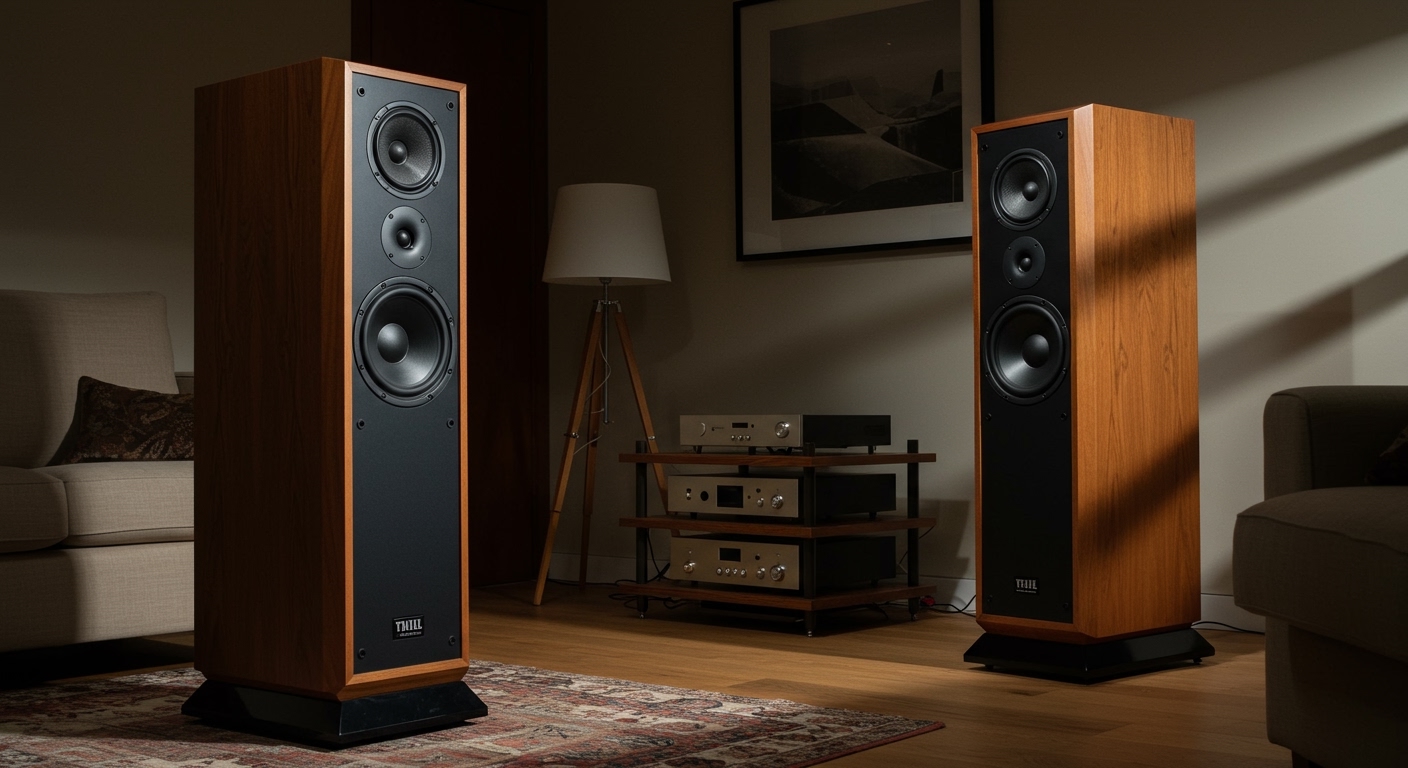
I have spent decades auditioning high-end floorstanders, and few brands carry the emotional weight of Thiel Audio. If you are looking for the “short version” of their disappearance, it was a classic case of a vision-driven company losing its North Star after the founder’s death. The brand attempted to compete in the “lifestyle” audio market with products like the Aurora wireless speaker, which alienated the dedicated audiophile base that sustained them for 30 years.
Key Takeaways: The Thiel Audio Timeline
- 1977–2009: The Golden Era. Jim Thiel designs world-class speakers in Lexington, Kentucky, focusing on time and phase coherence.
- 2009: Jim Thiel passes away, leaving a massive void in the company’s engineering leadership.
- 2012: The company is sold to a private equity group led by Bill Thomas.
- 2014–2017: Headquarters move to Nashville; the brand launches the Third Avenue (TT) series, moving away from Jim’s original sloped-baffle designs.
- 2018–Present: Thiel Audio is effectively defunct as a manufacturer, though a robust secondary market and dedicated repair service exist.
- Repair Legacy: Former longtime employee Rob Gillum founded Coherent Source Service, providing parts and repairs for legacy Thiel owners.
The Rise of an Audio Icon: Jim Thiel’s Vision
To understand what happened to Thiel speakers, you first have to understand why they were so special. Founded in 1977 by Jim Thiel, Tom Tomlinson, and Kathy Gornik, the company was built on a singular engineering philosophy: Coherent Source.
Jim believed that for a speaker to sound realistic, it had to preserve the time and phase relationships of the original signal. Most speakers have drivers that are out of sync; Thiel Speakers used sloped baffles and complex first-order crossovers to ensure every frequency reached the listener’s ear at the exact same moment.
We often remember the CS3.6 and CS2.4 as the peak of this era. These speakers were incredibly difficult to build because the tolerances for first-order crossovers are razor-thin. If a driver’s performance drifted even slightly, the whole system failed. This commitment to “doing it the hard way” earned the brand a cult-like following among critical listeners.
The Turning Point: 2009 to 2012
The decline began with the tragic passing of Jim Thiel in 2009. Without Jim’s specific engineering genius, the company struggled to innovate in the way the market expected. While his partner Kathy Gornik remained at the helm for a few years, the financial realities of high-end manufacturing in a changing economy led to the 2012 sale.
When the new ownership took over in 2012, the mission statement changed. The new management felt that the “Audiophile” market was too small and that Thiel Audio needed to become a “lifestyle brand.” They moved production from the beloved Kentucky factory to Nashville, Tennessee, and began phasing out the traditional Coherent Source designs.
Comparison: Golden Era vs. Post-Jim Thiel Era
| Feature | Golden Era (Pre-2012) | New Era (2014-2018) |
|---|---|---|
| Engineering Philosophy | Time and Phase Coherence | Traditional multi-order crossovers |
| Cabinet Design | Sloped baffles for time alignment | Flat baffles / Lifestyle aesthetics |
| Manufacturing | Hand-built in Lexington, KY | Designed in Nashville, Outsourced parts |
| Driver Tech | Custom-designed in-house drivers | Off-the-shelf or modified drivers |
| Flagship Model | CS3.7 | TT1 |
The Final Years and the “Aurora” Pivot
By 2016, the brand was barely recognizable to its original fans. The launch of the Thiel Aurora—a series of wireless, Bluetooth-enabled speakers—was the final straw for many. While the Aurora was a decent product for its category, it occupied a space dominated by giants like Sonos and Bose.
Thiel Audio had lost its “Unfair Advantage.” They were no longer the smartest engineers in the room when it came to time-aligned audio; they were just another luxury brand trying to sell expensive Bluetooth boxes. By 2018, news broke that the company had essentially stopped answering the phones. The Nashville office closed, and the remaining inventory was liquidated.
How to Buy and Maintain Thiel Speakers Today
Despite the company’s demise, Thiel Speakers remain a staple of the used high-end market. If you are looking to purchase a pair of CS2.4, CS3.7, or the legendary CS7.2, you need to know what to look for.
Inspect the Drivers for “Voice Coil Rub”
Many Thiel drivers use very tight gaps for higher efficiency and detail. Over decades, the spiders can sag, causing the voice coil to rub. I always recommend doing a “sweep test” with a signal generator (or a YouTube frequency sweep video) to check for buzzing in the woofers.
The Power Requirement Trap
Thiel Speakers are notoriously difficult to drive. Most models, like the CS3.6, have an impedance that drops below 3 ohms. You cannot run these on a standard home theater receiver. You need a high-current amplifier from brands like Pass Labs, Bryston, or Krell to make them sing.
Check the Grilles
The “socks” or grilles on older Thiel models are difficult to replace. If you find a pair with ripped fabric, know that sourcing original replacements is nearly impossible. However, the cabinets are usually heavy-duty MDF or even concrete-lined in older models, making them incredibly durable.
Troubleshooting: Who Repairs Thiel Speakers Now?
If you own a pair of these speakers and a tweeter blows, you aren’t out of luck. One of the most positive outcomes of the company’s closure was the emergence of Coherent Source Service.
Rob Gillum, who spent over 30 years at Thiel, purchased the remaining parts inventory and specialized tooling. Based in Lexington, Kentucky, he provides:
- Original driver repairs and diaphragms.
- Crossover component upgrades.
- Replacement grilles and spikes.
- Expert advice on matching your Thiels with modern electronics.
We highly recommend contacting Rob before attempting a DIY repair, as the first-order crossovers in these speakers are incredibly sensitive to changes in component values.
The Technical Soul: Why They Still Matter
Why do people still search for what happened to Thiel speakers years after they disappeared? It’s because the “Thiel Sound” is unique. When you sit in the “sweet spot” of a pair of CS3.7s, the soundstage is holographic. Because the frequencies are time-aligned, the speakers “disappear” in the room better than almost any modern design.
Key Technical Specs of the Golden Era
- Time Alignment: Achieved through sloped baffles and physical driver offset.
- Phase Coherence: Achieved through 6dB/octave (First-Order) crossover slopes.
- Low Distortion: Use of short-coil/long-gap motor systems.
- Cabinet Rigidity: Use of heavy internal bracing and, in some cases, cast stone baffles.
Frequently Asked Questions
Is Thiel Audio still in business?
No, Thiel Audio is no longer manufacturing speakers. The company ceased operations around 2018 after moving to Nashville and attempting to pivot into lifestyle audio.
Where can I get my Thiel speakers repaired?
The primary source for authorized repairs and parts is Coherent Source Service in Lexington, KY, run by former Thiel employee Rob Gillum.
Which Thiel speakers are the best?
Most audiophiles consider the CS3.7 to be Jim Thiel’s masterpiece and the pinnacle of his design philosophy. Other highly sought-after models include the CS2.4, CS3.6, and the massive CS7.2.
Why are Thiel speakers so hard to drive?
Because of their first-order crossovers, they require many electrical components in the signal path, which results in low impedance and low sensitivity. They require an amplifier capable of delivering high current into low-ohm loads.









