

What is Sound Pressure Level in Speakers?
Sound pressure level (SPL) in speakers is the objective measurement of the acoustic pressure (volume) a speaker produces, expressed in decibels (dB). It quantifies how much air a speaker displaces at a specific distance—typically one meter—when driven by a specific amount of power—usually one watt. Essentially, SPL tells you exactly how loud a speaker is capable of getting before reaching its physical limits.
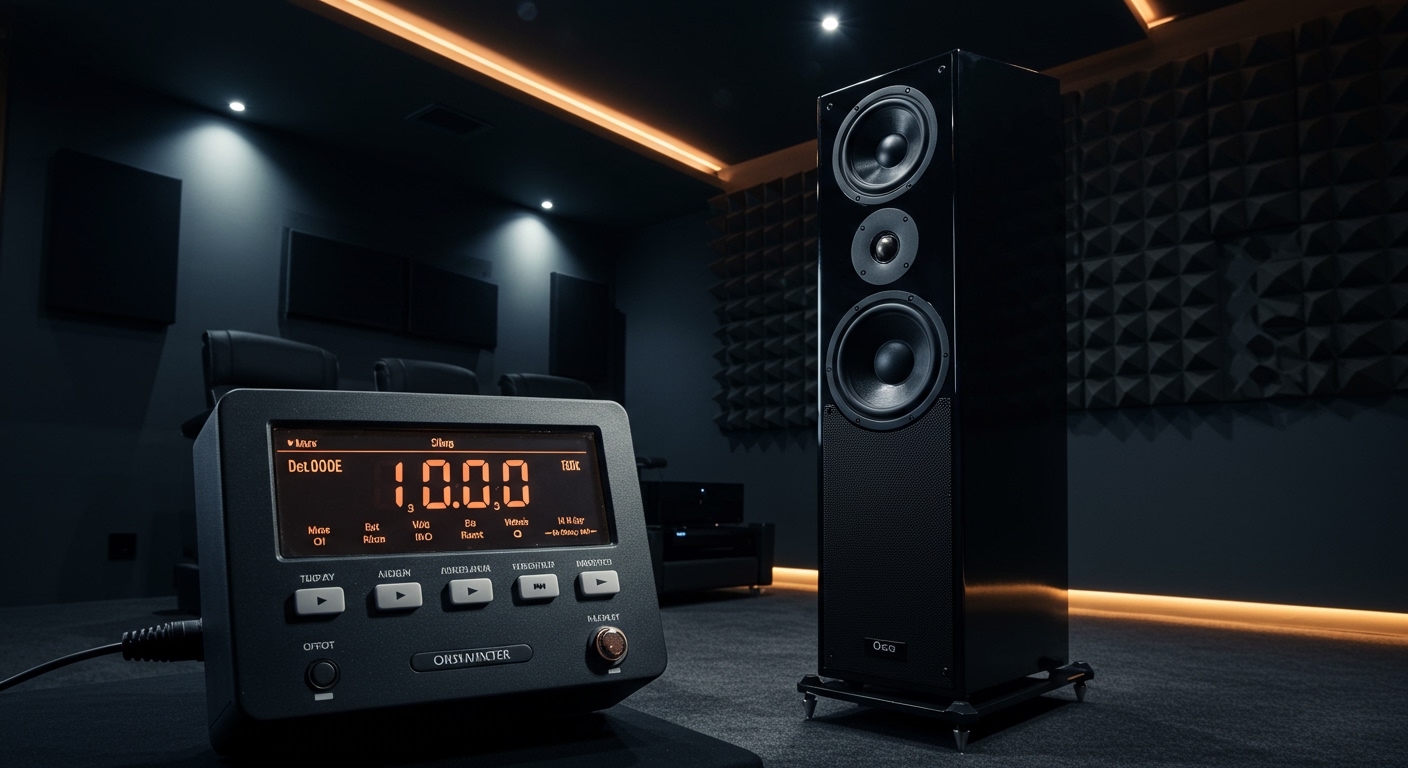
If you have ever stood in front of a massive concert stack and felt the bass in your chest, you were experiencing high Sound Pressure Level. In my years testing high-end home cinema gear and professional PA systems, I’ve found that understanding SPL is the single most important factor in matching the right speakers to the right room size. It is not just about “loudness”; it is about the efficiency and dynamic range of your audio system.
Key Takeaways: SPL Essentials
- Measurement Unit: SPL is measured in decibels (dB) on a logarithmic scale.
- The Golden Standard: Most speakers are rated by Sensitivity (dB @ 1W/1m).
- Logarithmic Growth: A 10dB increase represents a perceived doubling of loudness to the human ear.
- Power Requirements: To increase volume by just 3dB, you must double the amplifier power.
- Distance Loss: According to the Inverse Square Law, sound drops by 6dB every time you double your distance from a point source speaker.
Understanding the Physics of Sound Pressure
To truly grasp what is sound pressure level in speakers, we have to look at how sound moves through a room. Sound is a pressure wave. When a speaker cone moves forward, it compresses air molecules; when it moves back, it creates a vacuum (rarefaction).
The intensity of these pressure changes is measured in Pascals (Pa). However, because the human ear can hear a massive range of pressures—from a tiny whisper to a jet engine—scientists use the decibel (dB) scale. The decibel scale is logarithmic, meaning it compresses that massive range into a manageable scale of 0 to 140+ dB.
The Role of the Reference Level
In acoustics, 0 dB SPL is the “threshold of hearing,” which corresponds to 20 micropascals of pressure. This is the quietest sound a healthy young human ear can detect. When we talk about a speaker producing 90dB, we mean it is producing 90 decibels of pressure above that reference point.
Sensitivity vs. Efficiency: How Loud is Your Speaker?
Many people confuse wattage with loudness. In my experience, a 100-watt speaker isn’t necessarily louder than a 50-watt speaker. The difference lies in Sensitivity.
What is Speaker Sensitivity?
Sensitivity measures how effectively a speaker converts electrical energy (Watts) into acoustic energy (SPL).
| Speaker Category | Sensitivity Rating (dB @ 1W/1m) | Typical Application |
|---|---|---|
| Low Sensitivity | 80 – 84 dB | High-end bookshelf speakers, studio monitors |
| Moderate Sensitivity | 85 – 91 dB | Standard home theater speakers, floorstanders |
| High Sensitivity | 92 – 100+ dB | Horn-loaded speakers, professional PA systems |
Expert Insight: If you have a low-sensitivity speaker (84dB), you will need a massive amplifier to reach “cinema levels.” Conversely, a high-sensitivity speaker (98dB) can fill a room using just a few watts of power. We often use high-sensitivity designs in large-scale installations to prevent thermal compression in the voice coils.
Step-by-Step: How to Measure SPL in Your Speaker Setup
Measuring the sound pressure level in speakers at home helps you calibrate your system for the best possible “sweet spot.” Here is the process I use during professional calibrations.
Step 1: Gather Your Tools
You can use a dedicated SPL Meter (like those from Extech or Reed) or a high-quality smartphone app (such as NIOSH SLM). While apps are convenient, a calibrated hardware meter is much more accurate for low frequencies.
Step 2: Set the Weighting and Response
- A-Weighting (dBA): Use this for measuring general noise and hearing safety. It ignores very low and very high frequencies that the human ear is less sensitive to.
- C-Weighting (dBC): Use this for calibrating speakers and subwoofers. It provides a flatter response across the frequency spectrum.
- Slow Response: Set your meter to “Slow” so the needle or digital readout doesn’t jump around too fast.
Step 3: Position the Meter
Place the meter exactly where your head would be in your favorite listening chair. Hold it at a 45-degree angle or mount it on a tripod to avoid “body reflections” from your own chest altering the reading.
Step 4: Play a Test Tone
Play Pink Noise through your speakers. Pink noise contains all frequencies at equal energy per octave, making it the industry standard for SPL testing.
Step 5: Adjust Volume
Adjust your receiver or amplifier until the meter reads your target level (usually 75dB or 85dB for home theater calibration).
The Inverse Square Law: Why Distance Matters
One of the biggest mistakes I see in home audio is failing to account for distance. Sound pressure level decreases rapidly as you move away from the speaker.
In an “open field” (outdoors), the Inverse Square Law states that for every doubling of distance, you lose 6dB of SPL.
- 1 Meter: 90 dB
- 2 Meters: 84 dB
- 4 Meters: 78 dB
- 8 Meters: 72 dB
In a typical living room, you don’t lose quite that much because sound reflects off the walls (this is called boundary gain), but the loss is still significant. If you sit 4 meters (about 13 feet) away from your speakers, you need significantly more power than someone sitting 2 meters away.
The Relationship Between Power (Watts) and SPL
To understand what is sound pressure level in speakers, you must understand the “Rule of 3dB.”
- To increase SPL by 3dB, you must double your amplifier power.
- To increase SPL by 10dB (perceived as twice as loud), you must 10x your amplifier power.
Example Scenario:
- You have a speaker with 85dB sensitivity.
- 1 Watt = 85dB
- 2 Watts = 88dB
- 4 Watts = 91dB
- 8 Watts = 94dB
- 16 Watts = 97dB
- 32 Watts = 100dB
- 64 Watts = 103dB
- 128 Watts = 106dB
As you can see, the “jump” from 103dB to 106dB requires a massive 64-watt increase. This is why buying a 200-watt amplifier instead of a 100-watt amplifier only gives you a tiny bit of extra volume.
Safe Listening Levels and Hearing Protection
As a professional in the audio industry, I cannot stress enough the importance of monitoring your sound pressure level. Extended exposure to high SPL causes permanent tinnitus and hearing loss.
The CDC and OSHA have strict guidelines for noise exposure:
| SPL Level (dB) | Maximum Exposure Duration | Example Sound |
|---|---|---|
| 85 dB | 8 Hours | Busy City Traffic |
| 95 dB | 2 Hours | Motorcycle Engine |
| 105 dB | 15 Minutes | Maximum Volume on Personal Headsets |
| 115 dB | 28 Seconds | Rock Concert / Ambulance Siren |
| 140 dB | Immediate Damage | Jet Engine Takeoff |
If you are setting up a home theater, aim for Reference Level, which is a calibrated 85dB average with 105dB peaks for short bursts (like explosions). This provides an immersive experience without immediate risk to your hearing.
How Room Acoustics Affect SPL
Your room is just as important as your speakers when determining what is sound pressure level in speakers. Two factors primarily influence the measured SPL in a real-world environment:
Boundary Gain**
When you place a speaker against a wall, the sound waves that would have gone backward are reflected forward. This can increase the perceived SPL by 3dB to 6dB. Placing a speaker in a corner can increase the bass SPL by up to 9dB. While this makes the speaker “louder,” it often makes the bass sound “boomy” or “muddy.”
Absorption and Diffusion**
Rooms with lots of hard surfaces (hardwood floors, large windows) will have a higher measured SPL because sound bounces around. However, this “loudness” is often distorted. Adding acoustic panels or rugs absorbs energy, which might lower the overall SPL slightly but significantly improves the clarity of the sound.
Peak SPL vs. Continuous SPL
When reading speaker specification sheets, you will often see two different SPL ratings. Knowing the difference is critical for speaker longevity.
- Continuous SPL: The volume level the speaker can maintain for hours without overheating or sustaining damage.
- Peak SPL: The maximum volume the speaker can handle for a fraction of a second (like a drum hit).
Pro Tip: Always look for the Continuous rating. Many manufacturers inflate their “Peak” numbers for marketing purposes. If you run a speaker at its Peak SPL rating for too long, you will likely melt the voice coil or tear the surround.
Frequently Asked Questions (FAQ)
Is a higher SPL always better?
Not necessarily. A high SPL means the speaker can play loudly, but it doesn’t guarantee sound quality, clarity, or accuracy. A high-quality speaker with a moderate SPL is often better for music than a low-quality “loud” speaker.
How many dB is “loud” for a home speaker?
Most people find 70-75dB to be a comfortable listening level. 85dB is considered “loud” and is the standard for cinematic reference. Anything above 100dB is extremely loud for an indoor home environment.
Can I increase my speaker’s SPL without a bigger amp?
Yes. You can increase the measured SPL by moving the speakers closer to the walls (boundary gain) or by sitting closer to the speakers. However, the most effective way to get more SPL from the same power is to switch to higher-sensitivity speakers.
What is the difference between dBA and dBC?
dBA (A-weighting) mimics the human ear’s sensitivity to mid-range frequencies and is used for safety regulations. dBC (C-weighting) includes more low-frequency bass and is the standard for calibrating high-fidelity audio systems and subwoofers.









