

What is Top Mount Depth for Speakers?
Top mount depth for speakers is the precise measurement from the bottom of the speaker’s mounting flange (the rim that sits against the surface) to the lowest point of the speaker’s magnet or pole piece. This dimension is the most critical factor in car audio because it determines whether a speaker will fit inside a door or enclosure without hitting obstructions like window glass or internal bracing.
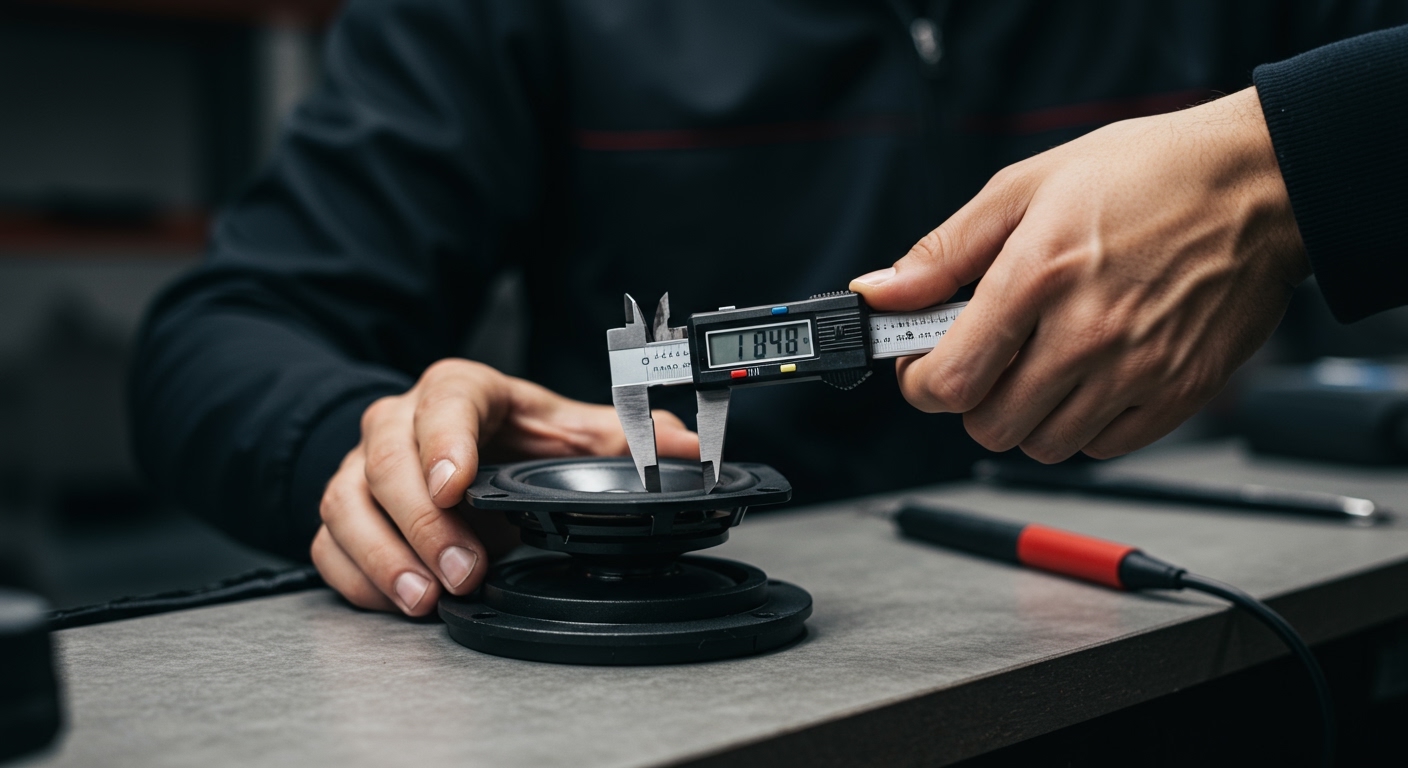
If your speaker is deeper than the available space in your door cavity, the window may shatter when rolled down, or the door panel may not snap back into place. Over the years, I have seen countless DIY installers overlook this single measurement, leading to expensive mistakes and “hacked” door panels. Understanding this spec ensures a clean, professional-grade installation that preserves your vehicle’s structural integrity.
Quick Key Takeaways: Speaker Mounting at a Glance
- Top Mount Depth: The distance from the mounting surface down to the bottom of the magnet.
- Bottom Mount Depth: The distance from the top of the speaker (tweeter/surround) to the mounting flange.
- The “Window Rule”: Always measure your door’s depth with the window rolled down to account for the glass track.
- Measurement Units: Usually provided in inches or millimeters (mm).
- Solution for Depth Issues: If a speaker is too deep, spacer rings or shallow-mount speakers are the go-to fixes.
How to Measure Top Mount Depth Like a Pro
Knowing what is top mount depth for speakers is only half the battle; you must also know how to measure your vehicle’s available cavity. In my experience, manufacturers provide specs based on the speaker’s physical build, but they don’t account for your specific car’s door anatomy.
Measuring the Speaker Itself**
To measure the speaker sitting on your workbench, place it magnet-side down on a flat surface. Use a digital caliper or a standard ruler to measure from the flat surface up to the underside of the mounting flange.
Pro Tip: Do not measure from the top of the rubber surround or the tweeter. The flange is the only point that contacts the door metal.
Measuring the Door Cavity**
This is where most errors occur. Follow these steps to get an accurate “Available Depth” reading:
- Remove your door panel carefully using nylon pry tools.
- Roll the window all the way down. This is non-negotiable.
- Place a straight edge across the speaker opening.
- Insert a tape measure until it hits the window glass or the window regulator track.
- Subtract 0.25 inches (6mm) from this measurement to allow for a “safety buffer.”
Top Mount vs. Bottom Mount Depth: Key Differences
While top mount depth is the industry standard for most installations, you may encounter “bottom mount” scenarios, especially in custom builds or specific European car models.
| Specification | Measurement Point | Why It Matters |
|---|---|---|
| Top Mount Depth | Flange to bottom of magnet | Prevents interference with windows and internal door guts. |
| Bottom Mount Depth | Flange to top of tweeter/surround | Ensures the speaker doesn’t hit the factory grilles or door panel. |
| Mounting Diameter | Width of the cutout hole | Ensures the speaker basket actually fits into the hole. |
| Magnet Diameter | Width of the magnet assembly | Crucial for tight spaces where the hole tapers inward. |
Important Note: If you are mounting a speaker behind a panel (bottom mounting), you must ensure the tweeter protrusion does not hit the factory grille. If the tweeter sticks out too far, it can be crushed or cause the door panel to bulge.
Why Speaker Magnet Size Impacts Top Mount Depth
The heart of the depth issue is usually the magnet assembly. Higher-end speakers often use large Ferrite magnets to drive the voice coil with more force. While this improves sound quality and power handling, it significantly increases the top mount depth.
In our testing of high-performance 6.5-inch drivers, we found that “SQ” (Sound Quality) speakers often require at least 2.75 to 3 inches of clearance. Conversely, entry-level speakers or “shallow-mount” series might only require 1.5 to 2 inches.
The Role of Neodymium Magnets
If you have a very shallow door (common in modern EVs like Teslas or compact cars like the Honda Fit), look for speakers using Neodymium magnets. Neodymium is much stronger than Ferrite, allowing manufacturers to use smaller magnets that provide the same motor strength with a fraction of the mounting depth.
Solutions for When Your Speaker is Too Deep
You’ve found the perfect set of component speakers, but the top mount depth is 0.5 inches too deep for your car. Don’t return them just yet. We frequently use these three “workarounds” to make deep speakers fit in shallow locations.
Using Speaker Spacer Rings**
Spacer rings (usually made of ABS plastic or high-density polyethylene) are the most effective solution. By placing a 0.5-inch spacer between the door metal and the speaker flange, you effectively move the speaker forward, reducing the required internal depth.
- Benefit: Allows for deeper magnets.
- Risk: If the spacer is too thick, the speaker surround might hit the back of the door panel/grille.
Foam Baffles and Gaskets**
While primarily used for sound isolation, a thick closed-cell foam gasket can provide an extra 2-3mm of clearance. This is often just enough to clear a window track that is barely “tickling” the back of the magnet.
Choosing “Shallow Mount” Variations**
Many brands, such as Kicker (KSC Series), Alpine (S-Series), and Rockford Fosgate, offer specific “thin” versions of their popular speakers. These are engineered with inverted motor structures to minimize the top mount depth while maintaining decent bass response.
Technical Factors: Pole Piece Venting and Clearance
One expert detail often ignored is pole piece venting. Many high-power speakers have a hole in the center of the magnet to allow air to cool the voice coil.
If your top mount depth measurement is exactly the same as your door’s available space, and the magnet is pressed tightly against the window track, you are blocking that vent. This leads to:
- Overheating: The voice coil cannot shed heat.
- Mechanical Noise: Air trapped in the vent will create a “chuffing” sound.
- Premature Failure: The speaker may seize over time.
Expert Advice: Always leave at least 0.25 inches (6mm) of “breathing room” behind a vented magnet to ensure long-term reliability.
Expert Tips for a Perfect Fitment Every Time
- Check Crutchfield’s Database: Even if you aren’t buying from them, their “Fit Guide” is the most accurate source for what is top mount depth for speakers in specific vehicle years/models.
- Account for Sound Deadening: If you add butyl rubber sound deadener (like Dynamat or Hushmat) to the inner door skin, remember it adds about 2mm of thickness. This can actually help “shim” the speaker out slightly.
- Inspect the Terminals: Sometimes it’s not the magnet that hits the window, but the speaker terminals. When measuring depth, look at where the wires connect. I recommend using 90-degree spade connectors in tight spots.
- The “Clay Test”: If you are unsure about clearance, place a small ball of modeling clay on the back of the magnet, install the speaker, and roll the window down. Remove the speaker and see how much the clay was compressed. This gives you a literal physical map of your clearance.
Frequently Asked Questions (FAQ)
What happens if my speaker’s top mount depth is too deep?
If the speaker is too deep, it will physically obstruct the window from rolling down. In the best-case scenario, the window just stops; in the worst-case scenario, the window glass hits the magnet and shatters. It can also interfere with lock rods or door handle cables.
Can I cut the metal behind the speaker to make it fit?
You can, but I highly discourage it. Cutting the inner door frame can weaken the side-impact protection of the vehicle and create sharp edges that can cut wires. It’s almost always better to use a spacer ring or a shallow-mount speaker.
Do 6.5-inch speakers always have the same mounting depth?
Absolutely not. A standard 6.5-inch speaker can have a top mount depth anywhere from 1.5 inches (shallow) to over 3.5 inches (competition grade). You must check the specific “Technical Specifications” sheet for every individual model.
Does mounting depth affect sound quality?
Generally, yes. Deeper speakers often have larger magnets and longer “throw” (excursion), which typically results in better bass response. However, modern engineering has made shallow-mount speakers sound significantly better than they did a decade ago.









