

Understanding What Size Speakers You Need for a Hall
To determine what size speakers do i need for a hall, you must match the woofer diameter and continuous power output (RMS) to the total cubic volume of the room and the number of attendees. For a standard community hall seating 100-150 people, a pair of 12-inch active PA speakers with at least 1,000 watts of peak power is the most versatile and effective choice. Larger venues or high-energy events like weddings typically require 15-inch speakers and dedicated subwoofers to maintain sound clarity at the back of the room.
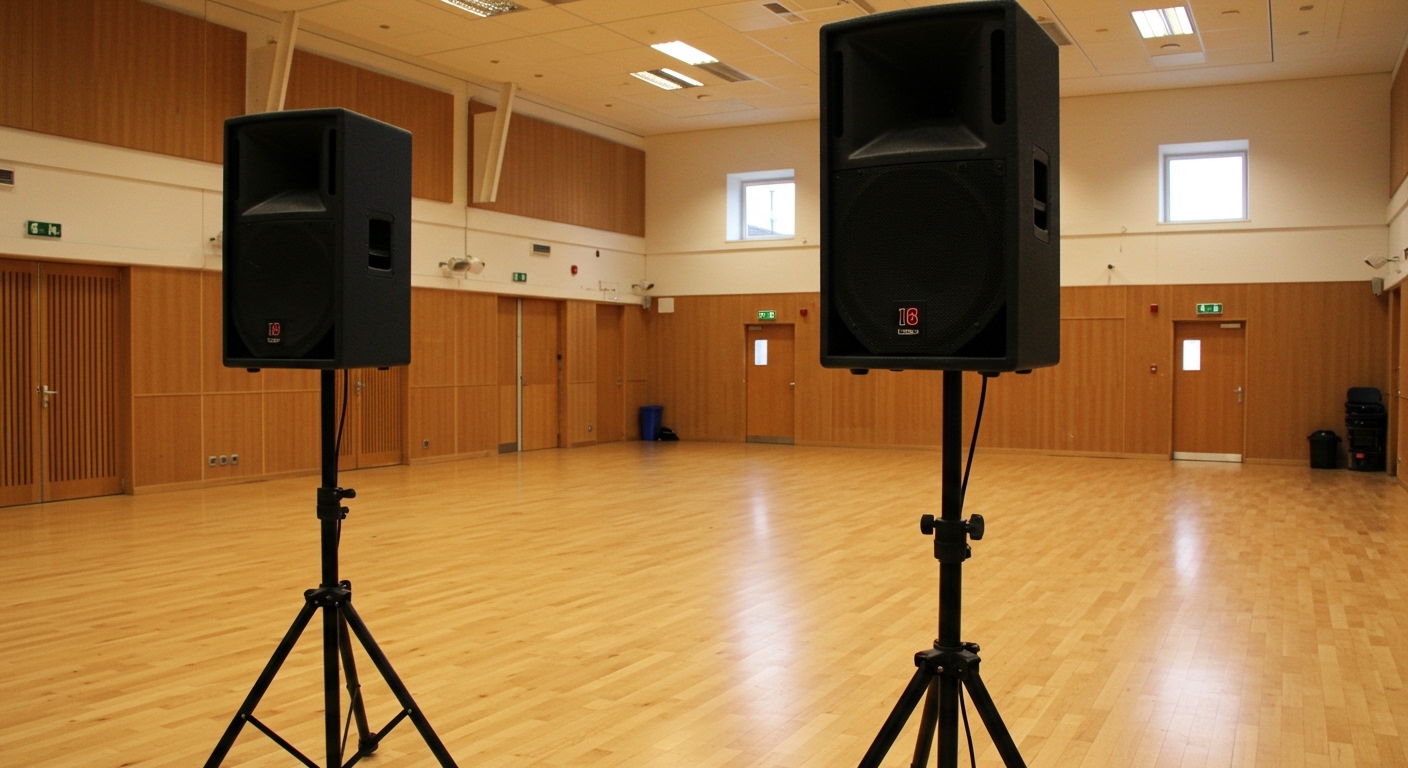
Key Takeaways for Quick Planning
- Small Halls (50-100 people): Use two 8-inch or 10-inch speakers (approx. 400-800 watts).
- Medium Halls (100-250 people): Use two 12-inch speakers (approx. 1,000-2,000 watts).
- Large Halls (250+ people): Use two 15-inch speakers plus one or two 18-inch subwoofers.
- Event Type Matters: Speech-only events require less “size” than live bands or DJ sets.
- Height is Key: Always use speaker stands to get the high-frequency drivers above the heads of the audience.
Calculating Speaker Size Based on Hall Dimensions
When I consult on venue setups, I always start by measuring the “throw distance.” This is the distance from the speaker to the furthest person in the hall. Sound follows the inverse square law, meaning it drops significantly in volume as it travels.
Small Community Halls and Meeting Rooms
For a space roughly the size of a double garage or a small classroom (up to 1,000 sq. ft.), 10-inch speakers like the QSC K10.2 are ideal. These offer a wide coverage angle (usually around 90 degrees), ensuring that people sitting off to the sides can still hear clearly.
In my experience, using speakers that are too large in a small hall creates “hot spots” where the front row is deafened while the back row is comfortable. Smaller drivers are often more articulate for vocal clarity.
Medium Banquet Halls and Wedding Venues
If you are wondering what size speakers do i need for a hall that hosts weddings or corporate galas (2,000 to 4,000 sq. ft.), the 12-inch woofer is the “Goldilocks” solution.
A 12-inch speaker, such as the JBL PRX912, provides enough “punch” for music while remaining light enough to be mounted on tripod stands safely. We found that pairing these with a single subwoofer allows the main speakers to focus on the mid-range and highs, which significantly increases the overall system headroom.
Large Auditoriums and Exhibition Spaces
For halls with high ceilings and capacities over 300 people, 15-inch speakers are mandatory. The larger surface area of a 15-inch woofer moves more air, allowing the sound waves to travel further (the “throw”) without losing energy.
In these environments, we recommend a Point Source or Line Array approach. If the hall is very deep, you may need “delay speakers” halfway down the room to ensure the back rows receive the same audio quality as the front.
Speaker Size vs. Hall Capacity Comparison Table
| Hall Type | Approx. Square Footage | Audience Capacity | Recommended Speaker Size | Recommended Total Wattage |
|---|---|---|---|---|
| Small Meeting Hall | 500 – 1,000 | 25 – 75 | 8″ or 10″ Drivers | 400W – 800W |
| Medium Parish Hall | 1,000 – 2,500 | 75 – 150 | 12″ Drivers | 1,000W – 2,000W |
| Large Banquet Hall | 2,500 – 5,000 | 150 – 300 | 15″ Drivers | 2,000W – 4,000W |
| Grand Ballroom | 5,000+ | 300+ | 15″ + Subwoofers | 4,000W+ |
Crucial Factors Beyond Just “Size”
While the physical diameter of the speaker matters, it is not the only metric for what size speakers do i need for a hall. You must also consider the technical specs that dictate how that size translates into real-world volume.
Watts vs. Max SPL
Many beginners focus on Watts, but SPL (Sound Pressure Level) is the more accurate measurement of “loudness.”
- A 1,000-watt speaker with a low sensitivity rating might be quieter than a 500-watt high-efficiency speaker.
- Look for a Max SPL of at least 126dB for medium halls.
- For large halls, aim for 130dB to 135dB to ensure the sound doesn’t “break up” at high volumes.
Active vs. Passive Systems
- Active (Powered) Speakers: These have the amplifier built-in. I recommend these for 90% of hall applications because the manufacturer has perfectly matched the amp to the driver size.
- Passive Speakers: These require an external amplifier. These are better for permanent installations where you want to keep the heavy equipment in a central rack.
Coverage Pattern (Dispersion)
If the hall is very wide, you need speakers with a wide horizontal dispersion (e.g., 100 degrees). If the hall is narrow and long, a narrower dispersion (e.g., 60-75 degrees) is better because it prevents sound from bouncing off the side walls and creating acoustic echoes.
Step-by-Step Guide to Choosing Your Hall Speakers
Follow this workflow to ensure you don’t overspend on gear you don’t need—or underspend on gear that won’t perform.
Step 1: Determine the Primary Use Case
Are you playing background music, hosting a lecture, or throwing a dance party?
- Speech: Prioritize 10-inch or 12-inch speakers with high-frequency clarity.
- Live Bands/DJs: You need 15-inch speakers and at least one 18-inch subwoofer to handle the low-end frequencies.
Step 2: Calculate the “Square Footage per Person”
In a typical hall setup:
- Seated in Rows: 7-10 sq. ft. per person.
- Seated at Tables: 15-20 sq. ft. per person.
Use this to estimate how much “air” your speakers need to fill.
Step 3: Check for Acoustic Obstacles
Walk the hall. Are there large pillars? Is the ceiling exceptionally high?
- High Ceilings: These require more power because sound dissipates upwards.
- Hard Surfaces: If the hall has marble floors or glass walls, use smaller speakers distributed throughout the room rather than two massive speakers at the front to minimize reverb.
Step 4: Choose the Connectivity
For modern halls, I always suggest speakers with XLR and 1/4 inch combo jacks. If the hall will be used for casual events, look for speakers with Bluetooth 5.0 capabilities for easy music playback.
The Importance of Subwoofers in Large Halls
A common mistake I see is trying to get “big bass” out of a pair of 15-inch speakers. While a 15-inch driver is large, it is not designed to reproduce the sub-bass frequencies found in modern music.
If your hall event involves dancing, adding an 18-inch powered subwoofer like the Electro-Voice ELX200-18P is a game-changer. It allows your main speakers to run “High Pass,” which means they only play the mids and highs. This results in:
- Lower Distortion: The main speakers don’t have to work as hard.
- Greater Clarity: Vocals won’t be “muddy” because of the bass.
- Better Energy: People feel the music, which is essential for a successful event.
Expert Tips for Hall Sound Setup
- Height is Your Friend: The biggest mistake is putting speakers on a table. The sound will hit the first row of people and stop. Get the speakers on heavy-duty stands at least 6-7 feet high.
- Aiming: Tilt the speakers slightly downward toward the last row of the audience. This prevents sound from reflecting off the back wall.
- Cable Management: In public halls, use Gaffer tape to secure all cables. Trip hazards are a major liability in venue management.
- Test the Room Empty vs. Full: A hall sounds very different when it is full of “sound-absorbing” people compared to when it is empty and “echoey.” Always do your soundcheck slightly louder than you think you need.
Frequently Asked Questions
Can I use home theater speakers in a community hall?
No. Home theater speakers are designed for “near-field” listening. They lack the projection power and durability for a hall. They will likely overheat or “clip” (distort) within the first 30 minutes of use in a large space.
Is one big speaker better than two smaller ones?
Two smaller speakers are almost always better. Using a “Stereo Pair” provides better coverage and ensures that the sound is balanced across the room. One large speaker creates a “mono” sound source that is often too loud for those nearby and too quiet for those far away.
How many watts per person do I need for a hall?
A good rule of thumb for a hall is 5 to 10 watts per person for speech and light music. For a high-energy dance party or a loud wedding, you should aim for 15 to 20 watts per person. For example, a 200-person wedding should ideally have a 3,000 to 4,000-watt system.
Do I need a mixer for my hall speakers?
If you are using more than one microphone or want to plug in both a laptop and a mic at the same time, yes, you need a small analog or digital mixer. This gives you control over the EQ (Equalization) to prevent feedback (that high-pitched squealing sound).









