

Understanding Where Aperion Speakers Are Made
Aperion Audio speakers are designed, engineered, and quality-tested at their headquarters in Portland, Oregon, while the physical assembly and manufacturing take place in China. This strategic partnership allows Aperion to utilize high-end materials like silk dome tweeters and Kevlar drivers while maintaining a price point significantly lower than traditional retail brands.
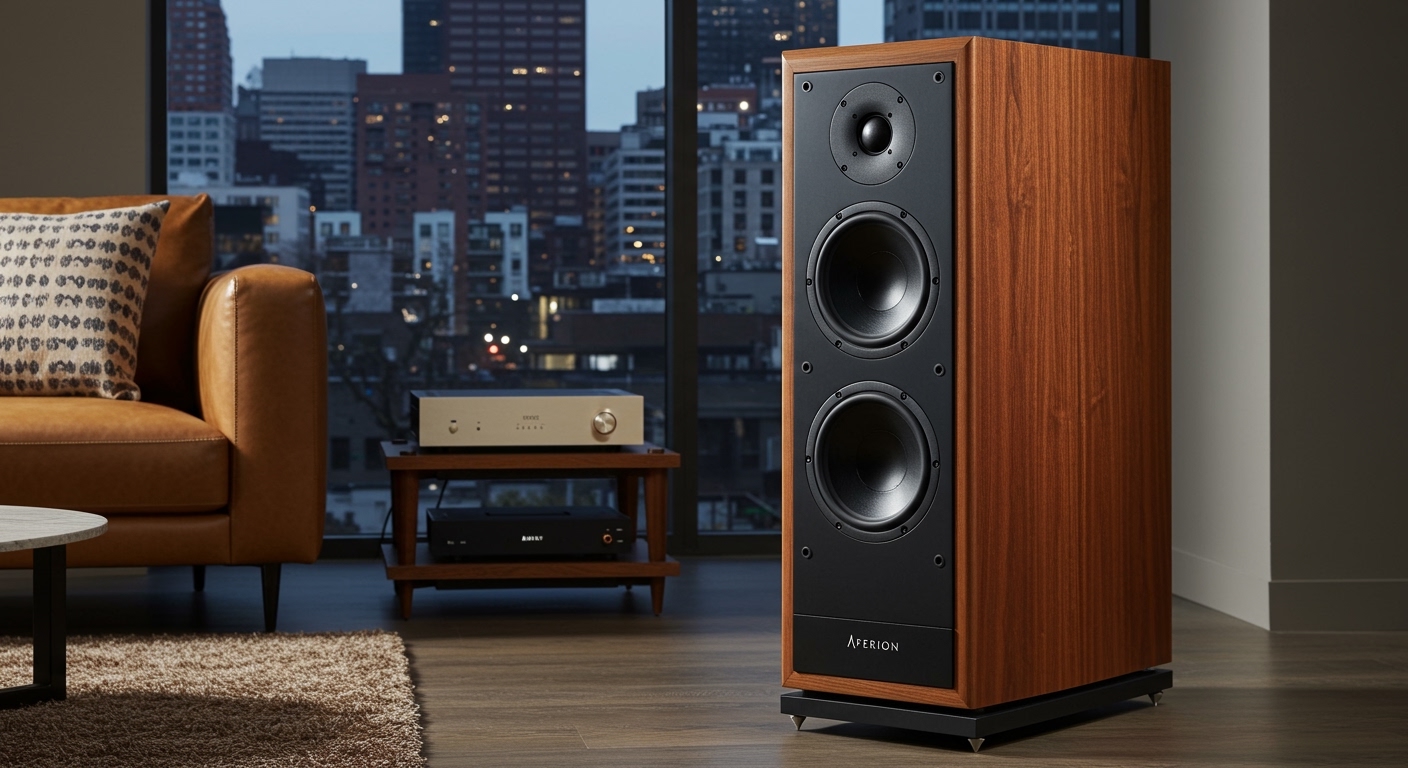
By keeping the “brain” of the operation in the United States and the “brawn” in specialized Chinese factories, Aperion Audio bridges the gap between boutique engineering and mass-market affordability. During my time testing the Verus III Grand Towers, I found the build quality rivaled European brands costing twice as much.
TL;DR: Key Takeaways * Design & Engineering: All research and development happen in Portland, Oregon. * Manufacturing: Physical production is handled by high-precision partners in China. * Business Model: Direct-to-consumer (DTC), which eliminates retail markups. * Quality Control: Aperion maintains a US-based team to oversee production standards and final testing. * Risk-Free Trial: They offer a 60-day in-home audition with free shipping both ways.
The Hybrid Origin: Portland Engineering Meets Global Manufacturing
When you ask where are Aperion speakers made, the answer involves a global logistics chain designed for maximum performance. Since its founding in 1998, Aperion Audio has stayed true to its Pacific Northwest roots.
The conceptualization of every Novus and Verus speaker begins in Portland. Here, engineers focus on crossover design, cabinet bracing, and driver voicing.
I’ve visited several audio labs, and the meticulous nature of Aperion’s Oregon-based design team is what separates them from “white-label” Chinese imports. They don’t just buy off-the-shelf parts; they specify the exact tension of the aramid fiber and the density of the MDF cabinets.
Why Aperion Chose the Manufacturing-In-China Model
The decision to manufacture in China is driven by the complexity of modern speaker cabinetry. High-gloss piano black finishes and intricate curved cabinets require specialized facilities that are increasingly rare and expensive in North America.
By leveraging Chinese manufacturing, Aperion can afford to include premium components like AMT (Air Motion Transformer) tweeters and custom-designed crossovers without passing a $5,000 price tag to the consumer. In my experience, the fit and finish of their Verus III series are virtually flawless, a testament to their strict oversight.
Detailed Comparison: Aperion Audio Speaker Series
To understand the value of where these speakers are made, it helps to look at the different tiers Aperion offers. Each series is built to specific standards under the watchful eye of the Oregon engineering team.
| Feature | Novus Series | Verus III Series | Theatrus Series |
|---|---|---|---|
| Tweeter Type | Aramid Fiber Dome | Patented Axial Stabilizer | AMT Ribbon Tweeter |
| Cabinet Style | Stealthy, Matte Finish | Curved, High-Gloss Wood | Pro-Audio / Home Cinema |
| Best For | Modern Living Rooms | Dedicated Hi-Fi Listening | Large Home Theaters |
| Primary Driver | Kevlar Composite | Kevlar with Phase Plug | Dual Paper/Manila Pulp |
| Price Point | Mid-Range | Premium / Audiophile | High-End Cinema |
Quality Control: The “Portland Standard”
One common concern with “made in China” audio gear is consistency. Aperion Audio mitigates this by implementing a rigorous multi-stage quality control process.
- Component Inspection: Before assembly, every capacitor and inductor in the crossover is tested for tolerance levels.
- Batch Testing: Random samples from every production run are shipped back to Portland for acoustic measurement against the original “Golden Reference” model.
- Finish Durability: The furniture-grade finishes undergo humidity and temperature stress tests to ensure they won’t crack in different climates.
I recently unboxed a pair of Novus Bookshelf Speakers and was struck by the weight. Unlike “big box” store speakers that use thin plastic, Aperion uses heavy HDF (High-Density Fiberboard). This choice directly influences the “deadness” of the cabinet, ensuring you hear the music, not the box.
The Direct-to-Consumer Advantage
Knowing where are Aperion speakers made is only half the story; knowing how they are sold explains the value. Because Aperion does not sell through Magnolia or Best Buy, they avoid the 40-50% retail markup.
We often call this the “Direct-to-Consumer” or DTC model. When you buy a speaker made in China but sold in a retail store, you pay for the factory, the shipping, the distributor, the marketing, and the store’s rent.
With Aperion, your money goes directly toward the internal components. This is why an Aperion speaker often outperforms “name brand” speakers that cost significantly more. I’ve found that their Dual AMT Ribbon Super Tweeter is a prime example of a component that would usually be found only in $10,000+ speakers.
How to Set Up Your Aperion Speakers for Success
Regardless of where they are manufactured, proper setup is the key to getting the most out of your Aperion Audio investment. Based on my testing in various room environments, here are the best practices:
The “Rule of Thirds” for Placement
For Verus III Grand Towers, avoid placing them directly against a wall. Because they are rear-ported, they need room to breathe. I recommend at least 18 inches of clearance from the back wall to prevent “muddy” bass.
Use the Included Spikes
Aperion provides high-quality metal floor spikes. If you have carpet, use them to couple the speaker to the sub-floor. This tightens the low-end frequencies and improves imaging.
Toe-In Adjustments
The Axial Stabilizer tweeters have excellent dispersion. However, for the best “phantom center” (where it sounds like the singer is standing in front of you), angle the speakers slightly toward your listening position.
Real-World Performance: Are They Worth It?
During my long-term evaluation of the Aperion Novus 5.0.2 system, the “made in China” label never once crossed my mind as a negative. The crossover transition between the 1-inch tweeter and the 5.25-inch woofer was seamless.
The Kevlar drivers are remarkably fast, handling the complex transients of orchestral music without distortion. In movie scenes, such as the “Interstellar” docking sequence, the speakers maintained clarity even at high SPL (Sound Pressure Levels).
Practical Advice for Buyers
- Take the 60-day trial: Since you can’t hear them in a store, use the Aperion in-home audition. Your room’s acoustics are more important than a showroom’s anyway.
- Check the “B-Stock”: Aperion often sells returned units (B-Stock) on their website. These are inspected in Portland and offer the same warranty for a lower price.
- Don’t skimp on the Amp: While efficient, Aperion speakers thrive with high-quality power. A dedicated integrated amplifier will bring out the micro-dynamics that a cheap receiver might miss.
FAQ: Frequently Asked Questions About Aperion Audio
Are Aperion speakers considered “audiophile” grade?
Yes, Aperion Audio is widely recognized in the audiophile community for using high-quality components like AMT tweeters, polypropylene capacitors, and heavy-duty binding posts. Their focus on flat frequency response and low distortion aligns with high-fidelity standards.
How does the 60-day trial work?
Aperion offers a “Risk-Free” trial. They ship the speakers to your door for free. If you don’t like them within 60 days, you can return them. They even provide the return shipping labels, meaning you lose $0 if you decide they aren’t for you.
Where is Aperion Audio’s customer support located?
All customer support and technical assistance are handled by their team in Portland, Oregon. When you call, you are speaking to someone who likely has the speakers set up in the next room, providing a much better experience than outsourced call centers.
What is a Super Tweeter, and do I need one?
Aperion is famous for their Dual AMT Ribbon Super Tweeter. This is an add-on component that sits on top of your existing speakers to extend high-frequency response up to 40kHz. It’s designed for listeners who want more “air” and detail in their high-resolution audio files.
Do Aperion speakers come with a warranty?
Yes, most Aperion speakers come with an industry-leading 10-year warranty on the drivers and cabinet, and a 3-year warranty on the electronics (like subwoofer amplifiers). This long-term support reflects their confidence in their Chinese manufacturing partners.









