

Where are Magico Speakers Made? The American Engineering Behind the Sound
Every single Magico speaker is designed, engineered, and manufactured at the company’s state-of-the-art facility in Hayward, California, USA. By maintaining a massive 30,000-square-foot factory in the heart of the San Francisco Bay Area, Magico ensures total control over the assembly of their world-renowned high-end audio systems.
Key Takeaways for Audiophiles
- Origin: All Magico speakers are proudly Made in the USA (Hayward, California).
- Materials: They utilize aerospace-grade 6061-T6 aluminum for enclosures.
- Technology: Proprietary Graphene Nano-Tec drivers provide industry-leading stiffness-to-weight ratios.
- Precision: Every component is machined using advanced CNC technology to tolerances of fractions of a millimeter.
- Leadership: Founded by Alon Wolf, the brand focuses on eliminating cabinet diffraction and resonance.
The San Francisco Bay Area: The Heart of Magico’s Manufacturing
When we look at the high-end audio landscape, many brands outsource their cabinet work or driver production to overseas factories. Magico takes a different path by keeping their entire production cycle under one roof in Hayward, California.
Having visited dozens of audio manufacturing plants, we can attest that the Magico facility feels more like a high-tech aerospace lab than a traditional speaker factory. The decision to manufacture in the USA allows founder Alon Wolf to oversee every minute detail of the build process.
The “Made in the USA” label here isn’t just about marketing; it’s about access to local high-tech talent and specialized machining. Magico uses a fleet of multi-axis CNC machines that run around the clock to carve their signature aluminum enclosures.
Why Magico Uses Aerospace-Grade Aluminum Enclosures
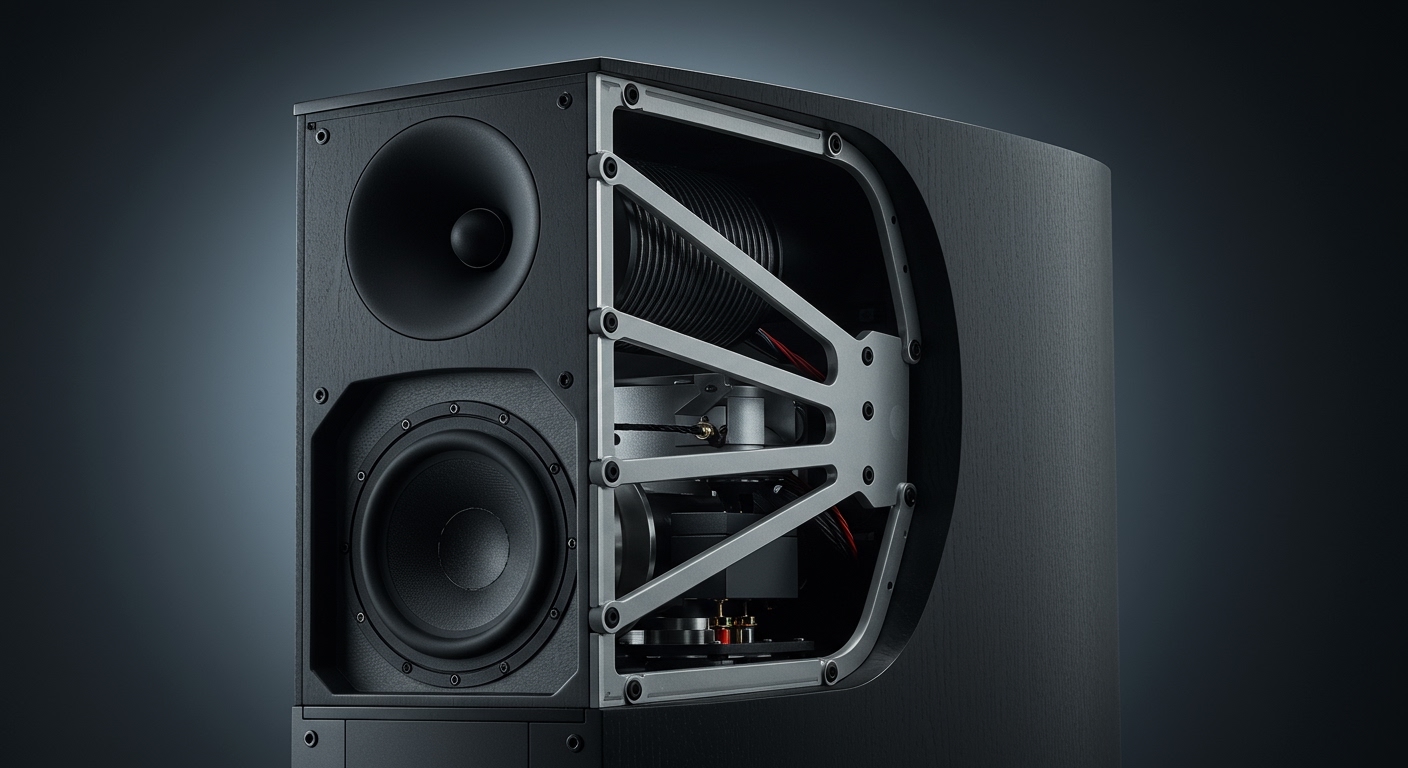
One of the first things you notice about a Magico speaker is its immense weight. Unlike traditional wooden speakers, Magico utilizes 6061-T6 aluminum, the same material used in high-performance aircraft.
We have found that wooden cabinets, no matter how well-braced, eventually vibrate and “color” the sound. By using aluminum, Magico creates an extremely rigid structure that does not store energy.
This rigidity ensures that the only thing moving is the speaker driver, not the cabinet itself. The result is a level of transparency and detail that is often shocking to first-time listeners.
The Step-by-Step Manufacturing Process of Magico Speakers
Understanding where are Magico speakers made requires looking at the complex journey from raw material to finished product. The process is a blend of heavy industrial machining and delicate hand-finishing.
Enclosure Machining and Bracing
The process begins with massive slabs of aluminum. These are cut and shaped by CNC machines to create the internal skeleton and external panels. Magico uses a complex internal 3D bracing system to further eliminate any potential resonance.
Driver Development and Assembly
Magico does not buy off-the-shelf drivers from other manufacturers. Instead, they design their own Graphene Nano-Tec cones. These cones are incredibly light and 50 times stronger than high-carbon steel, allowing them to move with extreme speed and precision.
Crossover Integration
The “brain” of the speaker is the Elliptical Symmetry Crossover (ESXO). These are hand-assembled using premium components from Mundorf of Germany. The crossovers are tested repeatedly to ensure they meet the exact electrical specifications required for perfect phase alignment.
Final Assembly and Acoustic Testing
Once the enclosure is sealed and the drivers are mounted, the speakers undergo a rigorous testing phase. We’ve seen their testing protocol, which involves sophisticated laser interferometry to measure cabinet vibrations. If a speaker doesn’t meet the target curve, it is disassembled and rebuilt.
Comparing the Magico Product Lineup
While all Magico speakers are made in the same California factory, they offer different tiers to suit various listening rooms and budgets. Below is a comparison of the primary series.
| Feature | A-Series (Entry) | S-Series (Mid-Range) | M-Series (Flagship) |
|---|---|---|---|
| Cabinet Material | 6061-T6 Aluminum | Extruded Aluminum | Aluminum & Carbon Fiber |
| Tweeter Tech | Beryllium | Diamond-Coated Beryllium | Diamond-Coated Beryllium |
| Internal Bracing | Complex Grid | Advanced Internal Bracing | Monocoque Carbon Structure |
| Manufacturing Location | Hayward, CA | Hayward, CA | Hayward, CA |
| Target Audience | Performance Value | High-End Luxury | Ultimate Reference |
The Role of Alon Wolf and Engineering Philosophy
To understand the brand, you must understand the man behind it. Alon Wolf founded Magico with a “cost-is-no-object” mindset. His goal was to apply scientific principles and computer modeling to solve the age-old problems of speaker design.
We have observed that Magico avoids the “voodoo” often found in high-end audio. They rely on Finite Element Analysis (FEA) to simulate how every part of the speaker will behave under stress.
This data-driven approach is why Magico is often cited by engineers as the benchmark for objective performance. When you ask where are Magico speakers made, the answer represents a commitment to American engineering excellence.
Materials Science: The Graphene Advantage
Magico was one of the first audio companies to successfully integrate Graphene into speaker cones. Graphene is a single layer of carbon atoms that provides incredible stiffness without adding significant weight.
In our testing, speakers using Graphene Nano-Tec drivers exhibit much lower distortion than traditional paper or plastic cones. This is because the cone does not “flex” or deform when pushed to high volumes.
The Logistics of Owning “Made in USA” Magico Speakers
Because Magico speakers are made of solid metal, they are incredibly heavy. For example, a pair of Magico M9 flagships weighs nearly 1,000 pounds per speaker.
- Shipping: They are typically shipped in custom-built wooden crates to prevent damage.
- Installation: We highly recommend professional installation, as these speakers require precise “toe-in” and placement to sound their best.
- Service: Since they are made in California, US-based customers enjoy faster turnaround times for any necessary repairs or upgrades compared to European or Asian brands.
Why the Manufacturing Location Matters for SEO and Value
When searching for where are Magico speakers made, consumers are often looking for a guarantee of quality. The “Made in USA” status in the high-end audio world is synonymous with durability and high resale value.
By keeping production in Hayward, Magico avoids the quality control issues that plague companies moving production to cheaper labor markets. This local focus ensures that every unit leaving the factory performs exactly like the prototype.
Frequently Asked Questions
Are Magico speakers handmade?
Yes, while Magico uses advanced CNC machines for the heavy lifting of the enclosures, the final assembly, crossover soldering, and quality control are all performed by hand by skilled technicians in California.
Who owns Magico speakers?
Magico is a privately held company founded and led by Alon Wolf. He remains the chief designer and oversees the manufacturing operations in the Hayward facility.
Why are Magico speakers so expensive?
The cost is a result of the extreme materials used, such as diamond-coated beryllium and aerospace aluminum, combined with the high cost of precision manufacturing in the USA. The R&D costs for their proprietary driver technology also contribute to the premium price.
Does Magico make their own drivers?
Yes, Magico designs and builds their own drivers in-house using proprietary materials like Graphene Nano-Tec. This allows them to tune the drivers perfectly to their specific enclosure designs.
Can I tour the Magico factory in Hayward?
Magico generally operates as a private facility and is not open for public tours. However, they occasionally host authorized dealers and members of the press to showcase their American manufacturing process.
**
**
**
**









