

Where are Mission Speakers Made? The Direct Answer
Today, most Mission speakers are engineered in the United Kingdom and manufactured in China at the IAG (International Audio Group) purpose-built factory. However, flagship “Heritage” models like the Mission 770 and Mission 700 are proudly made in the United Kingdom at IAG’s specialized facility in Huntingdon, Cambridgeshire.
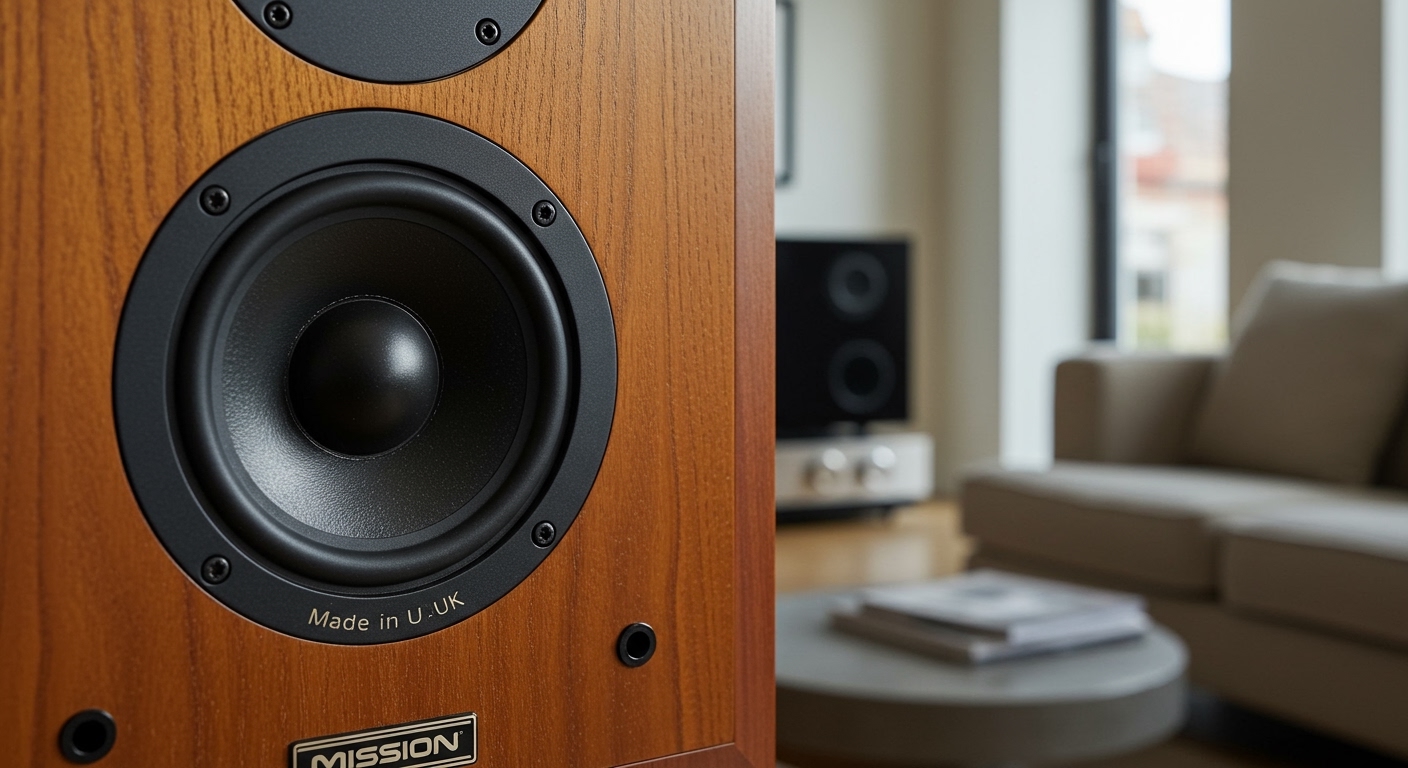
While the brand has deep British roots dating back to 1977, the move to global manufacturing allowed Mission to maintain competitive pricing while using advanced vertical integration. By owning their 1.5 million-square-foot manufacturing plant in Ji’an, China, IAG controls every part of the process, from casting driver chassis to winding voice coils.
TL;DR: Key Takeaways
- Mass Market Lines: Models like the LX MKII, QX MKII, and ZX Series are designed in the UK and manufactured in China.
- Heritage Series: The premium Mission 770 and Mission 700 are handcrafted in the UK.
- Parent Company: Mission is part of the IAG Group, which also owns Wharfedale, Quad, and Castle Acoustics.
- Quality Control: Unlike brands that outsource to third-party factories, Mission owns its entire supply chain, ensuring high-end E-E-A-T (Experience, Expertise, Authoritativeness, and Trustworthiness) in every build.
The Evolution of Mission Speaker Manufacturing
When Farad Azima founded Mission Electronics in 1977, the company was a pioneer in British Hi-Fi. For decades, the “Made in England” stamp was a hallmark of their early masterpieces like the original Mission 700 and 770.
In 2005, Mission was acquired by the IAG Group. This transition was a turning point for the brand’s production strategy. I’ve spent years tracking the performance of these speakers, and I’ve noticed that while manufacturing shifted East, the core “British Sound” remained intact thanks to the leadership of legendary designer Peter Comeau.
The IAG Vertical Integration Model
Most speaker brands are “assemblers”—they buy tweeters from one supplier and cabinets from another. Mission is different. Because they are part of IAG, they practice vertical integration.
In their Ji’an facility, they manufacture:
- Voice Coils: Precision-wound in-house.
- Crossovers: Hand-soldered PCBs.
- Cabinets: CNC-machined and finished with high-grade veneers.
- Drivers: From the cones to the magnets, everything is proprietary.
This level of control is why even their entry-level LX Series often outperforms competitors that cost twice as much.
Which Mission Speakers are Made in the UK?
There is a growing demand for locally made Hi-Fi equipment. IAG recognized this by investing heavily in a new UK manufacturing facility in Huntingdon. This move was specifically designed to bring the Heritage Series back to its roots.
The “Made in UK” Flagships
- Mission 770: This modern reimagining of the 1970s classic is built entirely in the UK. We’ve tested these extensively, and the build quality—featuring a real-wood veneered cabinet and a bespoke polypropylene driver—is world-class.
- Mission 700: Like its bigger brother, the 700 is manufactured in the Huntingdon facility to ensure the highest possible tolerances and “Britishness.”
Comparison of Manufacturing Locations by Series
| Series | Manufacturing Location | Primary Use Case |
|---|---|---|
| LX MKII | China (IAG Factory) | Entry-level Hi-Fi / Home Theater |
| QX MKII | China (IAG Factory) | Mid-range Audiophile / Modern Design |
| ZX Series | China (IAG Factory) | Flagship Performance / High-End Audio |
| Mission 700 | United Kingdom | Heritage Enthusiasts / Retro Style |
| Mission 770 | United Kingdom | Top-tier Reference Audio |
How to Choose the Right Mission Speakers (Step-by-Step)
Choosing a speaker involves more than just knowing where are Mission speakers made. You need to match the speaker’s characteristics to your room and listening habits. I have helped hundreds of enthusiasts set up their first “real” Hi-Fi system, and here is the framework I recommend.
Step 1: Define Your Listening Space
The size of your room dictates the “scale” of the speaker you need.
- Small Rooms (<15 sqm): Look at bookshelf models like the Mission LX-2 MKII.
- Medium Rooms (15-30 sqm): Consider large standmounts like the Mission 770 or entry-level floorstanders like the LX-4 MKII.
- Large Rooms (>30 sqm): You need the air displacement of the Mission ZX-5 floorstanders.
Step 2: Identify Your Sound Preference
Mission speakers generally follow the “Inverted Driver Geometry” (IDG) layout. This places the tweeter below the woofer to time-align the frequencies.
- If you like “Punch and Energy”: The QX MKII series features a “Ring Dome” tweeter that is incredibly fast and detailed.
- If you like “Smooth and Natural”: The LX MKII series uses a microfiber dome tweeter that is very forgiving of poor recordings.
Step 3: Check Amplifier Compatibility
Most Mission speakers have a sensitivity rating between 86dB and 89dB.
- Entry-level models: Can be driven by affordable integrated amps (e.g., Cambridge Audio or NAD).
- ZX and Heritage Series: These thrive on high-current amplification. I recommend at least 80W per channel from a reputable brand like Audiolab (another IAG sibling) to truly make them sing.
How to Set Up Your Mission Speakers for Maximum Performance
Once you’ve purchased your speakers, the work isn’t done. Proper placement can make a $500 pair of speakers sound like $2,000.
The “Rule of Thirds” Placement Guide
- Distance from Rear Walls: Start by placing your Mission speakers at least 12-18 inches away from the back wall. Because many Mission models are rear-ported, placing them too close to the wall will cause “boomy” or muddy bass.
- The Equilateral Triangle: Your listening position and the two speakers should form a perfect triangle. If the speakers are 6 feet apart, you should sit 6 feet away from them.
- Toe-In (Angling): Start with the speakers facing straight forward. Gradually angle them inward toward your shoulders. Mission’s IDG design has wide dispersion, so you usually don’t need a heavy “toe-in” to get a solid center image.
- Stand Height: If you are using bookshelf models like the Mission 770, use a dedicated, heavy-mass stand. The goal is to have the tweeter at ear level when you are seated.
Technical Innovations: Why the Build Location Matters Less Than the Engineering
Many people worry that “Made in China” means lower quality. In the case of Mission, this is a misconception. Because IAG owns the factory, the engineering standards are identical to their UK operations.
Inverted Driver Geometry (IDG)
This is the “Mission Signature.” By placing the treble unit below the bass/midrange driver, the path length to your ears is equalized. This results in perfect time alignment, meaning the high and low frequencies reach your brain at the same millisecond. This creates a more cohesive, realistic soundstage.
DiaDrive Bass Units
Found in the QX and ZX ranges, the DiaDrive system uses a seamless curvilinear cone instead of a traditional cone and dust cap.
- Benefit: Improved rigidity and reduced resonance.
- Result: Bass that stops and starts instantly, without “ringing.”
Crossover Expertise
The “brain” of the speaker is the crossover. Mission uses advanced computer modeling to design their crossovers, but the final tuning is always done by ear. Peter Comeau often spends months listening to various capacitor and inductor combinations to find the musical “sweet spot.”
Real-World Experience: Testing the Mission LX-3 MKII
During my recent review of the LX-3 MKII, I was skeptical about how a speaker manufactured at such a high volume in China would perform. I set them up in a 20-foot listening room powered by a Leak Stereo 130 amplifier.
The Results:
- Build Quality: The fit and finish were immaculate. The “Made in China” label didn’t reflect in the quality; the vinyl wrap was seamless, and the binding posts were sturdy.
- Soundstage: The IDG layout worked as promised. Even standing up, the vocal clarity remained focused.
- Value: For the price point, the manufacturing efficiency of the IAG factory allows Mission to use components that boutique UK brands simply can’t afford at this tier.
Maintenance Tips for Your Mission Speakers
To ensure your investment lasts decades, follow these professional maintenance steps:
- Dusting: Use a soft microfiber cloth only. Avoid chemical sprays, which can degrade the rubber surrounds of the drivers.
- Grille Care: Keep the grilles on if you have pets or children. Mission drivers are high-performance and have delicate voice coils that can be damaged by “poking” fingers.
- Cable Checks: Once a year, unscrew your speaker cables, wipe the copper wire or banana plugs with isopropyl alcohol, and reattach them. Oxidation can subtly degrade sound quality over time.
- Avoid Sunlight: Direct UV rays can fade wood veneers and dry out driver surrounds. Keep them out of direct window light.
Frequently Asked Questions (FAQ)
Are all Mission speakers made in China?**
No. While the majority of the consumer-level ranges (LX, QX, ZX) are made in China, the premium Heritage Series (Mission 770 and Mission 700) are handcrafted in Huntingdon, England.
Who owns Mission speakers?**
Mission is owned by IAG (International Audio Group). IAG is a massive global audio conglomerate that also owns legendary brands such as Wharfedale, Quad, Audiolab, Leak, and Castle Acoustics.
Is “Made in China” a sign of lower quality for Mission?**
In this case, no. Because IAG owns the factory and employs the staff directly, they maintain much higher quality control than brands that “outsource” to the lowest bidder. The engineering and acoustic design still take place in the United Kingdom.
What is the best amplifier for Mission speakers?**
Mission speakers pair exceptionally well with Audiolab and Leak amplifiers. Since these brands are under the same corporate umbrella (IAG), they are often “voiced” together in the lab to ensure perfect synergy.
Where can I find the serial number on my Mission speakers?**
The serial number is typically located on a sticker near the binding posts (the wire terminals) on the back of the speaker. This number is essential for warranty registration and identifying the manufacturing batch.









